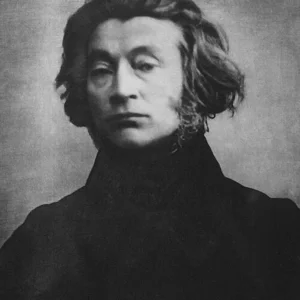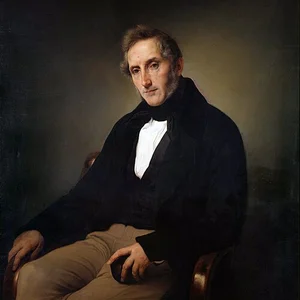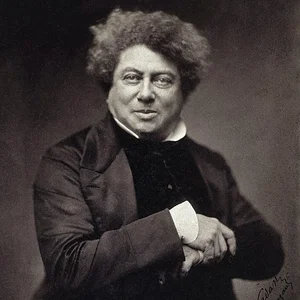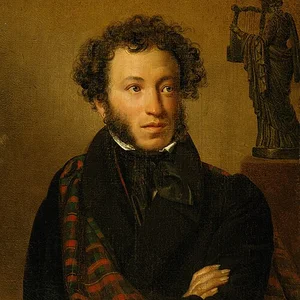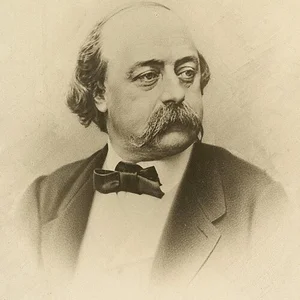

19th-century French novelist (1821–1880), Gustave Flaubert is the author of Madame Bovary, a founding work of literary realism. An obsessive perfectionist, he revolutionized the art of the novel through his refined style and his critique of bourgeois society.
Gustave Flaubert(1821 — 1880)
Gustave Flaubert
France
7 min read
Frequently asked questions
Famous Quotes
« A good critic is one who narrates the adventures of his soul among masterpieces.»
« Art is long and time is short.»
« Literature is a sacred responsibility.»
Key Facts
- 1856: Publication of Madame Bovary, which triggered an obscenity trial
- 1862: Publication of Salammbô, a historical novel set in ancient Carthage
- 1869: Publication of Sentimental Education, a sweeping portrait of Parisian and political life
- Extensive correspondence with George Sand and other writers, revealing his working method
- 1880: Death at Croisset, in Normandy, leaving Bouvard and Pécuchet unfinished
Works & Achievements
A founding novel of literary realism, telling the life and lost illusions of Emma Bovary, wife of a Norman country doctor. The work was the subject of a landmark trial for offending public morality.
A historical novel set in Carthage in the 3rd century BC, during the Mercenary War. Flaubert travelled to Tunis to research this epic and colourful fresco.
A great novel of disillusionment, tracing the life of Frédéric Moreau and his generation in 1840s Paris, against the backdrop of the 1848 revolution. Poorly received on publication, it is today considered a masterpiece.
A philosophical and visionary work on which Flaubert laboured for nearly twenty-five years, depicting the temptations and hallucinations of the hermit Saint Anthony in the desert.
A collection of three stories — A Simple Heart, The Legend of Saint Julian the Hospitaller, and Herodias — considered a pinnacle of Flaubert's narrative art for its concision and stylistic perfection.
An unfinished satirical novel about two clerks who attempt to master all fields of human knowledge and systematically fail. Flaubert was working on it at the time of his death, the culmination of his critique of human stupidity.
A satirical collection of bourgeois commonplaces and clichés, compiled by Flaubert throughout his life, conceived as an appendix to Bouvard and Pécuchet.
Anecdotes
Flaubert had the habit of 'bellowing' his texts in his study at Croisset. He would read each sentence aloud to test its rhythm and sound, a process he called 'the gueuloir test'. His neighbors could sometimes hear him declaiming through the open windows.
During the trial of Madame Bovary in January 1857, Flaubert was prosecuted for 'outrage against public and religious morality and decency'. He was ultimately acquitted on February 7, 1857, and the scandal of the trial paradoxically contributed to the commercial success of the novel, which sold thousands of copies.
Flaubert could spend an entire week working on a single page of text. For Madame Bovary, he worked for nearly five years (1851–1856), accumulating more than 4,500 pages of drafts for a novel that runs only a few hundred pages.
Flaubert maintained a passionate correspondence with the poet Louise Colet, which lasted several years. These letters are today considered one of the most valuable testimonies on his conception of literary art and his creative process. In them, he notably develops his theory of the artist's impersonality.
Toward the end of his life, Flaubert ruined himself financially to save his niece Caroline's husband from bankruptcy. This act of family generosity plunged him into serious financial difficulties and cast a considerable shadow over his final years — he who had until then lived comfortably off his private income.
Primary Sources
The author, in his work, must be like God in the universe, present everywhere and visible nowhere.
What seems beautiful to me, what I would like to do, is a book about nothing, a book with no external attachment, which would hold itself together by the inner force of its style.
Art without rules is no longer art; it is like a woman who would shed all clothing. To impose on the novel the sole rule of public decency is not to subjugate it, it is to honor it.
I am turning into a sentimental old fool. Everything wounds me, everything tears me apart, and I stay silent, making efforts to hide this universal softening.
Key Places
Family estate on the banks of the Seine, near Rouen, where Flaubert lived and worked for most of his life. It was in his study overlooking the river that he wrote almost his entire body of work.
Hospital where Flaubert was born and where his father served as chief surgeon. The child grew up in the adjoining official residence, exposed to illness and death from his earliest years.
Flaubert regularly stayed in Paris to frequent literary circles. There he met with his writer friends such as George Sand, Turgenev, and the Goncourt brothers at celebrated dinner gatherings.
Norman seaside resort where Flaubert, as a teenager, met Élisa Schlésinger in 1836, an impossible love that marked his entire life and inspired Sentimental Education.
During his journey to the Orient (1849–1851), Flaubert travelled through Egypt, an experience that fed his imagination and provided the material for Salammbô and The Temptation of Saint Anthony.
Typical Objects

Flaubert smoked heavily while working. He had brought back several pipes from his travels in the Orient, which he used during his long writing sessions.

The writer's daily working tools, worn by the countless crossings-out and rewritings that characterized his creative process.

Flaubert kept his many drafts, bearing witness to his painstaking work on style. The pages were covered in corrections, additions, and deletions.

A common domestic object in his study at Croisset, where he often worked at night, wrapped in his dressing gown, battling the Norman cold.

Flaubert's iconic garment, which he wore during his long nocturnal writing sessions in his study overlooking the Seine.

Flaubert accumulated considerable documentation for each novel. For Bouvard et Pécuchet, he is said to have read more than 1,500 works.
School Curriculum
Vocabulary & Tags
Key Vocabulary
Tags
Mouvement
Daily Life
Morning
Flaubert rose late, generally around ten o'clock, after his long working nights. He would take a bath, then join his mother for a hearty lunch. He would then read his correspondence and the newspapers in the Croisset drawing room.
Afternoon
In the afternoon, he would sometimes stroll along the Seine or in the Croisset garden. He occasionally received visitors or drafted his voluminous correspondence. He also devoted time to reading research material for his novels in progress.
Evening
The actual writing work began at the end of the day and stretched late into the night, often until two or three in the morning. Shut away in his study, he would write, cross out, and declaim his sentences aloud, pausing only to smoke his pipe.
Food
Flaubert had a hearty Norman appetite. He appreciated good food — bourgeois meals with meats, sauces, and regional cheeses. During his stays in Paris, he readily took part in literary dinners at Magny or at the Brébant restaurant with his fellow writers.
Clothing
At home in Croisset, Flaubert wore a loose dressing gown that became his emblematic garment. For his Parisian outings, he dressed as an elegant bourgeois: frock coat, waistcoat, cravat, and top hat, though his imposing build always made him instantly recognizable.
Housing
The house at Croisset, on the banks of the Seine near Rouen, was a fine eighteenth-century property surrounded by a garden. Flaubert's study on the first floor offered a wide view of the river and the passing boats. The house was unfortunately demolished after his death; only the pavilion remains.
Historical Timeline
Period Vocabulary
Visual Style
Un style visuel réaliste aux tons chauds et terreux, mêlant les intérieurs bourgeois normands éclairés à la bougie et les paysages brumeux de la Seine à Croisset.
Sound Ambience
L'atmosphère sonore du cabinet de travail de Croisset, entre le silence studieux, les éclats du gueuloir et les bruits paisibles de la Seine au-dehors.
Liens externes & ressources
Références
Œuvres
Madame Bovary
1857
L'Éducation sentimentale
1869
La Tentation de saint Antoine
1874
Trois Contes
1877
Bouvard et Pécuchet
1881 (posthume)
Dictionnaire des idées reçues
1913 (posthume)