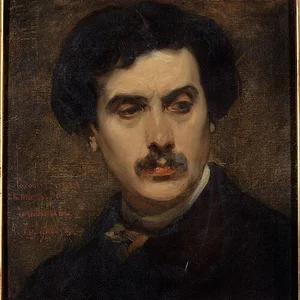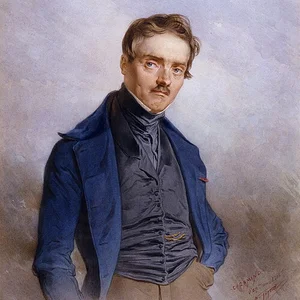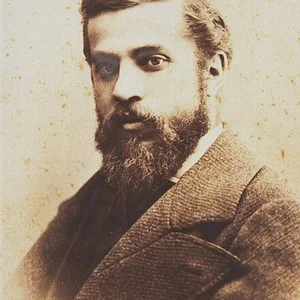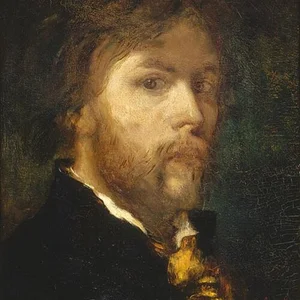

Gustave Moreau was a French painter and a major figure of Symbolism. His work, populated with mythological and biblical figures rendered with ornamental richness and a dreamlike quality, left a deep mark on the late 19th century. As a professor at the École des Beaux-Arts, he notably taught Matisse and Rouault.
Gustave Moreau(1826 — 1898)
Gustave Moreau
France
6 min read
Frequently asked questions
Famous Quotes
« I believe only in what I do not see, and solely in what I feel.»
Key Facts
- Born in 1826 in Paris, died in 1898.
- Presented Oedipus and the Sphinx at the Salon of 1864, which brought him to public attention.
- Painted several versions of Salome and The Apparition during the 1870s.
- Appointed professor at the École des Beaux-Arts in Paris in 1892, where he taught Henri Matisse and Georges Rouault.
- Bequeathed his house-studio to the State; it became the Gustave Moreau Museum, inaugurated in 1903.
Works & Achievements
The painting that established Moreau at the Salon; an enigmatic confrontation between the Greek hero and the monster, a manifesto of his erudite art.
A mythological composition teeming with ornament, illustrating his taste for ancient tales laden with symbols.
A major work of Symbolism, a captivating image of the femme fatale that inspired writers and artists alike.
A celebrated watercolour in which the haloed head of John the Baptist floats before Salome; admired by Huysmans.
A nymph asleep in a fantastical grotto, the pinnacle of the dreamlike, mineral richness of his world.
A vast, teeming canvas, a true visual cosmogony regarded as his pictorial testament.
A series of sixty-four watercolours of great virtuosity, commissioned by the collector Antony Roux.
Anecdotes
Gustave Moreau lived almost his entire life in the family home on the rue de La Rochefoucauld in Paris. At the end of his life, he transformed this private mansion into a museum to bring together his work, and bequeathed it to the State: today it is the Musée National Gustave-Moreau, one of the first artist's studio-museums.
After becoming a professor at the École des Beaux-Arts in 1892, Moreau was a teacher of rare open-mindedness. He pushed his students to follow their own path rather than imitate him; among them were Henri Matisse and Georges Rouault, future masters of modern art.
His painting *The Apparition*, showing Salome facing the head of John the Baptist floating in the air, caused a sensation at the Salon of 1876. The writer Joris-Karl Huysmans gave it a long, fascinated description in his novel *Against Nature* (À rebours), making Moreau an icon of the Decadent movement.
Moreau accumulated drawings, sketches, and studies by the thousands: his museum preserves nearly 15,000 of them. This scale reveals a relentless worker who endlessly reworked his compositions, often left unfinished, more concerned with inner dreams than with exhibiting.
Very discreet and solitary, Moreau never married and exhibited less and less from the 1880s onward, keeping himself apart from fashions. He did, however, maintain a long relationship with Alexandrine Dureux, whom he called his “best and only friend.”
Primary Sources
This painting of Salome, this supernatural and strange work... Des Esseintes remained, under its spell, before this canvas, in which the brilliance of symbolism mingled with the magic of colour.
I believe in my art; I believe neither in what I touch nor in what I see. I believe only in what I do not see, and solely in what I feel.
I bequeath my house located at 14 rue de La Rochefoucauld, with everything it contains... to the State, on the condition that it always keep... this collection, preserving its character as a whole.
Key Places
Private mansion where Moreau lived and worked, transformed into a national museum according to his will. The central place of his life and work.
Moreau was a student there and then a professor from 1892, training Matisse, Rouault and Marquet.
A major stop on his formative journey of 1857-1859, where he copied Michelangelo and the masters of the Renaissance.
City where Moreau absorbed the colours of Carpaccio and the Venetian painters, a decisive influence on his palette.
Burial place of Gustave Moreau, in the north of Paris where he spent most of his life.
Liens externes & ressources
Références
Œuvres
Jason et Médée
1865
Salomé dansant devant Hérode
1876
L'Apparition
1876
Jupiter et Sémélé
1895
Illustrations des Fables de La Fontaine
1881-1886