 flip
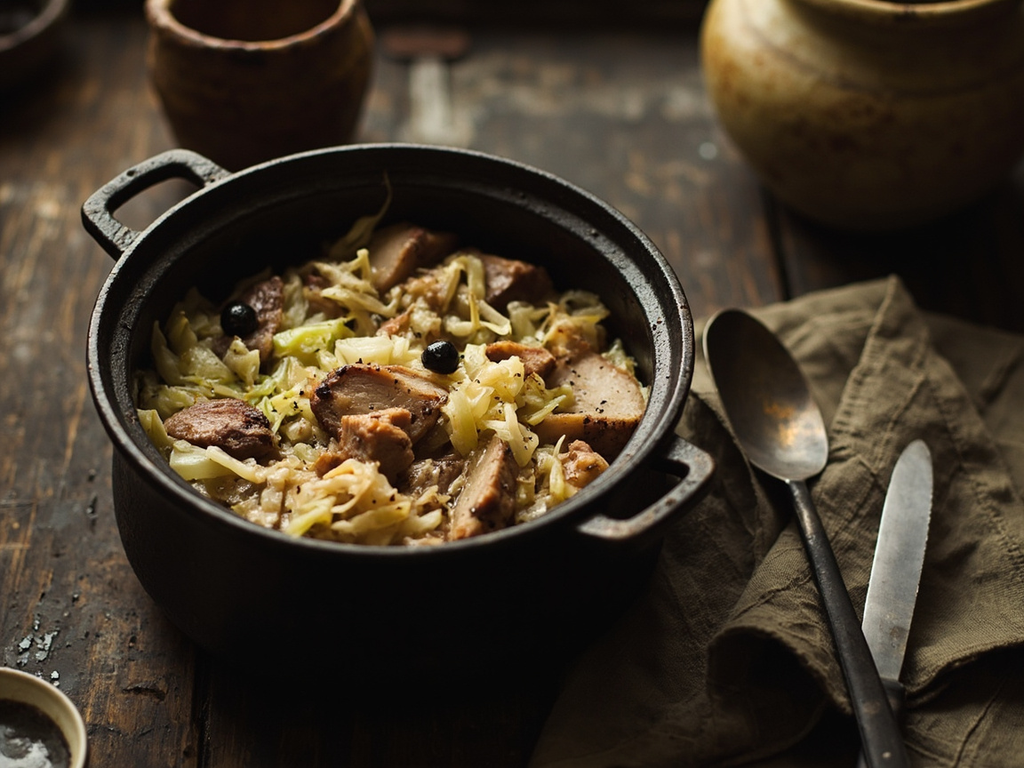
flipSauerkraut au lard salé (fermented cabbage with salted bacon)
Sauerkraut au lard salé (fermented cabbage with salted bacon)
Why this dish? Cabbage and turnip, the anchor tells us, are Gutenberg's seasonal vegetables, and salted or smoked meat his way of enduring winter. Fermented cabbage in brine was THE reserve that allowed a Rhenish household to get through the bad season without a vegetable famine.
Finely cut cabbage fermented in its own brine for weeks, then slowly cooked with a piece of salted meat, juniper berries, and a little wine. The tangy, deep flavor of the winter store.
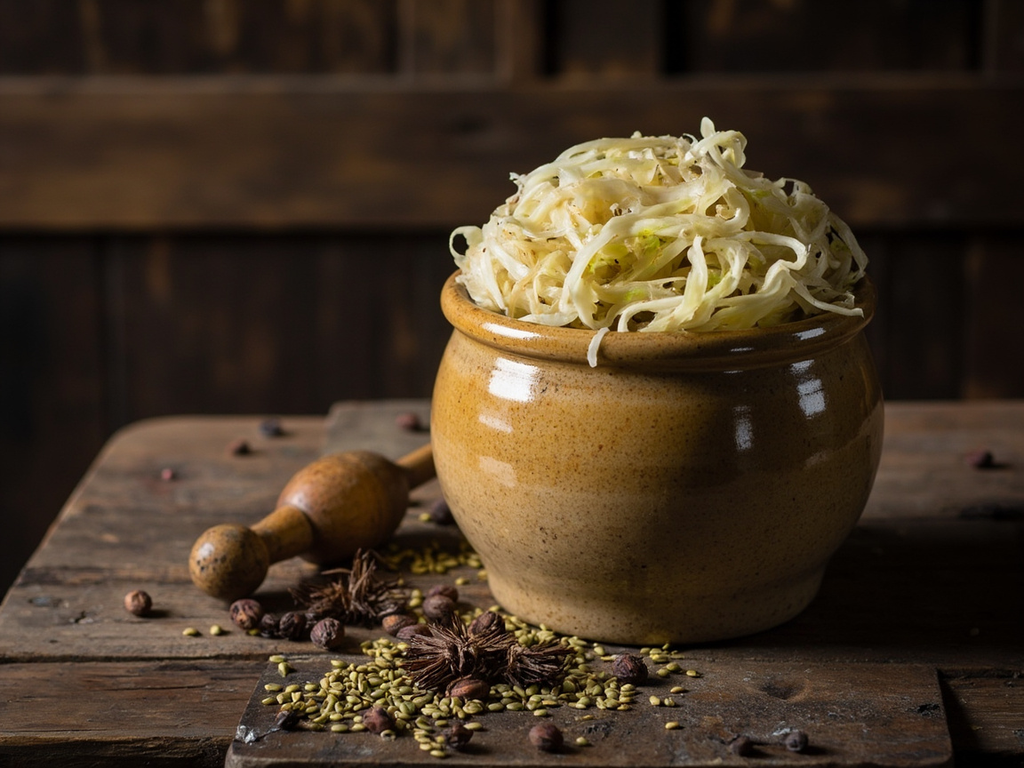
Winter is long and harsh under our sky, you see, and anyone who hasn't laid in provisions by autumn trembles until spring. So we would slice the cabbage fine and pack it with salt in large stoneware pots; after a few weeks it takes on that sharp sourness that awakens the palate. Then we cooked it slowly with a quarter of salted meat and a few juniper berries. That is food that costs nearly nothing and drives the cold from your bones.
- •White cabbage — several heads (vegetable to ferment)
- •Salt — generously (fermentation agent)
- •Juniper berries — a pinch (aromatic)
- •Salted meat or pork belly — a good piece (brine-cured meat)
- •Rhine white wine — a little (cooking liquid)
Sauerkraut au lard salé (fermented cabbage with salted bacon)
Finely cut cabbage fermented in its own brine for weeks, then slowly cooked with a piece of salted meat, juniper berries, and a little wine. The tangy, deep flavor of the winter store.
Why this dish? Cabbage and turnip, the anchor tells us, are Gutenberg's seasonal vegetables, and salted or smoked meat his way of enduring winter. Fermented cabbage in brine was THE reserve that allowed a Rhenish household to get through the bad season without a vegetable famine.
Winter is long and harsh under our sky, you see, and anyone who hasn't laid in provisions by autumn trembles until spring. So we would slice the cabbage fine and pack it with salt in large stoneware pots; after a few weeks it takes on that sharp sourness that awakens the palate. Then we cooked it slowly with a quarter of salted meat and a few juniper berries. That is food that costs nearly nothing and drives the cold from your bones.
Ingredients (period version)
- White cabbage — several heads (vegetable to ferment)
- Salt — generously (fermentation agent)
- Juniper berries — a pinch (aromatic)
- Salted meat or pork belly — a good piece (brine-cured meat)
- Rhine white wine — a little (cooking liquid)
Ingredients
- Raw sauerkraut (already fermented cabbage) — 1 kg (sour base)
- Salted pork belly or smoked bacon — 400 g (meat)
- Onion — 1 (aromatic)
- Juniper berries — 8 (aromatic)
- Dry white wine (Riesling) — 20 cl (cooking liquid)
- Lard or butter — 1 tbsp (fat)
Method
- Briefly rinse the raw sauerkraut and drain well (rinse more or less depending on desired acidity).
- Melt the lard in a casserole, brown the sliced onion.
- Add the sauerkraut, juniper berries, place the pork on top, and pour in the wine.
- Cover and simmer over very low heat for 1.5 to 2 hours, checking that it doesn't dry out (add a little water or wine if needed).
- Serve hot with rye bread.
How it was made : Lacto-fermentation of cabbage in brine is a very ancient preservation technique in Central Europe, attested well before Gutenberg. Without refrigeration, it provided tangy vegetables — and vitamin C, though unknown then — throughout the winter. Cabbage was kept in large stoneware jars weighted with a stone in the cool cellar.
The contemporary twist : An express version: quality raw sauerkraut, store-bought smoked bacon, and a splash of Riesling — the medieval winter provision in just under two hours.
Gutenberg · Charactorium