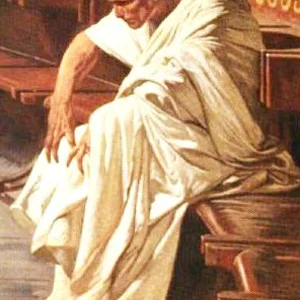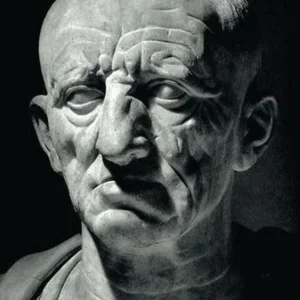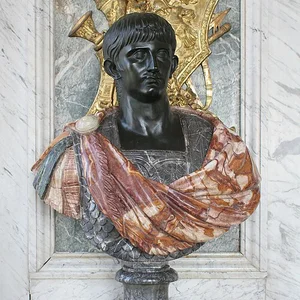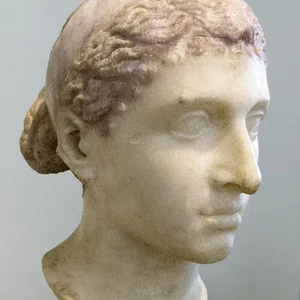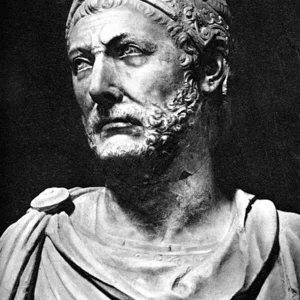

Carthaginian general (246–182 BC), son of Hamilcar Barca, he is one of the greatest military strategists of the ancient world. He led the Second Punic War against Rome, crossing the Alps with his war elephants to invade Italy. His victory at Cannae (216 BC) remains one of the most studied battles in military history.
Hannibal Barca(246 av. J.-C. — 182 av. J.-C.)
Hannibal Barca
civilisation carthaginoise
8 min read
Frequently asked questions
Key Facts
- Born in 246 BC in Carthage, son of general Hamilcar Barca
- Crossed the Alps with an army and war elephants in 218 BC
- Decisive victory at the Battle of Cannae against Rome in 216 BC
- Defeated by Scipio Africanus at the Battle of Zama in 202 BC
- Died in 182 BC in exile, to escape capture by Rome
Works & Achievements
Hannibal kept an army in enemy territory for 15 years, winning victory after victory without ever being decisively defeated in Italy. This campaign remains one of the longest and most brilliant of the ancient world.
An unprecedented logistical and military feat: leading 50,000 infantry, 9,000 cavalry, and 37 elephants across the Alps in autumn. This bold move bypassed Rome's defenses and brought the war straight to the heart of Italy.
A tactical masterpiece built around a double envelopment of the Roman army, still studied in military academies around the world. In a single day, Hannibal destroyed the largest army Rome had ever fielded.
Elected sufete (chief magistrate) of Carthage after the war, Hannibal undertook financial reforms to restore the city's finances and curb corruption among the oligarchs. These reforms earned him the hostility of the Carthaginian aristocracy.
In exile, Hannibal attempted to convince the Seleucid king to open a new front against Rome, advising a strategy of alliance and coordinated attack. His counsel, only partially heeded, proved insufficient to break Roman power.
Anecdotes
According to the historian Livy, Hannibal asked his father Hamilcar, as a young child, to take him along on campaign in Spain. Hamilcar agreed on one condition: that Hannibal swear eternal hatred toward Rome. This oath, taken before the altars of the Carthaginian gods, is said to have guided his entire life.
To cross the Alps in 218 BC, Hannibal dissolved rocks blocking the passage by heating them with fire and then dousing them with vinegar. This technique, recorded by Livy, allowed him to clear a passable path for his troops and his 37 war elephants.
At the Battle of Cannae (216 BC), Hannibal encircled a Roman army of more than 80,000 men with only 50,000 soldiers. This encirclement maneuver, known as the 'double envelopment,' is still studied in military academies around the world as an absolute masterpiece of tactical genius.
Hannibal was one-eyed: he lost the use of one eye while crossing the Pontine Marshes in Italy in 217 BC, due to a severe infection. He commanded his troops while riding the only surviving elephant in his army, so that he could be seen by everyone.
After being betrayed by Carthage, which refused to send him sufficient reinforcements, Hannibal ended his life in exile. Taking refuge at the court of King Prusias of Bithynia and hunted by Rome, he chose to poison himself rather than be handed over to his enemies, according to Livy and Cornelius Nepos.
Primary Sources
He was the first to enter the battle and the last to leave it. He combined great bravery with great prudence.
Hannibal, after crossing the Rhône without meeting any obstacle, led his army toward the Alps by the inland route, through the territory of the Allobroges.
Hannibal spent twenty years in Italy; during that time, he was never defeated in pitched battle by the Romans.
Hannibal, to fire up his soldiers before the Battle of Cannae, showed them the Romans hemmed in on ground with no way out and told them: In eight days, all these riches will be in your hands.
Key Places
Hannibal's birthplace and capital of the Carthaginian empire. It was in Carthage that Hannibal was born, received his military education, and was recalled to defend his homeland before the Battle of Zama.
The supposed crossing point where Hannibal led his troops and war elephants over the Alps in 218 BC. This heroic passage, accomplished in the depths of autumn through snow and ice, remains one of the most celebrated military feats of the ancient world.
Site of the Battle of Cannae (216 BC), Hannibal's most devastating tactical victory over the Roman legions. The site is today an archaeological park and museum dedicated to the battle.
Site of the Battle of Lake Trasimene (217 BC), where Hannibal sprung a devastating ambush on the Roman army of consul Flaminius. It stands as one of the largest ambushes in military history.
Site of the Battle of Zama (202 BC), where Scipio Africanus decisively defeated Hannibal, bringing the Second Punic War to an end. The exact location remains a subject of debate among historians.
Hannibal's place of exile and death in Bithynia (182 BC). It was here, in a villa provided by King Prusias, that he took poison to avoid being captured by the Romans.
Typical Objects

Hannibal wore armor consisting of chainmail and a bronze breastplate, a symbol of his rank as supreme commander. His equipment was both protective and imposing, allowing his soldiers to identify him in the heat of battle.

War elephants were the prestige weapon of the Carthaginian army. Hannibal had 37 of them during the crossing of the Alps; they served as terrifying war machines capable of breaking enemy formations, though few survived the Italian campaign.

Hannibal's soldiers, recruited largely from Spain, used the falcata, a curved-blade sword that was particularly deadly in close combat. This Iberian weapon was adopted as standard infantry equipment in the Carthaginian army throughout the Punic Wars.

Like all commanders of antiquity, Hannibal used wax tablets and a stylus to draft his orders, diplomatic correspondence, and battle plans. His messages were often encoded or entrusted to reliable messengers.

The Carthaginian silver shekel, often struck with the likeness of Hamilcar or Hannibal Barca, was used to pay mercenaries and fund military campaigns. Several coins bearing a presumed portrait of Hannibal have been found in Spain and North Africa.

During the siege of Saguntum, Hannibal deployed sophisticated siege engines, including catapults and battering rams. These machines reflect the advanced level of Carthaginian military engineering inherited from the Hellenistic world.
School Curriculum
Vocabulary & Tags
Key Vocabulary
Tags
Daily Life
Morning
Hannibal rose before dawn to personally inspect the camp and hear reports from his Numidian scouts. He held council with his lieutenants — Maharbal for the cavalry, and his brother Mago — to plan the day's movements. He had a reputation for always being ready before his men.
Afternoon
Afternoons on campaign were devoted to forced marches, tactical drills, and negotiations with Italic peoples who might be persuaded to join his cause against Rome. Hannibal personally led reconnaissance missions across the terrain, which occasionally earned him minor wounds.
Evening
In the evenings, Hannibal received his officers and ambassadors from allied cities. He dictated his correspondence to Carthage, repeatedly — and unsuccessfully — requesting reinforcements and supplies. According to Livy, he slept little, wrapped in his cloak among his soldiers, with no visible signs of preferential treatment.
Food
The diet of Carthaginian soldiers was based on wheat, legumes, olives, and wine diluted with water, provisions taken from the territories they crossed or supplied by allies. In Italy, the army lived off the land by plundering enemy farmland, while preserving the lands of potential allies.
Clothing
As supreme commander, Hannibal wore an ornate bronze cuirass, a purple cloak, and a crested helmet during battle so his troops could identify him. On campaign, he dressed simply in a wool tunic and a military cloak, rejecting ostentatious luxury in order to share his soldiers' living conditions.
Housing
On campaign, Hannibal lived in a leather tent similar to those of his officers, refusing comfortable lodgings even during winter quarters in southern Italy (Capua, Tarentum). In Carthage or in exile, he occupied a functional residence with no outward signs of excessive wealth, according to ancient sources.
Historical Timeline
Period Vocabulary
Visual Style
Esthétique de l'Antiquité méditerranéenne mêlant influences puniques, ibériques et hellénistiques, avec des tonalités chaudes pour l'Afrique du Nord et froides pour les Alpes et l'Italie.
Sound Ambience
L'ambiance sonore du camp d'Hannibal mêle les bruits des préparatifs militaires, le grondement des éléphants de guerre et les voix de mercenaires venus des quatre coins de la Méditerranée.
Liens externes & ressources
Références
Œuvres
Campagne d'Italie (Deuxième guerre punique)
218-203 av. J.-C.
Traversée des Alpes
218 av. J.-C.
Bataille de Cannes
2 août 216 av. J.-C.
Réformes administratives à Carthage
196 av. J.-C.
Alliance avec Antiochos III de Syrie
195-190 av. J.-C.