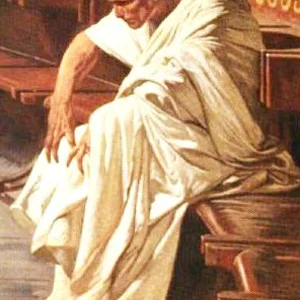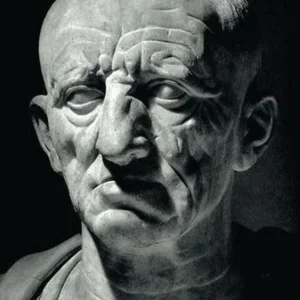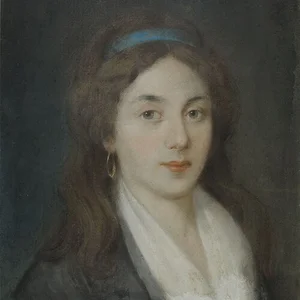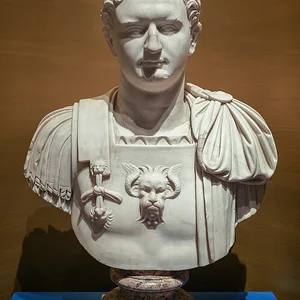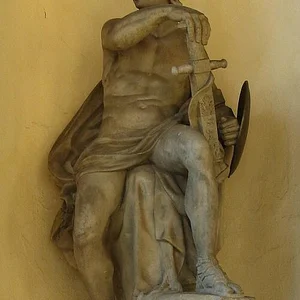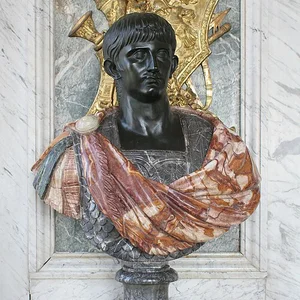

Fourth Roman emperor (41–54 AD), Claudius succeeded Caligula. Despite physical disabilities that long kept him on the margins of power, he proved to be a skilled administrator, reformer, and conqueror of Britain.
Claudius(9 av. J.-C. — 54)
Claudius
Rome antique
7 min read
Frequently asked questions
Key Facts
- Born on August 1, 10 BC (or 9 BC according to some sources) in Lugdunum (Lyon)
- Proclaimed emperor in 41 AD by the Praetorian Guard following the assassination of Caligula
- Conquest of Britain (present-day England) in 43 AD
- Reformed imperial administration by relying on capable freedmen
- Died in 54 AD, most likely poisoned by his wife Agrippina the Younger
Works & Achievements
A twenty-volume work on Etruscan civilization, now lost. It stands as a testament to Claudius's exceptional scholarship — he learned the Etruscan language in order to write it.
An eight-volume history of Carthage written in Greek, now lost. Pliny the Elder and other ancient authors quoted from it, praising the quality of his research.
A military campaign led by General Aulus Plautius, crowned by Claudius's personal appearance on the battlefield. It established the Roman province of Britannia and earned the emperor a formal triumph in Rome.
Two monumental aqueducts carrying water from the Simbruini Mountains over a distance of more than 70 km. Inaugurated in 52 AD, they rank among the most impressive aqueducts ever built in Rome.
Claudius professionalized the imperial bureaucracy by creating specialized secretariats covering finances, correspondence, and petitions, entrusted to capable freedmen — a lasting innovation in the governance of the Empire.
Anecdotes
Claudius was long despised by his own imperial family, who considered him unfit due to his disabilities (a limp, a stammer, and tremors). His grandmother Livia, wife of Augustus, called him 'a monster that nature had begun but never finished.' Yet this marginalization saved him from the successive purges of Tiberius and Caligula, as no one saw him as a threat.
In 41 AD, following the assassination of Caligula, Claudius hid behind a curtain in the palace, paralyzed with fear. A soldier of the Praetorian Guard found him, and his comrades hoisted him onto their shoulders, carrying him in triumph and proclaiming him emperor. Claudius thus became the first Roman emperor imposed by the army rather than designated by the Senate.
Claudius was a passionate scholar: before becoming emperor, he had written a history of the Etruscans in twenty volumes and a history of Carthage in eight volumes, both now lost. He even invented three new letters for the Latin alphabet, which he had engraved on official inscriptions — they disappeared after his death, deemed useless by his successors.
In 48 AD, Claudius discovered that his wife Messalina had publicly entered a bigamous marriage with her lover Gaius Silius, in what appeared to be an attempted coup. Claudius, in a state of shock, reportedly kept asking on his way back, 'Am I still emperor?' before finally ordering her execution. This episode illustrates his emotional vulnerability despite his very real political authority.
Primary Sources
He was subject to sudden fits of anger and passion […] His gait was unsteady due to the weakness of his knees; his games and conversation, even in ordinary times, had something of an unseemly quality.
Claudius, always under the dominion of his freedmen and his wives, acted more like a slave than a prince; he distributed honors, military commands, and impunity for crimes according to the whims of each.
What is so novel, I ask you, in my proposing to admit into this order men from Gallia Comata, now subdued, now long since initiated into our customs and civilization?
The Aqua Claudia was brought to Rome by the Emperor Claudius over a distance of forty-five miles, at enormous expense, for the convenience and adornment of the City.
Key Places
Birthplace of Claudius in 10 BC. The Claudian Tablets, a bronze inscription preserved at the Gallo-Roman Museum, bear witness to the speech he delivered in defense of the rights of the Gauls.
The imperial residence from which Claudius governed the Empire. It was here that the Praetorian Guard discovered him following the assassination of Caligula, and where he died in AD 54.
The first Roman capital of Britain following the conquest of AD 43. Claudius traveled there in person to celebrate his victory — one of the very few military expeditions of his reign.
Claudius commissioned a large artificial harbor here to secure Rome's grain supply, a major logistical reform that safeguarded the food supply of the capital.
Typical Objects

Claudius was renowned for his passion for letters and writing. He personally drafted his speeches, memoirs, and historical scholarship on these common writing materials of ancient Rome.

Following his triumph for the conquest of Britain in AD 43, Claudius received the laurel wreath, the supreme symbol of military victory awarded to Roman imperatores.

A white garment bordered with purple, reserved for magistrates and the emperor. Claudius wore it during official ceremonies, thereby asserting his authority despite lingering doubts about his legitimacy.

A folding seat of ivory and metal reserved for senior Roman magistrates. Claudius sat in it to administer justice, a duty he performed with a diligence that astonished his contemporaries.

Claudius had numerous coins struck commemorating his victories and reforms — including a series honoring the conquest of Britannia — an essential tool of imperial propaganda.

Claudius regulated the length of courtroom speeches by using the clepsydra during the trials he presided over, seeking to rationalize Roman justice and put an end to endless oratory.
School Curriculum
Vocabulary & Tags
Key Vocabulary
Tags
Daily Life
Morning
Claudius rose early and devoted his mornings to justice: he personally presided over many trials, sitting at his tribunal in the Forum or on the Palatine, sometimes from dawn. He paid meticulous attention to testimonies, which his contemporaries found either admirable or tedious.
Afternoon
Afternoons were given over to audiences, meetings with his secretaries (specialized freedmen such as Narcissus and Pallas), and reading petitions sent from across the Empire. Claudius also found time for writing and scholarship — passions he had cultivated during his long years of political exclusion.
Evening
Claudius's dinner parties were renowned for their lavishness and length. He welcomed many guests, enjoyed wine and fine food, and loved playing dice, which his contemporaries viewed as an unbecoming weakness for an emperor. He went to bed late and slept little.
Food
Like any Roman aristocrat, Claudius ate bread, olive oil, vegetables, fish, and meat at banquets. He was particularly fond of mushrooms — a tragic irony, given the tradition that he was ultimately poisoned by that very dish.
Clothing
In public, Claudius wore the toga praetexta — the white toga with a purple border of the highest magistrates — and the gold-embroidered toga picta during ceremonies. In private, he dressed more simply in a woolen tunic and pallium, in the manner of scholars.
Housing
Claudius lived on the Palatine Hill in the imperial palace that had been expanded since the time of Augustus, surrounded by gardens, libraries, and reception halls. He also had a villa at Tibur (modern Tivoli), where he would retreat to study and write away from the bustle of Rome.
Historical Timeline
Period Vocabulary
Visual Style
Le style visuel évoque la solennité de la cour julio-claudienne : marbres blancs, pourpre impériale et or sur fond d'architecture monumentale romaine du Ier siècle.
Sound Ambience
L'atmosphère sonore de la cour impériale de Claude mêle le calme studieux des bibliothèques du Palatin, les rumeurs des débats au Sénat et le brouhaha permanent de Rome, capitale d'un million d'habitants.
Liens externes & ressources
Références
Œuvres
Histoire des Étrusques (Tyrrhénika)
vers 10-40 ap. J.-C.
Histoire des Carthaginois (Karchedoniaka)
vers 10-40 ap. J.-C.
Conquête de la Bretagne (43 ap. J.-C.)
43 ap. J.-C.
Aqua Claudia et Anio Novus
38-52 ap. J.-C.
Réforme de l'administration impériale
41-54 ap. J.-C.