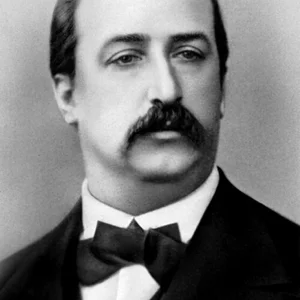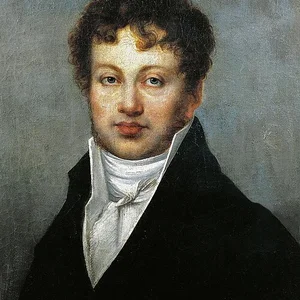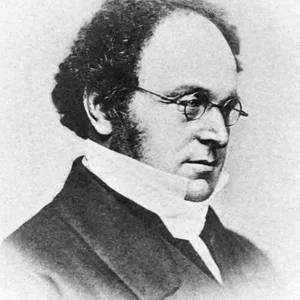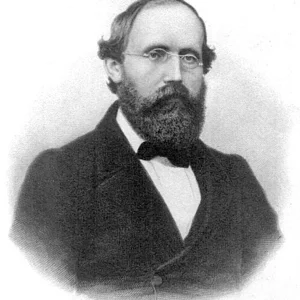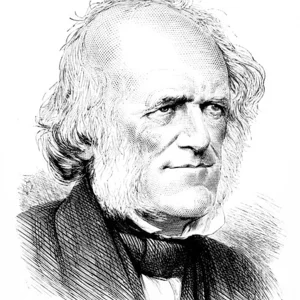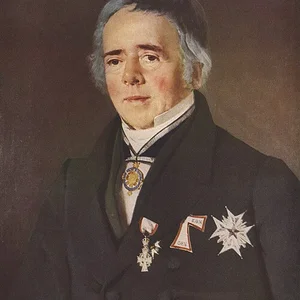

A Danish physicist and chemist, Hans Christian Ørsted discovered in 1820 that an electric current deflects a compass needle, revealing the link between electricity and magnetism. He thus founded electromagnetism and was the first to isolate metallic aluminium.
Hans Christian Ørsted(1777 — 1851)
Hans Christian Ørsted
Royaume de Danemark
5 min read
Frequently asked questions
Key Facts
- Born on 14 August 1777 in Rudkøbing (Denmark), died on 9 March 1851 in Copenhagen.
- Discovered in 1820 the deflection of a magnetized needle by an electric current, founding electromagnetism.
- First to isolate aluminium in metallic form in 1825.
- Professor at the University of Copenhagen and founder of the Society for the Dissemination of Natural Science (1824).
- The unit of magnetic field strength, the oersted (Oe), is named after him.
Works & Achievements
Demonstration of the effect of an electric current on a magnetized needle, founding a new branch of physics.
A four-page memoir in Latin announcing his discovery to all of learned Europe.
First production of metallic aluminium by chemical reduction, paving the way for the metallurgy of this metal.
Creation of a scientific and technical educational institution, today the Technical University of Denmark (DTU).
Development of an instrument (the piezometer) demonstrating that liquids are slightly compressible.
A philosophical collection setting out his vision of a nature governed by a unified reason, widely read during his lifetime.
Anecdotes
On 21 April 1820, during a lecture at the University of Copenhagen, Ørsted brought a wire carrying an electric current close to a compass: the needle moved abruptly. This observation, made in front of his students, would go on to found an entire science—electromagnetism.
Ørsted was not convinced right away: it took him several months to take up the experiment seriously after that first intuition, because the deflection of the needle matched no known theory of his time.
In 1825, Ørsted succeeded in isolating metallic aluminium for the first time, in an impure form—a remarkable chemical feat at a time when this metal was completely unknown in its pure state.
Ørsted was also a man of letters: a great friend of the storyteller Hans Christian Andersen, he encouraged him in his career and helped him at the start of his life as a writer. The two Hans Christians met regularly in Copenhagen.
It was Ørsted who introduced into Danish the word “tankeeksperiment” (thought experiment), a concept that would become essential in twentieth-century physics, notably for Einstein.
Primary Sources
When the opposite ends of the galvanic wire are joined by a metallic wire, a remarkable effect is produced on the magnetic needle placed nearby, which deviates from its position.
The electric effect exerts a circular action around the conducting wire, and not a simple attraction or repulsion as one might have supposed.
All of nature is the expression of a single reason and one and the same divine thought; to understand its laws is to read the mind of God.
Key Places
Ørsted's birthplace, where his father ran a pharmacy that sparked his taste for chemistry.
Where he studied, earned his doctorate, and pursued his career as a professor; it was here that he made his discovery in 1820.
The Danish capital where Ørsted lived, taught, and died, and where he founded the Polytechnic School.
An institution founded by Ørsted in 1829 to train engineers and scientists, the forerunner of today's Technical University of Denmark (DTU).
Ørsted's burial place, where his friend Hans Christian Andersen also rests.
Typical Objects

Instrument with a magnetic needle whose deflection near an electric wire revealed to Ørsted the link between electricity and magnetism.

A stack of metal disks separated by an electrolyte, the first source of continuous electric current, indispensable to Ørsted's experiments.

A simple metal wire connecting the terminals of the pile, whose flowing current deflected the needle placed nearby.

A heat-resistant vessel used for reduction reactions, such as the one that allowed Ørsted to isolate aluminium.

An instrument measuring the intensity and direction of an electric current, developed as a direct outcome of Ørsted's discoveries.

The professor's writing tools, with which he recorded his observations and prepared the public demonstrations for his lectures.
School Curriculum
Vocabulary & Tags
Key Vocabulary
Daily Life
Morning
Ørsted often began his day by preparing his lectures and reading the scientific correspondence that arrived from all over Europe. The morning might be devoted to adjusting the university laboratory's instruments before the demonstrations.
Afternoon
The afternoon was dedicated to experiments and to teaching in front of his students, whom he liked to involve in his public demonstrations. It was during one of these moments, in 1820, that he observed the deflection of the needle.
Evening
In the evening, Ørsted frequented the intellectual and literary circles of Copenhagen, where he mingled with writers and philosophers, including his friend Hans Christian Andersen. There he discussed physics as readily as poetry and the philosophy of nature.
Food
The diet of a Danish bourgeois in the early 19th century was based on rye bread, fish (notably herring), dairy products, beer, and root vegetables. Coffee and tea, both imported, accompanied scholarly gatherings.
Clothing
Ørsted wore the sober attire of the professor and notable of his time: a dark frock coat, a waistcoat, a high-collared shirt, and a knotted cravat. Wool and broadcloth garments suited Denmark's cold climate.
Housing
He lived in Copenhagen in a bourgeois dwelling near the university. The Danish state later granted him an official residence in recognition of his services to science.
Historical Timeline
Period Vocabulary
Liens externes & ressources
Références
Œuvres
Découverte de l'électromagnétisme
1820
Experimenta circa effectum conflictus electrici in acum magneticam
1820
Isolation de l'aluminium
1825
Fondation de l'École polytechnique de Copenhague
1829
Recherches sur la compressibilité de l'eau
1822
The Soul in Nature (Aanden i Naturen)
1850