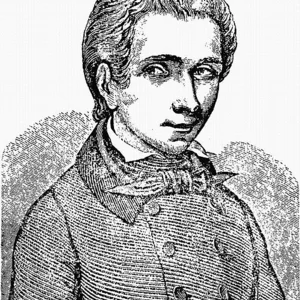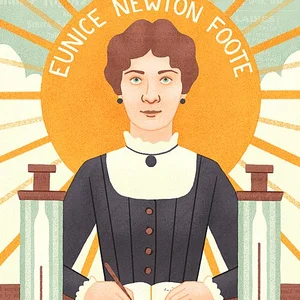

An American scientist, Eunice Newton Foote demonstrated as early as 1856 the ability of carbon dioxide to trap heat, anticipating the understanding of the greenhouse effect. An activist as well, she was a forgotten pioneer of climate science.
Eunice Newton Foote(1819 — 1888)
Eunice Newton Foote
États-Unis
6 min read
Frequently asked questions
Key Facts
- In 1848, she signed the Declaration of Sentiments at the Seneca Falls Convention for women's rights
- In 1856, her experiment showed that air rich in carbon dioxide warms up more in sunlight
- Her 1856 work was presented to the American Association for the Advancement of Science (by a colleague, since women were not allowed to speak)
- She is regarded as a forerunner of John Tyndall in the study of how gases absorb heat
- Her role in the discovery of the greenhouse effect was not rediscovered until 2010 onward
Works & Achievements
Groundbreaking article showing that carbon dioxide traps the sun's heat; the first experimental demonstration of the greenhouse effect.
In this same article, she links the amount of carbon dioxide in the air to the Earth's temperature: the very first insight into global warming.
A second scientific article, devoted to the static electricity produced by the compression and expansion of gases.
An act of activism at the Seneca Falls Convention, the founding manifesto of the women's rights movement in the United States.
Eunice filed patents, reflecting an inventive mind rare for a woman of her time and a life devoted to the technical.
Anecdotes
In 1856, Eunice Newton Foote carried out an experiment of brilliant simplicity: she placed two glass cylinders in the sun, one filled with carbon dioxide, the other with ordinary air, each fitted with a thermometer. The cylinder containing the CO₂ grew distinctly hotter and cooled down more slowly. Without realizing it, she had just demonstrated the principle of the greenhouse effect, three years before the famous experiments of the physicist John Tyndall.
Her paper was presented at the great American scientific congress (the AAAS) in August 1856 in Albany, but Eunice could not read it herself: women were not allowed to address the assembly. It was the scholar Joseph Henry, of the Smithsonian, who read her text in her place, declaring that “science was of no country and of no sex.”
In her paper, Foote wrote a visionary sentence: an atmosphere richer in carbon dioxide would give the Earth “a high temperature.” She is thus the first known person to link the amount of CO₂ in the air to the warming of the planet — the basic insight of climate change, formulated back in 1856!
Long before her experiments, Eunice was an activist for women's rights: in 1848, she was among the first to sign the “Declaration of Sentiments” at the Seneca Falls Convention, the founding act of American feminism. Science and the fight for equality shaped her entire life.
Her discovery was almost entirely forgotten for more than 150 years, and credit for the greenhouse effect was long attributed to men. It was only in 2011 that a retired geologist, Raymond Sorenson, came across her paper by chance and finally did her justice.
Primary Sources
“The highest effect of the sun's rays I have found to be in carbonic acid gas. An atmosphere of that gas would give to our earth a high temperature; and if, as some suppose, the air at one period contained a larger proportion of it than at present, an increased temperature must necessarily have resulted.”
Eunice Foote's second scientific paper, devoted to the static electricity produced by the compression and rarefaction of gases in the air.
“We are pleased to learn that in our country, too, ladies are engaging in original scientific research”: the article praises the experiments by Mrs. Foote presented at the AAAS.
“We hold these truths to be self-evident: that all men and women are created equal.” Eunice Newton Foote is among the signatories of this manifesto.
Key Places
Small town where Eunice Newton was born in 1819, before her family moved to New York State.
School for young women founded by Emma Willard, where Eunice received a scientific education that was rare for a woman of her time.
Town where she lived and where the 1848 women's rights convention was held, whose Declaration of Sentiments she signed.
Site of the 1856 AAAS meeting where her paper was read, since she was not allowed to present it in person.
Town where Eunice Newton Foote died in 1888, long forgotten by the scientific world.
Typical Objects

Eunice used two identical glass cylinders, each fitted with a thermometer, which she filled with different gases to compare how much they heated up in the sun.

An instrument essential to her measurements: placed inside each cylinder, it revealed which gas retained the sun's heat the most.

A device used to compress or rarefy the air inside a chamber; Eunice used it to prepare her gases and vary their density.

Writing tools with which she wrote up her observations and scientific papers before submitting them to journals.

A garment typical of well-off American women in the mid-19th century, with full skirts held out by a light frame.

An official document protecting an invention; Eunice, like her husband Elisha, filed patents, a sign of her inventive mind.
School Curriculum
Vocabulary & Tags
Key Vocabulary
Tags
Daily Life
Morning
A woman from a well-to-do background in Seneca Falls, Eunice began her day by managing the household and raising her children. But whenever she could, she devoted her mornings to reading scientific journals and preparing her experiments.
Afternoon
In the afternoon, she arranged her glass cylinders and thermometers in the sunlight to observe how each gas heated up. She carefully recorded her measurements, like a true researcher, in a century when science remained a field reserved for men.
Evening
In the evening, by the glow of an oil lamp, she wrote up her observations and discussed science and politics with her husband Elisha. The Footes sometimes hosted neighbors involved in the women's rights movement.
Food
Her diet was that of the northeastern United States middle class: bread, meats, vegetables from the garden, seasonal fruits, accompanied by tea or coffee. Preserves and goods from the local market rounded out the everyday fare.
Clothing
She wore the long dresses with fitted bodices and full skirts held out by a crinoline that were fashionable in the mid-nineteenth century, with a shawl and bonnet when going out.
Housing
She lived in a comfortable house in Seneca Falls, a prosperous town along a canal. The home had a parlor, bedrooms, and a space quiet enough to carry out her scientific experiments.
Historical Timeline
Period Vocabulary
Liens externes & ressources
Références
Œuvres
Circumstances Affecting the Heat of the Sun's Rays
1856
Hypothèse sur le climat et le CO₂
1856
On a New Source of Electrical Excitation
1857
Signature de la Déclaration de sentiments
1848
Brevets d'invention
vers 1860