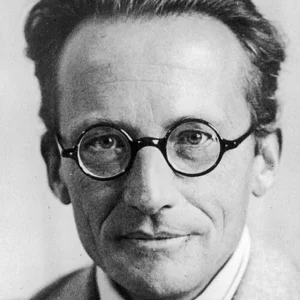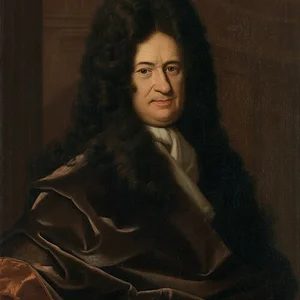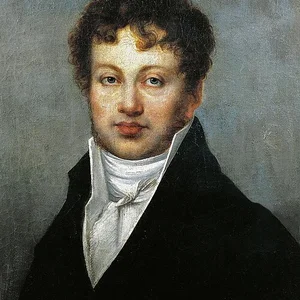

French physicist and mathematician, Ampère is the founder of electrodynamics. He established the mathematical laws governing the interactions between electric currents and magnetic fields. The international unit of electric current, the ampere, bears his name.
André-Marie Ampère(1775 — 1836)
André-Marie Ampère
France
8 min read
Frequently asked questions
Key Facts
- 1775: born in Lyon on January 20 into a cultivated bourgeois family
- 1820: formulated the first laws of electrodynamics in one week following Ørsted's discovery
- 1826: published his “Memoir on the Mathematical Theory of Electrodynamic Phenomena”
- His name is given to the SI unit of electric current intensity (the ampere, symbol A)
- 1836: died in Marseille on June 10
Works & Achievements
The founding text of electrodynamics, presented to the Académie des sciences just two weeks after Ørsted's discovery. Ampère establishes that two wires carrying electric currents attract or repel each other depending on the direction of those currents.
A synthesis of his experiments between 1820 and 1822, including the description of the solenoid and the first mathematical formulations of the forces between currents. The work also brings together contributions from several European correspondents.
A mnemonic rule for determining the direction of the magnetic field produced by an electric current: if an imaginary figure walks in the direction of the current, a magnetic needle deflects toward his left hand. This rule is still taught in physics classes today.
Ampère's scientific masterpiece, often compared to Newton's *Principia* for its rigor. He demonstrates that all known magnetic phenomena can be explained by electric currents circulating inside matter.
An attempt to systematically classify the whole of human knowledge into two major branches, each subdivided into sub-disciplines. The work reflects Ampère's encyclopedic ambition, inherited from the Enlightenment tradition.
Anecdotes
In September 1820, Ampère learned from a friend about Ørsted's discovery: an electric current deflects a magnetized needle. In just two weeks, he presented a complete mathematical theory of this phenomenon to the Académie des sciences. His colleagues were astonished by the speed at which his mind had organized and formalized a brand-new discovery.
Ampère was famous for his extraordinary absent-mindedness. The story goes that one day, looking for a surface to jot down an equation that had just crossed his mind, he began writing on the back panel of a horse-drawn cab stopped in the street. When the carriage drove off, he ran after it, desperately trying to finish his calculation, until he watched it disappear around a corner.
The Revolution left a deep mark on Ampère: his father, Jean-Jacques Ampère, a civil servant in Lyon, was guillotined in 1793 during the Terror. The young André-Marie, then eighteen years old, fell into a state of prostration that lasted more than a year. This trauma permanently shaped his philosophical reflections on the nature of the soul and the meaning of life.
A child prodigy, Ampère taught himself Latin at the age of twelve for the sole purpose of reading in the original the mathematical works of Euler and Bernoulli, which his father had pointed out to him. Having never attended a regular school, he was educated entirely by his father according to Rousseau's principles, learning through observation and curiosity rather than rote recitation.
Ampère was not only a physicist: throughout his life he took an interest in philosophy, poetry, and botany. He maintained a long correspondence with his son Jean-Jacques, a future writer and historian, in which he reflected as much on the classification of the sciences as on the nature of God. This universal curiosity earned him the admiration of his contemporaries, who readily compared him to Leibniz.
Primary Sources
Two parallel conducting wires, carrying electric currents in the same direction, attract each other; carrying currents in opposite directions, they repel each other.
I sought to reduce all the phenomena I observed to a single fact: the mutual action of two infinitely small portions of electric currents, an action that depends on their intensity, their direction, and their distance.
The theory I present here is entirely founded on experiment; I have deduced from it no consequence that is not capable of being verified by direct observation.
The sciences can be arranged according to the order in which they derive from one another, from pure mathematics to the sciences whose object is the study of man and societies.
I know of no greater happiness than that of discovering a new truth, however small it may be; it seems to me then that the world grows a little clearer and that my life has not been in vain.
Key Places
Ampère's birthplace, nestled in the hills above Lyon. The family home, where he received his entire education from his father, has since been converted into the Musée Ampère.
The city where Ampère spent his childhood and youth, where his father was executed in 1793, and where he taught mathematics before moving to Paris. Lyon is inseparable from his intellectual development and his earliest traumas.
The institution where Ampère was appointed tutor and then professor of analysis in 1804. There he trained generations of engineers and scientists, and developed the mathematical foundations of his electrodynamic theory.
The institution before which Ampère presented his discoveries in October 1820, just days after learning of Ørsted's finding. Its weekly sessions were the beating heart of French scientific life.
Ampère held the chair of experimental physics here from 1824 until his death. He gave free, open-to-all public lectures in which he set out his theories on electromagnetism.
The city where Ampère died on 10 June 1836 during an inspection tour of lycées on behalf of the Imperial University. He succumbed to a sudden bout of pneumonia at the age of sixty-one.
Liens externes & ressources
Références
Œuvres
Mémoire sur l'action mutuelle de deux courans électriques
1820
Recueil d'observations électro-dynamiques
1822
Loi d'Ampère (formulation de la règle du bonhomme d'Ampère)
1820
Mémoire sur la théorie mathématique des phénomènes électrodynamiques uniquement déduite de l'expérience
1827
Essai sur la philosophie des sciences
1834