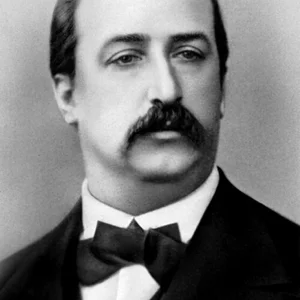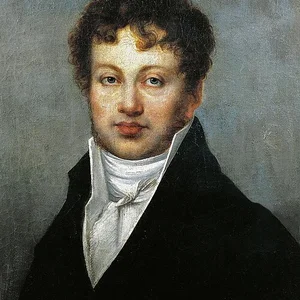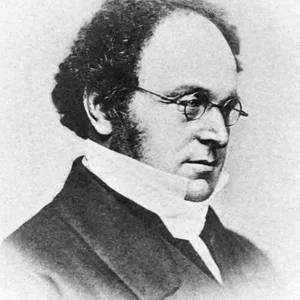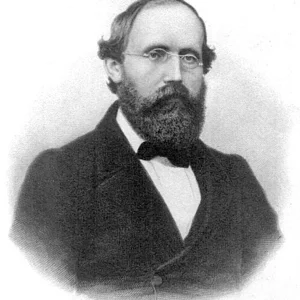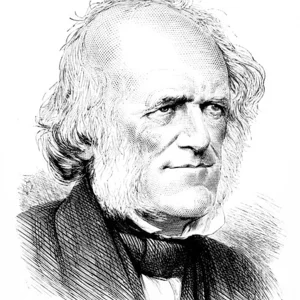

Charles Lyell was a 19th-century British geologist and a major figure in modern geology. His work 'Principles of Geology' popularized uniformitarianism, the idea that present-day geological processes explain the formation of the Earth over very long stretches of time. He had a profound influence on Charles Darwin.
Charles Lyell(1797 — 1875)
Charles Lyell
Royaume-Uni de Grande-Bretagne et d'Irlande
6 min read
Frequently asked questions
Key Facts
- Born in 1797 at Kinnordy in Scotland, died in 1875 in London
- Published 'Principles of Geology' in three volumes (1830-1833), a founding work of modern geology
- Championed uniformitarianism: present-day geological causes have always been at work and explain the Earth's past
- His work directly influenced Charles Darwin during the voyage of the Beagle
- Knighted in 1848, he received the Copley Medal of the Royal Society
Works & Achievements
A foundational work that popularized uniformitarianism and made geology a science of deep time. It had a lasting influence on Darwin.
A concise textbook for students, describing rocks and their fossils in order of age. A teaching reference for decades.
An account of his geological observations during his journeys across the United States and Canada. In it he compared the formations of the two continents.
A study gathering the evidence for the great antiquity of humankind, drawing on prehistoric tools and bones.
Lyell coined these terms, still in use today, basing them on the proportion of shells belonging to species still living.
Anecdotes
Before becoming a geologist, Charles Lyell studied law and briefly worked as a lawyer in London. But his eyesight was fragile, and reading legal files tired his eyes. He gave up the bar to roam the countryside, hammer in hand, observing rocks out in the open air.
His book *Principles of Geology* accompanied Charles Darwin on his voyage aboard the Beagle. Darwin read the work during the crossing and used it to interpret the formations he observed in South America. Lyell later became a close friend of Darwin, even though he took a long time to fully accept the theory of evolution.
Lyell championed the idea that the Earth was extraordinarily ancient, shaped very slowly by forces still at work today: rain, rivers, volcanoes and earthquakes. This view, known as uniformitarianism, clashed with those who believed in a young Earth transformed by sudden catastrophes.
To illustrate the slowness of natural processes, Lyell used the Temple of Serapis near Naples: its marble columns were bored through by marine shellfish several metres up, proving that the ground had sunk beneath the sea and then risen again. He made it the emblem of his book.
Charles Lyell was knighted and received the title of baronet in 1864. Upon his death in 1875, he was buried in Westminster Abbey, an honour reserved for the greatest British figures, a sign of the immense respect that science and the nation held for him.
Primary Sources
Geology is the science which investigates the successive changes that have taken place in the organic and inorganic kingdoms of nature; it inquires into the causes of these changes, and the influence which they have exerted in modifying the surface and external structure of our planet.
An attempt to explain the former changes of the Earth's surface by reference to causes now in operation.
The present work aims to give a systematic description of the rocks that compose the Earth's crust and of the fossils they contain, arranged according to their relative age.
The accumulated evidence of the antiquity of man tends to push back the appearance of our species far into the past, well beyond the limits hitherto accepted.
Key Places
Family estate where Charles Lyell was born in 1797. His earliest observations of nature took root there.
Lyell studied here and attended the geology lectures of William Buckland, who awakened his calling.
Learned society where Lyell presented his work and which he presided over twice. The heart of British geological science.
Ancient site near Naples whose columns, bored through by marine molluscs, illustrated for Lyell the slow movements of the ground. He made it the frontispiece of his book.
Volcano that Lyell studied to understand the extremely slow build-up of lava flows over the ages. Key evidence for his theory of deep time.
Burial place of Charles Lyell in 1875, among the great figures of the nation. A rare honour attesting to his scientific standing.
Typical Objects

A tool with a flat head and a tapered point used to break off rock samples in the field. An indispensable companion to Lyell on his expeditions.

An instrument for measuring the orientation and dip of geological layers. Lyell used it to record the arrangement of the strata.

A small magnifying lens used to examine the texture of minerals and microscopic fossils. It fit in a field pocket.

A notebook in which Lyell recorded sketches of cross-sections, measurements, and observations gathered on site. The foundation of his future works.

A set of shells and petrified remains arranged by their relative age. Lyell used it to date sedimentary layers.

A heavier tool used to dislodge large blocks from cliffs and quarries. Useful in hard terrain.
School Curriculum
Vocabulary & Tags
Key Vocabulary
Tags
Daily Life
Morning
Lyell often began his days with reading and scientific correspondence, exchanging letters with geologists across Europe and America. When in the field, he set out early, hammer and notebook in pocket, to examine cliffs and quarries.
Afternoon
Afternoons were devoted to surveys, sketches of geological cross-sections, and the sorting of the samples he had brought back. In town, he attended meetings of the Geological Society or received fellow scientists.
Evening
In the evening, Lyell worked on his books, his wife Mary often assisting him by reading aloud, as his eyesight was fragile. London dinners gave him the chance to debate the great scientific questions of the age.
Food
A member of the comfortable Victorian middle class, Lyell ate the hearty meals typical of the period: meats, fish, vegetables, and tea. While travelling, he adapted to the local fare of Italy, Sicily, or America.
Clothing
He wore the sober attire of the Victorian gentleman: a dark frock coat, waistcoat, high-collared shirt, and necktie. In the field, he adopted sturdy clothing suited to walking and the dust of the rocks.
Housing
Lyell lived in a comfortable London house, complete with a study and collections of minerals and fossils. He also stayed at the family estate of Kinnordy, in Scotland.
Historical Timeline
Period Vocabulary
Liens externes & ressources
Références
Œuvres
Principles of Geology (3 volumes)
1830-1833
Elements of Geology
1838
Travels in North America
1845
The Geological Evidences of the Antiquity of Man
1863
Classification des époques du Tertiaire (Éocène, Miocène, Pliocène)
1833