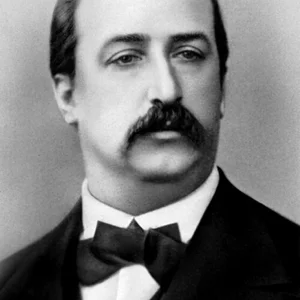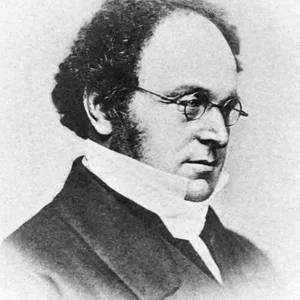

Augustus De Morgan was a 19th-century British mathematician and logician. A pioneer of modern formal logic, he helped found the algebra of logic and gave his name to De Morgan's laws, which are fundamental to logic and set theory.
Augustus De Morgan(1806 — 1871)
Augustus De Morgan
Royaume-Uni de Grande-Bretagne et d'Irlande
6 min read
Frequently asked questions
Key Facts
- Born in 1806 in Madurai (India) and died in 1871 in London
- First professor of mathematics at University College London in 1828
- Formulated De Morgan's laws, connecting the operations of negation, conjunction, and disjunction
- Introduced and popularized the term “mathematical induction” as a method of proof
- Co-founder and first president of the London Mathematical Society in 1865
Works & Achievements
A clear, rigorous textbook that helped renew the teaching of arithmetic in England. Reprinted many times.
A vast treatise on infinitesimal calculus attentive to logical foundations. One of his most influential works for the training of mathematicians.
An accessible account of the calculus of probabilities applied to insurance and life annuities. In it he also uses the phrase “mathematical induction”.
A major work founding the algebra of logic and formulating the celebrated De Morgan's laws. It modernises the syllogism inherited from Aristotle.
A treatise in which De Morgan deepens symbolic algebra and the nature of complex numbers. An important contribution to algebraic abstraction.
Transformation rules linking negation, conjunction and disjunction, fundamental in logic, set theory and computer science. They bear his name to this day.
De Morgan was the first president of this learned society, still active today. A milestone in the organisation of British mathematics.
A delightful, erudite collection denouncing pseudo-sciences and “circle-squarers”. A classic of critical thinking and mathematical humour.
Anecdotes
Augustus De Morgan liked to say that he was "x years old in the year x²". The riddle is solved for x = 43, because 43 × 43 = 1849: he was therefore 43 years old in 1849, which indeed gives 1806 as his year of birth. It was his mischievous way of making people guess his age.
At just 21 years old, De Morgan became in 1828 the very first professor of mathematics at the new University College London. He would resign twice on principle, to defend academic freedom and to refuse any injustice against a colleague.
Throughout his life, De Morgan refused to sign the compulsory religious declarations. This refusal closed the doors to advanced degrees and to positions at Cambridge and Oxford, which were reserved for members of the Church of England: he chose his convictions over his career.
Among his students was the young Ada Lovelace, future pioneer of computing, whom he guided through her study of mathematics by correspondence. He considered her to have an exceptionally quick mind.
A great lover of humour and paradoxes, De Morgan slipped a famous parody into his book 'A Budget of Paradoxes': "Great fleas have little fleas upon their backs to bite them, and little fleas have lesser fleas, and so ad infinitum."
Primary Sources
The contrary of a compound proposition is formed by negating each of its parts and swapping conjunction for disjunction — the formulation that gave rise to “De Morgan's laws.”
“Great fleas have little fleas upon their backs to bite 'em, and little fleas have lesser fleas, and so ad infinitum.”
In these papers, De Morgan develops a logic of relations and a new symbolic notation, broadening Aristotle's classical syllogism.
A rigorous yet accessible work applying the calculus of probabilities to insurance and life annuities.
Key Places
City in southern India where De Morgan was born in 1806, his father being an employee of the East India Company. The family returned to England shortly after his birth.
College where De Morgan pursued his advanced studies in mathematics and was ranked “fourth wrangler.” His refusal to take the religious tests prevented him from pursuing a career there.
Newly founded university, open to all without religious conditions, where De Morgan became the first professor of mathematics in 1828. He taught there for most of his career.
City where De Morgan lived, taught, founded the London Mathematical Society, and died in 1871. The intellectual centre of Victorian England.
Typical Objects

An erasable surface on which teachers and students traced calculations and proofs every day. A basic tool of mathematics teaching in the 19th century.

Writing instruments with which De Morgan composed his treatises, articles and his abundant scientific correspondence. The metal nib pen was then replacing the quill.

Printed books such as *Formal Logic* or his *Differential and Integral Calculus*, spreading his ideas among students and scholars. The main vehicle for the transmission of knowledge.

De Morgan was a passionate flautist who played for his own pleasure. Chamber music filled his Victorian evenings.

Geometric tools used to construct figures and diagrams in proofs. Indispensable to mathematics teaching and research.

Collections of numerical tables used to calculate annuities and insurance, a field in which De Morgan worked as a populariser. A reflection of the rise of Victorian insurance companies.
School Curriculum
Vocabulary & Tags
Key Vocabulary
Tags
Daily Life
Morning
De Morgan devoted his mornings to writing his treatises and his very numerous letters, pen in hand in his study. A committed city dweller, he disliked the countryside and rarely left London.
Afternoon
In the afternoon, he taught at University College London, lecturing at the blackboard and guiding his students through proofs. He took great care over the clarity of his teaching.
Evening
In the evening, he read, organised his vast library and played the flute. A lover of puzzles and paradoxes, he enjoyed debating by correspondence with his learned friends such as Hamilton and Boole.
Food
His table was that of a middle-class Victorian academic: bread, meats, boiled vegetables and tea set the rhythm of his meals. Moderation and regularity took precedence over indulgence.
Clothing
He wore the dark attire of the Victorian professor: a frock coat, waistcoat, high-collared shirt and a knotted necktie. An austere and formal outfit suited to the lecture hall.
Housing
De Morgan lived in a London townhouse, crammed with the immense library he cherished. His home, shared with his wife Sophia and their children, was a place of constant study.
Historical Timeline
Period Vocabulary
Liens externes & ressources
Références
Œuvres
The Elements of Arithmetic
1830
The Differential and Integral Calculus
1836-1842
An Essay on Probabilities
1838
Formal Logic
1847
Trigonometry and Double Algebra
1849
Lois de De Morgan
1847
Fondation de la London Mathematical Society
1866