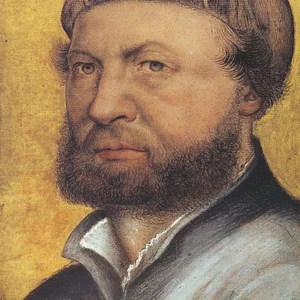

Hans Holbein the Younger was a German painter and engraver of the Renaissance, famous for his portraits of striking precision. Having become court painter to Henry VIII of England, he immortalized the great figures of the Tudor era and the humanists of his time.
Hans Holbein the Younger(1497 — 1543)
Hans Holbein the Younger
Suisse, France, Saint-Empire romain germanique
6 min read
Frequently asked questions
Key Facts
- Born around 1497 in Augsburg, Germany, into a family of painters
- Worked in Basel from 1515, where he mingled with the humanist Erasmus, of whom he painted several portraits
- Painted “The Ambassadors” (1533), famous for its anamorphosis of a skull
- Became official court painter to Henry VIII of England from 1536 onwards
- Died in London in 1543, probably of the plague
Works & Achievements
A profile image of the greatest humanist of the age, writing at his desk. The portrait spread Erasmus's face throughout Europe.
A series of small engravings in which Death carries off people from every walk of society. A masterpiece of Renaissance graphic art.
A raw and realistic depiction of Christ's body laid out. A striking work that left a lasting impression on viewers.
A portrait of the famous humanist and Lord Chancellor of England, author of “Utopia.” Holbein displays here all his mastery of the detail of fabrics.
A double portrait of two French envoys surrounded by objects of learning, with a skull in anamorphosis. One of the most analyzed works in the history of art.
A powerful, frontal image of the king in majesty, which fixed the image of the Tudor sovereign for centuries.
A diplomatic portrait made for the planned royal marriage. It played a direct role in a political decision by Henry VIII.
A portrait of a German Hanseatic merchant in London, surrounded by the tools of his trade. A pinnacle of meticulous detail and symbolism.
Anecdotes
In his painting *The Ambassadors* (1533), Holbein painted a strange, elongated, blurry shape in the foreground. Seen from the side, at a certain angle, it reveals a human skull: it is an anamorphosis, a reminder that death lies in wait even for the powerful, amid their riches and their learning.
In 1539, **Henry VIII** sent Holbein to paint **Anne of Cleves** to decide whether he should marry her. Charmed by the portrait, the king agreed to the marriage, but was disappointed when he met the princess in person. The union was quickly annulled; Holbein, however, kept his position as court painter.
When Holbein arrived in England in **1526**, he carried a letter of recommendation from the great humanist **Erasmus**, addressed to his friend **Thomas More**. Thanks to this network of humanists, the German painter gained entry into the best circles of London.
Holbein did not only paint: he also designed jewellery, goldsmiths' cups, bookbindings, and decorations for the court. Many of these precious objects have been lost, but his preparatory drawings have survived.
Before becoming famous as a portraitist, Holbein created in **Basel** a series of woodcuts titled *The Dance of Death*, in which a skeleton comes to seize in turn the pope, the emperor, the merchant, or the peasant, reminding everyone that death spares no one.
Primary Sources
Here, the arts are frozen stiff; that is why he [Holbein] is travelling to England to gather a few angels there.
The portrait of Erasmus of Rotterdam, captured from life.
Holbein painted King Henry VIII and many lords of his court with such truthfulness that one believed one saw them alive.
Jean de Dinteville, lord of Polisy, aged twenty-nine; Georges de Selve, bishop of Lavaur, aged twenty-five.
Key Places
A prosperous Imperial city in southern Germany where Holbein was born, in the workshop of his father, a painter. A great merchant and artistic center.
A Swiss city of printing and humanism where Holbein trained, became a master, and met Erasmus. There he painted portraits and made engravings.
The English capital where Holbein settled and became court painter to Henry VIII. He died there, most likely of the plague, in 1543.
Henry VIII's royal residence where Holbein created the great mural of the Tudor dynasty, destroyed in a fire in the 17th century.
Typical Objects

Essential tools of the portrait painter, allowing the tiny details of embroidery, jewels and gazes. Holbein was renowned for his almost photographic precision.

Preparatory drawing instruments used to quickly capture a sitter's features. Holbein's drawings in chalk and black stone are among the most admired of the Renaissance.

A block of wood into which the artist carves an image to print it in many copies. Holbein used it for his famous series “The Dance of Death”.

Colours ground by hand from rare minerals such as lapis lazuli. Their high cost reflected the prestige of the court patrons.

A wooden support coated with a white layer on which Holbein painted his portraits, before canvas came into general use. Its smooth surface allowed very crisp finishes.

A paper design for cups, pendants or ceremonial weapons intended for the Tudor court. Holbein was also a great designer of precious objects.
School Curriculum
Vocabulary & Tags
Key Vocabulary
Daily Life
Morning
Holbein began his day at the workshop as soon as the morning light appeared, the most precious light for painting colours faithfully. His apprentices ground pigments and prepared the wooden panels while he studied his drawings.
Afternoon
In the afternoon, he received his sitters: merchants, courtiers, or members of the royal family came to pose. Holbein first made a quick, precise drawing of the face, which he would later transfer onto the panel.
Evening
When evening came, by candlelight, he worked on tasks that did not require the full clarity of daylight: designs for goldsmith's work, decoration projects, or correspondence with his patrons.
Food
At court and in the merchants' houses where he was received, people ate bread, roasted meats, fish, and cheese, washed down with beer or wine. Sugar and spices remained luxury goods reserved for the wealthy.
Clothing
Holbein wore the plain, well-kept clothes of a high-ranking craftsman: a woollen doublet, a linen shirt, and a cap. His own paintings show the period's taste for rich fabrics, furs, and jewels among the powerful.
Housing
In London, he lodged for a time with Thomas More, then in timber-framed houses in the merchants' quarter. His workshop served at once as a place of work, a place to receive clients, and sometimes a dwelling.
Historical Timeline
Period Vocabulary
Liens externes & ressources
Références
Œuvres
Portrait d'Érasme de Rotterdam
1523
La Danse des morts (gravures sur bois)
vers 1526
Le Christ mort au tombeau
1521-1522
Portrait de Thomas More
1527
Les Ambassadeurs
1533
Portrait d'Henri VIII
vers 1537
Portrait d'Anne de Clèves
1539