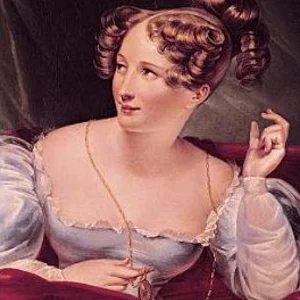

Irish actress famous for her Shakespearean roles, she triumphed in Paris in 1827. Hector Berlioz, madly in love with her, dedicated his Symphonie fantastique to her before marrying her in 1833.
Harriet Smithson(1800 — 1854)
Harriet Smithson
France
5 min read
Frequently asked questions
Key Facts
- Born in 1800 in Ennis, Ireland
- Triumphed in Paris in 1827 in plays by Shakespeare (Ophelia, Juliet) with an English troupe
- Inspired Hector Berlioz to compose his Symphonie fantastique (1830), in which she becomes the “idée fixe”
- Married Hector Berlioz in 1833, a marriage that later deteriorated
- Died in 1854 in Paris after years of illness
Works & Achievements
The role that made her famous in Paris: her mad scene moved audiences deeply and left a lasting mark on French Romantic theatre.
An acclaimed performance that made her the embodiment of the Shakespearean heroine for Parisian audiences.
Another great Shakespearean role in her repertoire, presented during the English season in Paris.
Engagements at the great English theatres that built her reputation before her success in France.
Though not its author, she was the muse of this founding work of musical Romanticism composed by Berlioz.
Anecdotes
In September 1827, an English theatre troupe arrived in Paris to perform Shakespeare in the original language. When Harriet Smithson played Ophelia and then Juliet at the Odéon, French audiences discovered a violent, passionate kind of theatre that broke with the classical rules. The young Hector Berlioz, sitting in the audience, fell madly in love with her without ever having spoken to her.
Berlioz was so obsessed with Harriet that he turned his passion into music: the Symphonie fantastique (1830) recounts the daydreams of an artist haunted by a beloved woman, represented by a recurring melody called the “idée fixe.” Yet at the time, Harriet knew almost nothing of this composer's existence.
The couple barely spoke each other's language when they finally met: Berlioz could only stammer in English, and Harriet hardly knew any French. They married all the same in October 1833, with the poet Heinrich Heine and the pianist Franz Liszt among the witnesses.
A serious fall broke her leg around 1833, putting an end to her acting career. In debt and unable to return to the stage, she watched her marriage to Berlioz slowly deteriorate, until they separated, even though the composer continued to support her financially.
When Harriet played Ophelia driven mad, Parisian spectators, unaccustomed to such dramatic intensity, burst into tears or cried out in the theatre. Her way of dying on stage as Juliet became a model for an entire generation of Romantic actors.
Primary Sources
I fell at once, it was a thunderbolt, into a love of which I can give no idea. Shakespeare, by appearing to me thus unexpectedly, struck me down.
Miss Smithson overwhelms me; I saw her as Juliet, I saw her as Ophelia, and I can no longer think of anything else.
In the role of Ophelia, Miss Smithson conveyed a truth of sorrow and a grace of madness that stirred the entire house.
Key Places
Town in Ireland associated with the birth and family origins of Harriet Smithson, daughter of actors.
Parisian stage where the English troupe performed Shakespeare in 1827, sealing Harriet's triumph as Ophelia and Juliet.
Capital where Harriet began her theatrical career, notably at Drury Lane and Covent Garden, before leaving for Paris.
City of her glory, her marriage to Berlioz, and her death. She spent her final years there, ill and in debt.
District where Harriet was buried; her remains were later transferred to the cemetery where Berlioz also rests.
Liens externes & ressources
Références
Œuvres
Ophélie dans Hamlet
1827
Juliette dans Roméo et Juliette
1827
Desdémone dans Othello
vers 1827-1828
Saisons londoniennes au Drury Lane et Covent Garden
années 1820
Inspiration de la Symphonie fantastique
1830