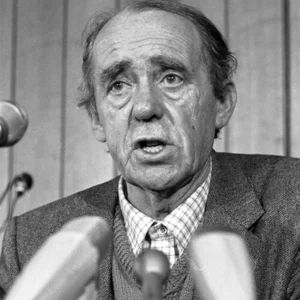

German writer, a major figure of post-war literature. His work, marked by a moral critique of West German society and the memory of Nazism, earned him the Nobel Prize in Literature in 1972.
Heinrich Böll(1917 — 1985)
Heinrich Böll
Allemagne
6 min read
Frequently asked questions
Key Facts
- Born in 1917 in Cologne into a Catholic family of craftsmen
- Conscripted into the Wehrmacht during the Second World War (1939-1945), an experience central to his work
- Member of Group 47, the literary circle of young post-war German writers
- Published “The Lost Honour of Katharina Blum” in 1974, a critique of the tabloid press
- Awarded the Nobel Prize in Literature in 1972; died in 1985
Works & Achievements
His first published story: a young soldier senses his own death as he heads to the Eastern Front. A foundational work of post-war literature.
A novel made up of episodes on the absurdity and horror of war as seen by ordinary men.
An account of post-war Germany seen through the eyes of two children whose fathers were killed in combat.
The saga of a Cologne family across half a century, confronting Nazism and its aftermath.
The bitter monologue of a fallen artist, a critique of the social and Catholic hypocrisy of West Germany.
A vast novelistic fresco cited by the Nobel Academy; the portrait of a free-spirited woman moving through German history.
A novel denouncing the tabloid press that destroys the reputation of an innocent woman. A huge success, adapted for the screen.
Crowning his entire body of work, praised for its renewal of German literature and its moral scope.
Anecdotes
Conscripted into the Wehrmacht in 1939, Heinrich Böll fought on several fronts, was wounded four times, and ended up a prisoner of the Americans in 1945. His entire body of work bears the mark of this war he loathed, so much so that he often said he wrote “against” it.
After 1945, Böll dug through the ruins of Cologne, his native city devastated by bombing. From this experience was born what came to be called “rubble literature” (Trümmerliteratur): rather than being ashamed of it, he proudly claimed the name in a 1952 essay.
In 1972, Böll received the Nobel Prize in Literature, becoming the first West German honored since the war. Many saw it as a sign of reconciliation: the voice of a Germany that dared to look its Nazi past in the face.
In 1974, when the dissident writer Alexander Solzhenitsyn was expelled from the Soviet Union, it was at Böll's country house that he found refuge during his first days in the West. Böll defended the persecuted on both sides of the Iron Curtain.
Viciously attacked by the major tabloid Bild for having called for a fair trial for alleged terrorists, Böll turned the experience into a novel: *The Lost Honour of Katharina Blum* (1974), a scathing critique of the sensationalist press.
Primary Sources
It was already dark when I arrived in Bonn.
How violence develops and where it can lead.
Stranger, go tell the Spartans… — a line scratched on a school blackboard by a young dying soldier, an echo of the epitaph of Thermopylae.
Böll embraces the disparaging term “literature of rubble” as a badge of honour: the writer must show the world as it is, ruins included.
Key Places
Böll's native city, on the Rhine. Destroyed by bombing, it is the setting of many of his novels and the source of his “rubble literature.”
Capital of West Germany, where Böll trained as a bookseller and studied. The setting of *The Clown* and of the political life he observed with severity.
Island off the west coast of Ireland where Böll owned a cottage. A writing retreat far from Germany, it is where he wrote his *Irish Journal*.
The city where Böll received the Nobel Prize in Literature in 1972 and delivered his acceptance speech.
Village in the Eifel region where Böll had his country house and where he died in 1985. He notably hosted Solzhenitsyn there in 1974.
Typical Objects

The writer's daily working tool, on which Böll typed novels, short stories, and politically engaged articles. A symbol of literature as both a profession and a struggle.

A heavy smoker, Böll wrote surrounded by smoke, the cigarette becoming almost an attribute of the post-war intellectual. It ruined his health.

Böll wore this uniform against his will during six years of war. In his work it embodies the absurdity and horror of a conflict forced upon young Germans.

Parcels of food sent from America to the starving Germans of the post-war years. Böll made them the subject of a famous text, a symbol of survival amid the ruins.

Awarded to Böll in 1972, it crowned a body of work devoted to moral criticism and made him a spokesman for a Germany reconciled with its past.

A travel notebook kept during his stays on Achill Island, published under the title “Irish Journal.” For him, Ireland was a refuge far from the Germany of the economic miracle.
School Curriculum
Vocabulary & Tags
Key Vocabulary
Daily Life
Morning
Böll most often worked in the morning, seated at his typewriter with a cigarette in hand. He imposed on himself the discipline of a craftsman of writing, inherited from his humble background where work was a core value.
Afternoon
His afternoons combined abundant correspondence, reading, and meetings: Böll was a public figure in great demand. He took stands on political current events and replied to the many writers and activists who asked for his support.
Evening
Evenings were devoted to family, friends from literary circles, and discussions about German society. A critical Catholic, he loved to debate morality, justice, and the duty to remember in the face of the Nazi past.
Food
Marked by the hunger of the postwar years and the food parcels sent from America, Böll kept a simple, unostentatious cuisine. He rejected the flashy abundance of the West German “economic miracle.”
Clothing
Böll dressed plainly, rejecting bourgeois elegance: simple suits, the look of an unassuming intellectual. His modest attire reflected his distrust of appearances and money.
Housing
He lived in Cologne, his rebuilt hometown, and owned a country house in Langenbroich, in the Eifel region. He also escaped to a cottage on the Irish island of Achill, far from the pressures of German public life.
Historical Timeline
Period Vocabulary
Liens externes & ressources
Références
Œuvres
Le Train était à l'heure (Der Zug war pünktlich)
1949
Où étais-tu, Adam ? (Wo warst du, Adam?)
1951
Les Enfants des morts / Maison sans gardien (Haus ohne Hüter)
1954
Billard à neuf heures et demie (Billard um halb zehn)
1959
Les Opinions d'un clown (Ansichten eines Clowns)
1963
Portrait de groupe avec dame (Gruppenbild mit Dame)
1971