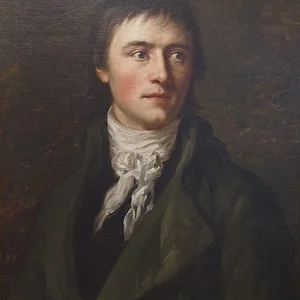

Heinrich von Kleist (1777-1811) was a German writer, the author of plays, tales, and short stories. A singular figure between Classicism and Romanticism, he is famous for his tragedies and his tautly plotted short stories, before taking his own life at the age of 34.
Heinrich von Kleist(1777 — 1811)
Heinrich von Kleist
royaume de Prusse, Empire russe
7 min read
Frequently asked questions
Key Facts
- Born in 1777 in Frankfurt an der Oder into a family of the Prussian military nobility
- Wrote the comedy The Broken Jug (Der zerbrochene Krug), completed around 1806
- Published in 1808 the novella The Marquise of O... and the tragedy Penthesilea
- Released in 1810 the novella Michael Kohlhaas, the story of a man in revolt against injustice
- Took his own life in 1811 on the shore of the Wannsee, near Berlin, together with Henriette Vogel
Works & Achievements
Kleist's first published drama, a dark tragedy about two families torn apart by hatred and misunderstanding.
A major comedy of German literature: a farcical trial in which a corrupt judge must, against his will, unmask his own crime.
A violent tragedy about the queen of the Amazons and her fatal love for Achilles, of an unprecedented emotional intensity.
A novella famous for its bold opening and its tense plot centered on a woman who becomes pregnant without knowing how.
A powerful novella about a horse dealer who, the victim of an injustice, takes the law into his own hands until he becomes an outlaw.
A chivalric drama blending dream, love and the marvelous, one of Kleist's most frequently performed plays.
A brief but major philosophical essay on grace, consciousness and lost innocence, explored through the image of the puppet.
A drama published after his death, about an officer torn between military obedience and individual freedom; regarded as his theatrical masterpiece.
Anecdotes
In 1801, Kleist read the philosophy of Immanuel Kant and came away shattered: he believed he had discovered that human beings can never reach absolute truth, only their own impressions. This "Kant crisis" destroyed his dream of understanding everything through science and drove him to seek meaning in writing. He described it in a famous letter to his fiancée Wilhelmine von Zenge.
In 1807, just after Prussia had been crushed by Napoleon, Kleist traveled toward Berlin, then occupied by the French. Mistaken for a spy, he was arrested by French troops and imprisoned for several months in France, notably at Châlons. He was eventually released for lack of evidence.
In 1808, the great Goethe agreed to stage Kleist's comedy “The Broken Jug” in Weimar. But Goethe clumsily split the play into several acts, and the performance was a fiasco. Furious and humiliated, Kleist held a stubborn grudge against the master of Weimar.
In 1810, Kleist founded the “Berliner Abendblätter” in Berlin, one of the city's first daily newspapers, in which he published short stories, news items, and reflections. But Prussian censorship and money troubles strangled the paper, which closed after only a few months in 1811.
On 21 November 1811, on the shore of the Kleiner Wannsee near Berlin, Kleist took his own life at the age of 34. He had made a pact with Henriette Vogel, a gravely ill friend: at her request, he shot her with a pistol, then killed himself. Before dying, he wrote astonishingly serene farewell letters.
Primary Sources
We cannot decide whether what we call truth is truly the truth, or whether it only appears so to us.
On the banks of the Havel there lived, around the middle of the sixteenth century, a horse dealer named Michael Kohlhaas, the son of a schoolmaster, one of the most upright and at the same time most terrible men of his age.
So, I said somewhat distractedly, we would have to eat once again of the tree of knowledge in order to fall back into the state of innocence?
Kisses and bites, they rhyme together, and one who loves with all her heart may easily mistake the one for the other.
Key Places
Town in Prussia where Kleist was born in 1777 and studied for a time at the university. The cradle of his family of military nobility.
Prussian capital where Kleist settled at the end of his life and founded the daily newspaper “Berliner Abendblätter” in 1810. The center of his literary and journalistic activity.
Lakeshore to the southwest of Berlin where Kleist took his own life on November 21, 1811, together with Henriette Vogel. His grave is still located there.
Town in Saxony where Kleist lived from 1807 to 1809 and, together with Adam Müller, launched the literary journal “Phöbus.” A period of great creative productivity.
The French capital that Kleist visited after his intellectual crisis of 1801, fascinated and troubled by the great city and the science of his time.
Town in France where Kleist was held prisoner in 1807, after his arrest by the French as a suspected spy.
Typical Objects

The writer's writing instruments; he composed plays, short stories, and letters with a goose quill dipped in ink. With them he produced his entire body of work in a few intense years.

The military attire Kleist wore during his years in the Prussian army. It symbolizes the noble, martial world he came from and that he eventually left behind.

A handgun common in the Napoleonic era. It was with a pistol that Kleist took his own life on the shore of the Wannsee in 1811.

An everyday object that gives its title to Kleist's most famous comedy. Shattered at the start of the play, it sets off a farcical trial in which the judge turns out to be the culprit.

A jointed puppet suspended from strings, at the heart of the essay “On the Marionette Theatre.” Kleist makes it the symbol of a perfect grace that humankind, having grown too self-aware, has lost.

A daily newspaper founded by Kleist in Berlin in 1810, one of the city's first, printed on a movable-type press. In it he mixed short stories, news items, and reviews before censorship made it disappear.
School Curriculum
Vocabulary & Tags
Key Vocabulary
Daily Life
Morning
An early riser and tireless worker, Kleist often devoted his mornings to writing, pen in hand at his desk. During his Berlin years, he also sifted through the mail and the news for his newspaper, the *Berliner Abendblätter*.
Afternoon
His afternoons might be taken up with errands: visits to publishers, to the printer, or the search for a patron and a steady job that always eluded him. He walked a great deal and kept up an abundant correspondence.
Evening
In the evening, Kleist frequented cafés and literary salons where people discussed theatre, philosophy and politics. There he met friends such as **Adam Müller** and sometimes read his texts aloud.
Food
People then ate a simple Prussian cuisine: rye bread, potatoes, soups, pork, cabbage, washed down with beer or wine. Often penniless, Kleist sometimes depended on help from his family or friends for his meals.
Clothing
Born into the nobility, Kleist wore the bourgeois dress of the early 19th century: a dark frock coat, a waistcoat, a high-collared shirt and a knotted cravat. As a young officer, he had earlier sported the blue uniform of the Prussian army.
Housing
His was the life of a man with no fixed home: rented rooms, stays with relatives, lodgings in Dresden and then in Berlin. He moved very often, following his travels, his projects and his money troubles.
Historical Timeline
Period Vocabulary
Liens externes & ressources
Références
Œuvres
La Famille Schroffenstein
1803
La Cruche cassée
1808
Penthésilée
1808
La Marquise d'O…
1808
Michael Kohlhaas
1810
Catherine de Heilbronn
1810
Sur le théâtre de marionnettes
1810