 flip
flipMadeleines of Memory
Madeleines of Memory
Why this dish? Bergson married Louise Neuburger in 1891, cousin of Marcel Proust—who was a witness at their wedding. And it was Proust who made the dipped madeleine the emblem of involuntary memory, a literary echo of the duration and memory that Bergson theorized in "Matter and Memory" (1896). This small shell-shaped cake, which keeps and can be carried in a box, connects the philosopher to the writer of his family.
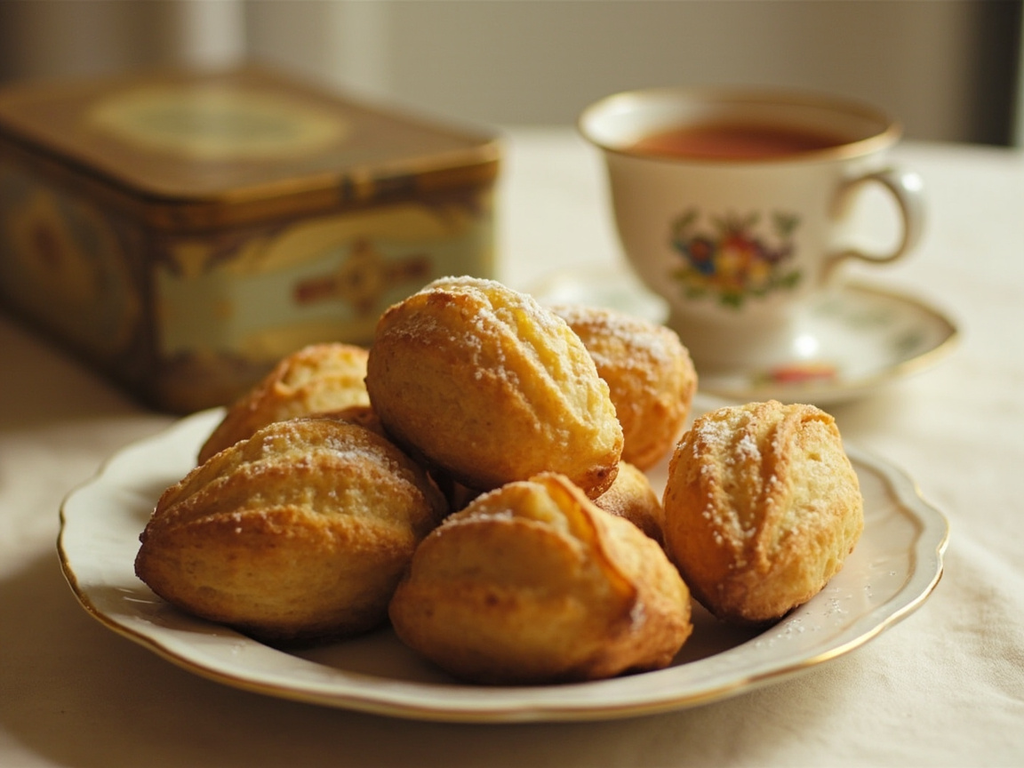
Small, soft shell-shaped cakes with a characteristic hump, flavored with browned butter and lemon zest, golden from the oven. They are served at tea time, dipped in tea or herbal tea.
You may know that Marcel, cousin of my dear Louise and witness at our wedding, made a simple madeleine the greatest of revealers: that a dipped cake can resurrect an entire swath of the past—this can hardly surprise the man who wrote about memory. The secret, I was told, lies in the butter cooked to a hazelnut hue, and in resting the batter in the cold—that is what gives the famous hump. We stored them in a tin box, and they kept for days, ready for tea. Dip one, I pray you, and observe what rises in you.
- •Fresh eggs — three (structure)
- •Powdered sugar — as much as flour (softness and browning)
- •Wheat flour — one measure (body)
- •Fine butter, cooked to hazelnut — a generous portion (signature flavor)
- •Lemon zest — one (freshness)
Madeleines of Memory
Small, soft shell-shaped cakes with a characteristic hump, flavored with browned butter and lemon zest, golden from the oven. They are served at tea time, dipped in tea or herbal tea.
Why this dish? Bergson married Louise Neuburger in 1891, cousin of Marcel Proust—who was a witness at their wedding. And it was Proust who made the dipped madeleine the emblem of involuntary memory, a literary echo of the duration and memory that Bergson theorized in "Matter and Memory" (1896). This small shell-shaped cake, which keeps and can be carried in a box, connects the philosopher to the writer of his family.
You may know that Marcel, cousin of my dear Louise and witness at our wedding, made a simple madeleine the greatest of revealers: that a dipped cake can resurrect an entire swath of the past—this can hardly surprise the man who wrote about memory. The secret, I was told, lies in the butter cooked to a hazelnut hue, and in resting the batter in the cold—that is what gives the famous hump. We stored them in a tin box, and they kept for days, ready for tea. Dip one, I pray you, and observe what rises in you.
Ingredients (period version)
- Fresh eggs — three (structure)
- Powdered sugar — as much as flour (softness and browning)
- Wheat flour — one measure (body)
- Fine butter, cooked to hazelnut — a generous portion (signature flavor)
- Lemon zest — one (freshness)
Ingredients
- Eggs — 3 (structure)
- Sugar — 120 g (softness)
- Flour — 120 g (body)
- Butter — 120 g (browned butter)
- Baking powder — 1 tsp (hump)
- Lemon zest — 1 (flavor)
- Pinch of salt — 1 (balance)
Method
- Melt the butter until it takes on a hazelnut aroma and an amber color, then let it cool slightly.
- Whisk eggs and sugar until the mixture whitens, incorporate the flour, baking powder, salt, and zest, then the browned butter.
- Let the batter rest in the refrigerator for at least 1 hour (ideally overnight): this temperature contrast creates the hump.
- Fill buttered madeleine molds, bake at 220 °C for 4 minutes then at 200 °C for 5–6 minutes, until the edges are golden; unmold while warm.
How it was made : A specialty of Commercy popularized in the 18th century, the madeleine was a universal tea-time cake at the turn of the 20th century, sold in boxes and offered as a travel gift. It was baked in scallop-shaped tin molds.
The contemporary twist : Insert a heart of lime blossom jelly in the center before baking, a nod to the Proustian herbal tea that accompanied the madeleine.
Sources : Marcel Proust, Swann's Way, 1913 · Pierre Lacam, Le Mémorial historique de la pâtisserie, 1890
Henri Bergson · Charactorium