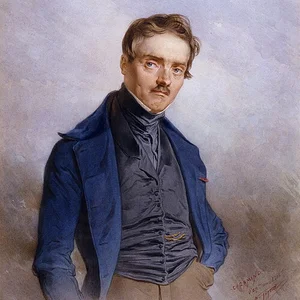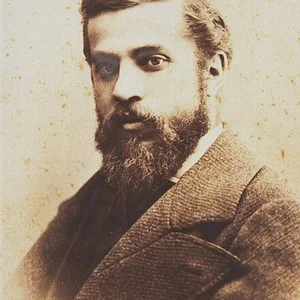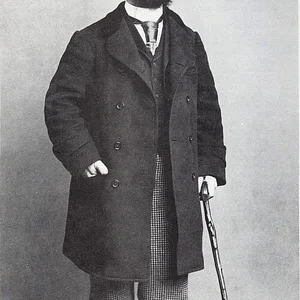

French painter, draughtsman, lithographer and poster artist, a major figure of Post-Impressionism. A witness to the Paris of the Belle Époque, he immortalized the cabarets, the music halls and the nightlife of Montmartre.
Henri de Toulouse-Lautrec(1864 — 1901)
Henri de Toulouse-Lautrec
France
6 min read
Frequently asked questions
Famous Quotes
« I have tried to depict the true and not the ideal.»
Key Facts
- Born in 1864 in Albi into an aristocratic family
- Suffered fractures to both legs in his adolescence (around 1878-1879) that stunted his growth
- Settled in Montmartre in the 1880s and frequented the cabarets
- Created his famous poster for the Moulin Rouge in 1891, which made him famous
- Died prematurely in 1901 at the age of 36, worn down by alcohol and illness
Works & Achievements
Large canvas depicting the atmosphere of the cabaret, its patrons and its dancers; a masterpiece of the painting of modern life.
The artist's first lithographic poster, which revolutionized advertising art through its flat areas of color and stylized silhouette.
Portrait of the cabaret singer with his red scarf and broad-brimmed hat, an image that became iconic of the Paris of the cabarets.
Portrait of the famous cancan dancer, a witness to the nightlife of Montmartre.
A series of lithographs on the intimate lives of the women of the brothels, observed with humanity and without caricature.
A painting showing the residents of a brothel in a moment of waiting, without any sense of wretchedness.
Portraits and posters of the dancer Jane Avril, one of his models and friends, captured in full motion.
An intimate study of a woman seen from behind, an example of his talent for scenes of everyday life.
Anecdotes
As a teenager, Toulouse-Lautrec broke both of his femurs a year apart (1878 and 1879). Because of a probable genetic disorder made worse by his parents' consanguinity (they were first cousins), his legs stopped growing while his torso developed normally: as an adult, he stood about 1.52 m tall.
A devotee of the Moulin Rouge cabaret, which opened in 1889, he had his own reserved table there. The director, Charles Zidler, hung one of his large paintings in the entrance hall, which brought the artist to the attention of the Parisian public.
To escape the heat and work in peace, Toulouse-Lautrec would sometimes settle for weeks at a time in the brothels of Paris, where he drew the women in their daily lives, without judgment or condescension.
An inventor of cocktails, he is said to have created the “earthquake” (tremblement de terre), an explosive mix of absinthe and cognac. His alcoholism, which wrecked his health, led him to hide alcohol inside a hollow walking cane.
His lithographed posters for the Moulin Rouge and the performer Aristide Bruant were pasted on the walls of Paris in 1891–1892 and revolutionized the art of the poster, turning advertising into an art form in its own right.
Primary Sources
Throughout his life, Toulouse-Lautrec kept up an abundant and affectionate correspondence with his mother, to whom he reported on his work and his Parisian life.
The artist's first major lithographic poster, commissioned by the cabaret, depicting the dancer La Goulue and the dancer Valentin le Désossé.
A series of lithographs devoted to the daily life of the women of the brothels, observed with tenderness and without voyeurism.
A childhood friend and the artist's dealer, Joyant wrote a definitive biography after his death and worked to preserve his oeuvre, laying the foundations of the museum in Albi.
Key Places
Toulouse-Lautrec's birthplace in the Tarn. The Palais de la Berbie now houses the museum dedicated to him.
The district of cabarets and nightlife where the artist lived and worked. The heart of his work on the Belle Époque.
Famous cabaret on the Boulevard de Clichy, opened in 1889. Toulouse-Lautrec found his subjects there, along with his first major poster commission.
Studio where the young artist trained from 1882 and met, among others, Vincent van Gogh and Émile Bernard.
His mother's estate in the Gironde where Toulouse-Lautrec died on 9 September 1901, at the age of 36.
The place where the artist is buried, near the Château de Malromé, in the Gironde.
Typical Objects

A block of polished limestone on which the artist draws with a greasy crayon before printing. Toulouse-Lautrec made it his tool of choice for his posters and prints.

A large color print meant for the city's walls to advertise cabarets and shows. The artist turned it into a true artistic genre.

A cane in which Toulouse-Lautrec hid alcohol so he could drink in secret. An emblematic object of his addiction.

A green liquor very much in vogue in the Paris of the Belle Époque, nicknamed the “green fairy.” Toulouse-Lautrec drank a great deal of it.

Toulouse-Lautrec drew from life, in the cabarets and backstage, sketching dancers and patrons with great speed.

He often painted on cardboard with paint thinned with turpentine, a quick technique giving a characteristic matte finish.
School Curriculum
Vocabulary & Tags
Key Vocabulary
Daily Life
Morning
Toulouse-Lautrec often rose late, after the long nights spent in the cabarets. The morning was for resting, writing letters to his mother, and preparing his studio materials.
Afternoon
In the afternoon, he worked in his Montmartre studio, painting on cardboard or working up the sketches brought back from his outings. He received models, fellow artists, and dealers such as Maurice Joyant.
Evening
When evening came, he headed to the Moulin Rouge, the music halls, and the café-concerts. Notebook in hand, he watched the dancers and patrons, sketched from life, and drank heavily, late into the night.
Food
A true gourmet, Toulouse-Lautrec loved to cook and to host elaborate dinners for his friends. But his consumption of absinthe, cognac, and cocktails of his own invention gradually ruined his health.
Clothing
He wore the bourgeois clothing of his time: a dark suit, a bowler hat or top hat, and the pince-nez that was indispensable to him because he was very short-sighted.
Housing
Born into a wealthy aristocratic family, he lived in apartments and studios in the Montmartre district, dividing his time between Paris and the family estates in the South-West.
Historical Timeline
Period Vocabulary
Liens externes & ressources
Références
Œuvres
Affiche « Moulin Rouge : La Goulue »
1891
Affiches d'Aristide Bruant (« Ambassadeurs »)
1892
La Goulue entrant au Moulin Rouge
1892
Album « Elles »
1896
Jane Avril dansant
1892