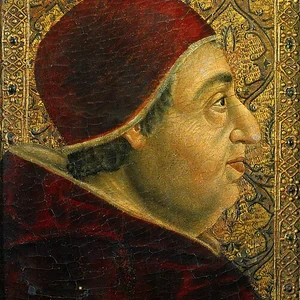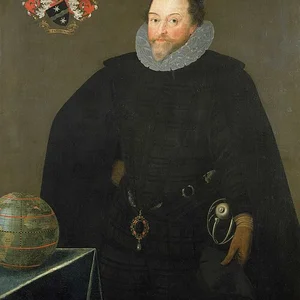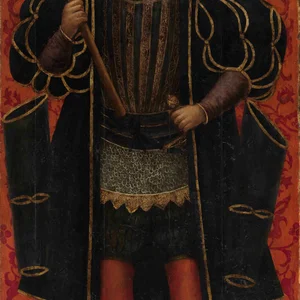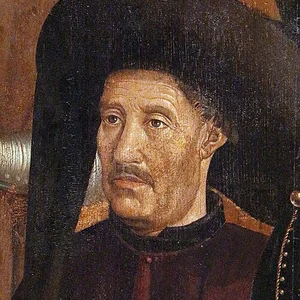

A 15th-century Portuguese prince, son of King John I of Portugal. Although he himself rarely went to sea, he was the great organizer and patron of the expeditions along the coasts of Africa, ushering in the era of the great Portuguese discoveries.
Henry the Navigator(1394 — 1460)
Henry the Navigator
royaume de Portugal
7 min read
Frequently asked questions
Key Facts
- Born on 4 March 1394 in Porto, the third surviving son of King John I of Portugal
- Took part in 1415 in the capture of Ceuta, in North Africa
- Funded the development of the caravel and organized expeditions along the African coasts from Sagres
- In 1434, his captain Gil Eanes rounded Cape Bojador, long considered impassable
- He died on 13 November 1460, having laid the foundations of the Portuguese maritime empire and of Atlantic trade
Works & Achievements
Henry's first feat of arms and the first Portuguese foothold in Africa, the starting point for his interest in maritime expansion.
Here Henry gathered pilots, cartographers, and merchants; without being the legendary “school” sometimes imagined, this hub coordinated expeditions and maritime knowledge.
Settlement and agricultural development of the archipelago (wheat, vines, sugar cane), a model for the future Atlantic colonies.
Discovery and gradual settlement of the islands, a strategic stage on the Atlantic routes.
The culmination of Henry's perseverance: overcoming this obstacle opened up the systematic exploration of the West African coast.
By supporting improvements to ships and maps, Henry laid the technical foundations for the great Portuguese discoveries.
Under his direction, the Portuguese surveyed the coasts as far as Senegal, the Gambia, and Sierra Leone, launching the gold trade and, sadly, the slave trade.
Anecdotes
Despite his nickname, Henry the Navigator almost never went to sea: he took part only in the military expeditions to Ceuta (1415) and Tangier (1437). His role was that of an organizer and financier who, from southern Portugal, sent captains, ships, and cartographers to explore the African coasts.
The nickname “the Navigator” was never given to him during his lifetime: he was called Infante Dom Henrique. It was British and German historians of the 19th century who popularized the expression “Henry the Navigator,” creating the legend as we know it today.
For centuries, sailors dreaded Cape Bojador, on the coast of the Sahara, which they called the “Sea of Darkness”: people believed the water boiled there and that no one ever returned. Henry sent fifteen expeditions before his squire Gil Eanes, in 1434, finally rounded the cape and proved the legend false.
Henry administered the Order of Christ, the Portuguese heir to the Templars, and used its revenues to finance the voyages. This is why the sails of the caravels bore the great red cross of the Order, which became the symbol of the Portuguese discoveries.
In 1444, the first major slave market in Western Europe was held at Lagos, in Portugal: 235 African captives were sold there before Henry's eyes. The chronicler Zurara, though favorable to the prince, described with emotion the weeping of the separated families, bearing witness to the tragic origins of the Atlantic slave trade.
Primary Sources
What heart, however hard, would not be touched with pity at the sight of such a company? Some kept their faces bathed in tears; others moaned, looking up to heaven and imploring it; and when they were divided up, fathers were parted from their sons, wives from their husbands, brothers from their brothers.
He spent his whole life in purity, and his body was always subjected to such toil that he seemed to make little account of rest; beneath his clothes he wore a hair shirt, and he abstained from wine.
The pope grants the King of Portugal and Prince Henry the exclusive right to sail, conquer and trade along the lands discovered south of Cape Bojador, and to reduce to servitude the enemies of the faith found there.
The lord Prince Dom Henry had small caravels fitted out, the finest ships that sail, and sent his captains to explore ever further the unknown coasts of Africa, towards which no one before had dared to venture.
Key Places
City in northern Portugal where the infante Henry was born in 1394.
Muslim stronghold in North Africa conquered by the Portuguese in 1415; it was there that Henry was knighted.
Promontory in the Algarve where Henry established his residence and his navigation center (the Vila do Infante); he died there in 1460.
Port in the Algarve from which Henry's caravels set sail; in 1444 it hosted the first large-scale sale of African captives.
Atlantic archipelago colonized at Henry's instigation from 1419 onward, planted first with wheat and then with sugarcane.
Dreaded cape on the Saharan coast, long thought to be impassable, which Gil Eanes rounded in 1434 on Henry's behalf.
Typical Objects

A small, fast and maneuverable ship with triangular lateen sails that allowed it to sail into the wind. It was the key tool of the expeditions Henry financed along the African coasts.

A metal instrument used to measure the height of the sun or the stars in order to estimate latitude. Henry's pilots began using it to find their bearings far from the coasts.

A magnetized needle pointing north, inherited from Mediterranean sailors. It allowed mariners to hold a course in bad weather or out on the open sea.

A hand-drawn sea chart covered with rhumb lines and the names of ports. Henry gathered cartographers and pilots to keep these surveys of the newly explored coasts up to date.

A large red cross painted on the sails of the caravels. It was a reminder that the Order of Christ, led by Henry, financed the voyages.

A graduated quarter-circle fitted with a plumb line, used to measure the height of the Pole Star. An astronomical navigation tool used by the prince's sailors.

Henry had sugar cane planted on the island of Madeira, which became a rich export crop. This “island sugar” foreshadows the colonial plantation economy.
School Curriculum
Vocabulary & Tags
Key Vocabulary
Daily Life
Morning
A deeply religious prince, Henry began his day with Mass and prayer. He would then receive pilots, captains and merchants to prepare the coming expeditions and to hear accounts of past voyages.
Afternoon
He devoted the afternoon to studying nautical charts and to the affairs of the Order of Christ, whose vast revenues he managed, as well as to the administration of his estates in the Algarve.
Evening
According to Zurara, Henry worked very late into the night and slept little. In the evening, he read, dictated instructions and planned the routes his navigators would follow the next year.
Food
He was said to be abstemious at table: he refrained from wine and ate in moderation. His court, however, sampled the new products brought back from the islands and Africa, such as Madeira sugar.
Clothing
He wore the dark, well-kept garments of a great lord, but concealed a hair shirt beneath his clothing, a mark of Christian penance. The cross of the Order of Christ adorned his insignia.
Housing
He resided mainly in southern Portugal, near Sagres and Lagos, facing the ocean, while also frequenting the royal court in Lisbon for the affairs of the kingdom.
Historical Timeline
Period Vocabulary
Liens externes & ressources
Références
Œuvres
Participation à la conquête de Ceuta
1415
Centre de navigation de Sagres (Vila do Infante)
vers 1420-1460
Colonisation de Madère
à partir de 1419
Colonisation des Açores
à partir de 1427
Franchissement du cap Bojador par Gil Eanes
1434
Patronage de la caravelle et de la cartographie
XVe siècle
Exploration de la côte de Guinée
1434-1460