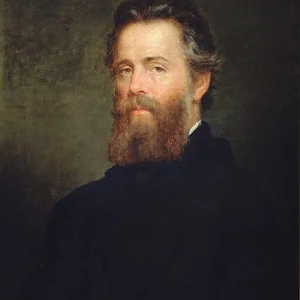

Herman Melville (1819-1891) was an American novelist, short-story writer, and poet. Author of Moby-Dick, a masterpiece of world literature, he drew on his experience as a sailor to explore obsession, evil, and the human condition.
Herman Melville(1819 — 1891)
Herman Melville
États-Unis
6 min read
Frequently asked questions
Famous Quotes
« Call me Ishmael.»
« I would prefer not to.»
Key Facts
- Born on August 1, 1819, in New York into a family of merchants who had fallen into ruin
- Sailed in 1841 aboard the whaler Acushnet, an experience that would nourish his work
- Published Moby-Dick in 1851, a novel at first misunderstood by readers and critics
- Wrote the short story Bartleby, the Scrivener in 1853
- Died in obscurity on September 28, 1891, in New York; his work was rediscovered in the 1920s
Works & Achievements
His first novel, an account of his stay among a people of the Marquesas Islands. A great success that made him famous.
A novel inspired by his first crossing to Liverpool, the coming-of-age story of a young sailor.
His masterpiece: Captain Ahab's obsessive hunt for a white sperm whale. Recognized today as one of the greatest novels in world literature.
A dark and complex novel about an idealistic young man, poorly received by the critics of the time.
A famous short story about a copyist who refuses to work, repeating “I would prefer not to,” a meditation on passivity and the absurd.
A gripping short story centered on a slave revolt aboard a ship, questioning appearance and freedom.
A short novel written at the end of his life and published only after his death, about innocence crushed by military justice.
Anecdotes
In 1841, at the age of 21, Herman Melville signed on to the whaler Acushnet for a whale hunt in the Pacific. This long and grueling life as a sailor would feed almost his entire body of work, and Moby Dick in particular. Without these years at sea, the great white-whale novel would never have existed.
In 1842, weary of the harsh life on board, Melville deserted his ship in the Marquesas Islands and spent several weeks among the Typee people, who were reputed to practice cannibalism. He turned this adventure into his first novel, Typee (1846), which was a great success and made him a fashionable writer.
Moby Dick, published in 1851, was a resounding commercial failure. The public and critics of the time did not understand this strange, philosophical novel. Melville died in 1891 almost forgotten; it was only in the 1920s, thirty years later, that his masterpiece was rediscovered and recognized as one of the greatest American novels.
In 1850, Melville became the friend and neighbor of the writer Nathaniel Hawthorne, author of The Scarlet Letter, in Massachusetts. Full of admiration, Melville dedicated Moby Dick to him. Their long conversations about literature and evil deeply influenced the writing of the novel.
To provide for his family, Melville worked for nearly twenty years (from 1866 to 1885) as a customs inspector at the port of New York, a modest and obscure job. It was during these quiet years that he secretly wrote Billy Budd, Sailor, published only in 1924, long after his death.
Primary Sources
Call me Ishmael.
I would prefer not to.
I have written a wicked book, and feel spotless as the lamb.
The savage is at least exempted from one-half of the miseries to which the civilized man is subject.
Key Places
Melville's birthplace, where he was born in 1819 and died in 1891. He also worked there for many years as a customs inspector.
Farm where Melville lived from 1850 to 1863 and wrote Moby-Dick. From his window he could see Mount Greylock, whose silhouette reminded him of a whale.
Polynesian archipelago where Melville deserted his whaling ship in 1842 and stayed among the Typee people. This journey inspired his first novel.
Major New England whaling port from which the hunting expeditions set out. It is from here that the narrator Ishmael sets sail at the beginning of Moby-Dick.
English port that Melville discovered during his first crossing as a sailor in 1839. This experience fed into his novel Redburn.
Typical Objects

A weapon with a barbed point attached to a long line, thrown by hand to capture sperm whales and whales. It is the central tool of the hunt described in *Moby-Dick*.

A small, fast, slender craft launched from the ship to approach the whale. Several men rowed it while the harpooner took aim.

The everyday writing tools of the nineteenth-century novelist, before the typewriter. Melville wrote his thousands of pages by hand.

Large wooden casks used to store the oil extracted from whale blubber, the main wealth brought back from voyages. This oil was used to fuel lamps for lighting.

Compass, quadrant and sea charts used to find one's way on the open ocean for months at a time. Captain Ahab constantly consults these instruments in *Moby-Dick*.

A prosthesis carved from a sperm whale's jaw, worn by Captain Ahab, who lost his leg to Moby Dick. It symbolizes his wound and his obsession with revenge.
School Curriculum
Vocabulary & Tags
Key Vocabulary
Tags
Daily Life
Morning
During the Arrowhead years, Melville rose early, fed the animals on the farm, then went up to shut himself in his study. There he wrote for long hours, his gaze sometimes resting on the snow-covered mountain that reminded him of a whale.
Afternoon
The afternoon was devoted to continuing his writing or to farm work. Later, in New York, he spent his days on the docks as a customs inspector, checking the cargoes of merchant ships.
Evening
In the evening, Melville read widely — Shakespeare, the Bible, the philosophers — which nourished his imagination. When Hawthorne was his neighbor, they spent long evenings discussing literature and the great questions of existence.
Food
Aboard the whalers, the food was harsh: hard sea biscuits, salted meat, and coffee. On land, in Massachusetts, his family ate the produce of the farm: vegetables, milk, meat, and homemade bread.
Clothing
As a sailor, Melville wore the rough garb of seamen: a thick canvas jacket, sturdy trousers, and a cap. Back on land as a respectable man, he dressed in the bourgeois fashion of the 19th century, in a frock coat, waistcoat, and collared shirt.
Housing
Melville lived sometimes crammed aboard cramped ships, sometimes on the Arrowhead farm, a vast wooden house surrounded by fields. His final years were spent in a modest apartment in New York.
Historical Timeline
Period Vocabulary
Liens externes & ressources
Références
Œuvres
Moby Dick, ou le Cachalot
1851
Pierre ou les Ambiguïtés
1852
Bartleby le scribe
1853
Benito Cereno
1855
Billy Budd, marin
1924