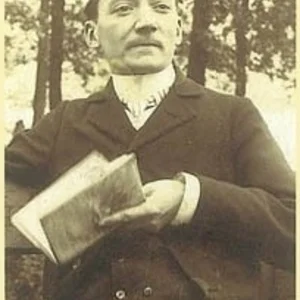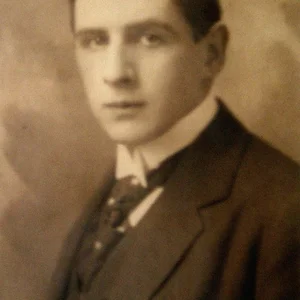

Hermann Broch (1886–1951) was an Austrian writer and essayist, a major figure of German-language literary modernism. Forced into exile by Nazism, he wrote novels that examine the disintegration of European civilization's values.
Hermann Broch(1886 — 1951)
Hermann Broch
États-Unis, Autriche
6 min read
Frequently asked questions
Key Facts
- Born in 1886 in Vienna into a Jewish industrialist family
- Published the novel trilogy *The Sleepwalkers* between 1931 and 1932
- Briefly arrested in 1938 after the Anschluss, then emigrated to the United States
- Published his masterpiece *The Death of Virgil* in 1945
- Died in 1951 in New Haven, Connecticut, USA
Works & Achievements
Novel trilogy tracing the "decomposition of values" in German society from 1888 to 1918. A foundational work that established Broch as a major modernist.
Novel featuring a young mathematician, reflecting Broch's interest in scientific rigor and the quest for knowledge.
Masterpiece composed during exile: the long interior monologue of the dying poet Virgil. A pinnacle of 20th-century lyrical and philosophical fiction.
Novel in stories questioning the passive guilt of those who, through indifference, made the Nazi catastrophe possible.
Major essay on fin-de-siècle Vienna, analyzing the aestheticism and moral emptiness of an era on the brink of collapse.
Unfinished novel about the arrival of a demagogue in a mountain village, a parable on the seduction of crowds by totalitarianism.
Vast theoretical project, left unfinished, on mass psychology and the conditions that lead to totalitarian regimes.
Anecdotes
Before becoming a writer, Hermann Broch managed his father's textile mill near Vienna for nearly twenty years. Only after the age of forty did he sell the factory to devote himself entirely to literature and resume studies in mathematics and philosophy.
After Austria's annexation by Nazi Germany in 1938 (the Anschluss), Broch, of Jewish origin, was arrested and briefly imprisoned in the Alt-Aussee region. Writer friends, including James Joyce, helped him obtain support and a visa to flee Europe.
His masterpiece, "The Death of Virgil," recounts only the last hours of the Roman poet Virgil, agonizing and torn by the desire to burn his great poem, the *Aeneid*. The entire novel consists of this long interior monologue spanning nearly five hundred pages.
The philosopher Hannah Arendt was a close friend of Broch. After his death, she helped publicize his work and edit his texts, seeing him as one of the great witnesses to Europe's intellectual collapse.
Broch's mother, who remained in Europe, died in 1942 in the Theresienstadt camp. This tragedy haunts his later work, which focuses on mass psychology and the mechanisms that make totalitarianism possible.
Primary Sources
Steel-blue and light, driven by a barely perceptible contrary breeze, the waves of the Adriatic rippled to meet the imperial fleet.
The world is given over to the disintegration of values, each domain of life following its own logic without any longer relating to a common meaning.
Vienna at the end of the century was the center of a joyful void, a gay apocalypse where aesthetics took the place of ethics.
Understanding how a human mass can tip into collective madness has become the most urgent task of our time.
Key Places
Broch's birthplace and the capital of a vibrant intellectual Mitteleuropa. He grew up there, ran the family factory, and studied at the university.
Site of the textile mill managed by Broch during the 1910s–1920s. This industrial world fueled his reflections on bourgeois society.
Region where Broch was arrested and briefly imprisoned after the Anschluss in 1938. There he began to conceive “The Death of Virgil.”
A stop in Broch's exile after his flight from Austria in 1938, before his departure for America.
Broch's place of residence in the United States, where he frequented the circle of émigré intellectuals and continued his work.
City where Broch spent his final years, near Yale University, and where he died in 1951.
Typical Objects

Daily tool of the writer in exile, on which Broch typed his novels and essays. He constantly reworked his texts in multiple versions.

Symbol of the family textile mill that Broch managed before dedicating himself to literature. The textile industry represented the bourgeois world he eventually left behind.

At the heart of *The Death of Virgil*, the scroll of the poem that Virgil wants to destroy. It symbolizes the artist's doubt about the value of his work in the face of death.

Vital documents for fleeing Nazi Europe and reaching the United States. For German-speaking exiles, obtaining these papers was a matter of life or death.

The form in which *The Sleepwalkers* and *The Death of Virgil* were published. For Broch, the novel was an instrument of knowledge as much as a work of art.

Familiar object of the intellectual who spent his days reading, writing, and studying mathematics and philosophy. Broch often worked until exhaustion.
School Curriculum
Vocabulary & Tags
Key Vocabulary
Tags
Daily Life
Morning
During his factory days, Broch devoted his mornings to managing the textile mill and business affairs. After becoming a writer, he started early, immersed in writing and study, accumulating readings and notes.
Afternoon
Afternoons were dedicated to intellectual work: writing novels and essays, and studying mathematics, philosophy, and psychology, which he took up later in life. He tirelessly revised his manuscripts.
Evening
In the evening, Broch frequented Viennese literary circles and, later in exile, the circle of émigré intellectuals. He maintained an extensive correspondence and discussed the ideas of his time with friends like Hannah Arendt.
Food
Coming from the Viennese bourgeoisie, Broch was familiar with Central European cuisine, but his lifestyle was frugal. In exile and absorbed in his work, he often neglected meals, to the detriment of his health.
Clothing
Broch wore the sober attire of the bourgeois and intellectual of early 20th-century Europe: a three-piece suit, shirt, and tie—the outfit of an industrialist turned man of letters.
Housing
He first lived in Viennese bourgeois comfort and near the family factory. Exile reduced him to modest, temporary lodgings in the United States, in Princeton and later New Haven, often relying on friends' help.
Historical Timeline
Period Vocabulary
Liens externes & ressources
Références
Œuvres
Die Schlafwandler (Les Somnambules)
1930-1932
Die unbekannte Größe (L'Inconnue)
1933
Der Tod des Vergil (La Mort de Virgile)
1945
Die Schuldlosen (Les Irresponsables)
1950
Hofmannsthal und seine Zeit (Hofmannsthal et son temps)
1947-1948
Die Verzauberung / Der Versucher (Le Tentateur, roman de la montagne)
posthume, années 1950
Massenwahntheorie (Théorie de la folie des masses)
années 1940 (posthume)