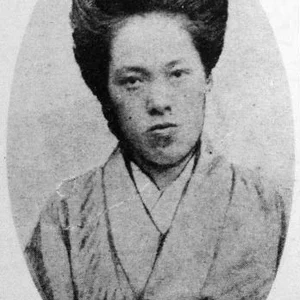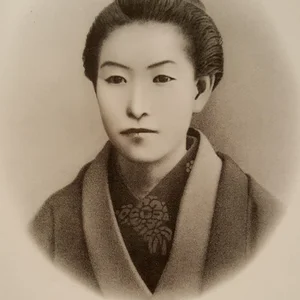

Japanese novelist and poet of the Meiji era (1872–1896), considered one of the greatest writers of modern Japan. Author of major short stories such as Takekurabe, she was the first woman to appear on a Japanese banknote (5,000 yen).
Higuchi Ichiyō
Higuchi Ichiyō (樋口一葉)
9 min read
Frequently asked questions
Famous Quotes
« The world is harsh and sad, and yet one goes on living.»
Key Facts
- Born on May 2, 1872 in Tokyo, died on November 23, 1896 at age 24 from tuberculosis
- Published her most celebrated short story, Takekurabe (Growing Up), in 1895–1896
- Wrote in a style blending classical Japanese and modern vernacular
- First woman honored on a Japanese banknote (5,000 yen, since 2004)
- Produced the bulk of her literary work in less than four years of creative activity
Works & Achievements
Ichiyō's masterpiece, published in serial form in the literary journal *Bungakukai*. This novella follows the awakening into adulthood of a group of children living near the **Yoshiwara** district, capturing with rare delicacy the melancholy of lost innocence and the rigid constraints of social destiny.
A tragic short story centered on **Oriki**, a courtesan torn between an impossible love and her inability to escape her lot in life. The work denounces with remarkable subtlety the inequalities weighing on women in **Meiji**-era Japanese society.
A poignant short story about a woman who gives up seeking a divorce so as not to bring shame on her family. Ichiyō deftly explores the conflict between the desire for female emancipation and the family and social constraints of the time.
A realist short story depicting the dilemma of a young maidservant forced to steal in order to help her family on New Year's Eve. This work marks the turning point toward Ichiyō's literary maturity and reflects her interest in Western-inspired realist literature.
One of Ichiyō's last short stories, published just a few months before her death. It tells the story of a woman who sacrifices her own happiness out of a sense of duty — a recurring theme in Ichiyō's work, which constantly meditates on female freedom and constraint.
Kept from the age of fifteen until her death, this diary is regarded as a literary work in its own right. With striking lucidity, it documents her struggles against poverty, her literary aspirations, and her vision of women's condition in modern Japan.
Anecdotes
To support her impoverished family, Higuchi Ichiyō opened a small candy and school supplies shop in the Maruyamacho district, just steps from the brothels of Yoshiwara. It was by observing every day the children growing up in the shadow of this forbidden quarter that she drew inspiration for her masterpiece Takekurabe, where she captures with rare delicacy the melancholy of the passage from childhood to adulthood.
Higuchi Ichiyō produced nearly all of her major work in just fourteen months, between 1894 and 1896, while she was already suffering from tuberculosis. She died on November 23, 1896, at the age of twenty-four, leaving behind a body of literature admired by the greatest writers of her time, such as Mori Ōgai and Kōda Rohan.
In 2004, the Japanese 5,000-yen banknote was adorned with the portrait of Higuchi Ichiyō, making her the first woman to appear on a banknote in Japan. This highly symbolic choice, more than a century after her death, recognizes her status as a national figure in Japanese literature and her pioneering role for women writers.
Despite her modest circumstances, Ichiyō was admitted to the prestigious Haginoya poetry school, led by the master Nakajima Utako, one of the great poets of the Meiji era. In these literary circles frequented by daughters of wealthy families, Ichiyō distinguished herself through her exceptional talent for waka, the classical Japanese poetry form of 31 syllables.
Higuchi Ichiyō kept a personal diary from the age of fifteen until her death, a document of both personal and literary significance with great historical value. This nikki, written in a careful classical style, reveals her doubts, her ambitions, her financial hardships, and her lucid vision of the condition of women in Meiji-era Japan — to the point that it is now considered a literary work in its own right.
Primary Sources
The children of the neighborhood gather every day to play, still unaware of the invisible boundaries the adult world has drawn around them. But time passes, and soon each will come to understand that the paths opening before them were already decided by their birth.
Oriki receives her clients with laughter and sake, but deep in her eyes shines a sadness no one wants to see. She is a prisoner of a world she cannot escape, and the love she holds for Genshichi will bring her nothing but misfortune.
She had come to her parents' home to ask for a divorce, the words of her grievance ready to spill out, but seeing the tears on her old father's face, she understood she could never speak them. The night of the thirteenth moon is one when the deepest sorrows are swallowed back down.
I have neither wealth nor powerful connections, but my pen is all I possess. As long as I live, I will write what I see and what I feel, so that my words may outlast my life better than my life itself can.
Key Places
Higuchi Ichiyō was born in the Ushigome district of Tokyo, into a family of former samurai who had become civil servants. It was in this rapidly transforming urban environment that her relationship with both traditional and modern Japan took root.
The neighborhood where Ichiyō ran her small shop from 1893 to 1894, steps away from the famous Yoshiwara pleasure district. Her daily observation of the children and women living in the shadow of that forbidden world directly inspired the characters and atmosphere of *Takekurabe*.
A *waka* poetry school founded by Nakajima Utako, where Ichiyō studied from 1887. This place gave her access to the literary circles of the Meiji era and allowed her to refine the classical style that defines her entire body of work.
Higuchi Ichiyō has been buried here since her death in November 1896. The cemetery is the resting place of several major figures of Japanese culture, and Ichiyō's grave has become a pilgrimage site for readers and literature enthusiasts.
The Higuchi family lived for several years in this intellectual quarter of Tokyo, close to the Imperial University. It was here that Ichiyō grew up, continued her literary education, and began moving in the capital's writers' circles.
Typical Objects

Ichiyō wrote her stories and diary by hand, with a brush, in the classical calligraphic style. India ink, diluted on a stone inkwell (suzuri), was the daily tool of every Japanese scholar during the Meiji era.

This 8th-century Japanese poetry collection was among the foundational texts studied at the Haginoya school. Ichiyō read it diligently to refine her mastery of waka and the classical language, whose richness permeates her entire body of work.

Due to her family's poverty, Ichiyō wore modest cotton kimonos with understated patterns, far removed from the embroidered silks worn by wealthy women. Her clothing reflected the social divide she crossed daily by moving in aristocratic literary circles.

To manage the meager finances of her shop and household, Ichiyō used a soroban, the traditional Japanese abacus. The laborious end-of-month calculations — a central theme of her story *Ōtsugomori* — bear witness to her daily struggle against poverty.

Ichiyō often wrote in the evening by the light of a paper-and-bamboo oil lamp (andon), unable to afford electric lighting, which was still rare and costly in Tokyo. This flickering light accompanied her long writing vigils in the family home.

Ichiyō recorded her waka compositions in special notebooks called utachou. The regular practice of classical poetry was for her both a literary exercise in style and a way of coming to terms with the melancholy of her existence.
School Curriculum
Vocabulary & Tags
Key Vocabulary
Daily Life
Morning
Ichiyō rose early to help her mother with household chores: lighting the fire, preparing the morning rice, and tending to the modest family home. These daily tasks, shared with her mother and sister since her father's death in 1889, invariably set the rhythm of her mornings before any literary work could begin.
Afternoon
Afternoons were devoted to reading Japanese classics — the Man'yōshū, the Genji Monogatari, Sei Shōnagon's Pillow Book — and to drafting her short stories. During the shop year (1893–1894), she also served customers and closely observed the residents of the Yoshiwara district, whose lives fed her imagination.
Evening
Evenings were given over to creative writing and the composition of waka poems, by the light of an oil lamp. Ichiyō also kept her diary at night, recording reflections, financial hardships, and notes on her reading. Fatigue and money worries often cast a shadow over these studious evening hours.
Food
Ichiyō's diet was frugal and typically Japanese: boiled rice, pickled vegetables (tsukemono), miso soup, and only occasionally dried fish. The family's poverty often reduced meals to their barest essentials, and periods of real scarcity were not uncommon in the Higuchi household.
Clothing
Ichiyō wore simple cotton kimonos (komon) in muted tones and understated patterns, befitting her modest circumstances. She could not afford the silks or the wide embroidered obi worn by the wealthy women she encountered at the Haginoya school. Her clothes, carefully kept despite their wear, spoke of a dignity maintained in the face of hardship.
Housing
The Higuchi family lived in small rented wooden houses in Tokyo, moving several times as financial difficulties mounted. The rooms were few, with tatami-covered floors and minimal furnishings: a low writing desk (chabudai), futons stored away during the day, and a few shelves for books and manuscripts.
Historical Timeline
Period Vocabulary
Liens externes & ressources
Références
Œuvres
Takekurabe (たけくらべ — Qui grandira le plus ?)
1895-1896
Nigorie (にごりえ — Eaux troublées)
1895
Jūsan'ya (十三夜 — La treizième nuit)
1895
Ōtsugomori (大つごもり — Le dernier jour de l'année)
1894
Warekara (われから — De moi-même)
1896
Journal intime (日記 — Nikki)
1887-1896