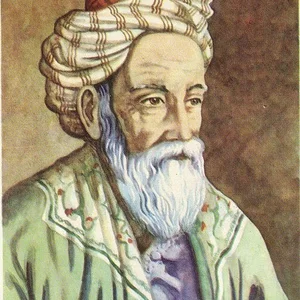

An 11th-century Persian poet, mathematician, and astronomer, Omar Khayyam is celebrated for his quatrains (the Rubaiyat) and his work in algebra. He reformed the Persian calendar and solved cubic equations using geometric methods.
Omar Khayyam(1048 — 1131)
Omar Khayyam
Empire seldjoukide
7 min read
Frequently asked questions
Famous Quotes
« A loaf of bread, a jug of wine, a book of verses — and thou beside me singing in the wilderness.»
« The eternal secret is known neither to you nor to me.»
Key Facts
- Born around 1048 in Nishapur (present-day Iran), died around 1131
- Wrote the Treatise on Demonstration of Problems of Algebra (around 1070), classifying cubic equations
- Reformed the Persian calendar in 1079 under Sultan Malik-Shah, creating the remarkably accurate Jalali calendar
- Composed the Rubaiyat, a collection of philosophical and poetic quatrains translated worldwide in the 19th century
- Worked on the theory of ratios and anticipated certain concepts of infinitesimal calculus
Works & Achievements
A collection of Persian quatrains meditating on time, death, pleasure, and fate. Translated into English by FitzGerald in 1859, they made Khayyam one of the most widely read poets in the world.
The first systematic work on cubic equations, solved geometrically through the intersection of conic sections. It represents a major milestone in the history of mathematics.
A remarkably precise solar calendar commissioned by Sultan Malik-Shah. Still in use today in Iran and Afghanistan under the name of the Solar Hijri calendar.
A critical analysis of Euclid's fifth postulate (the parallel postulate), anticipating by several centuries the ideas that would lead to the development of non-Euclidean geometries.
A treatise on the origins and significance of the Persian New Year celebration (Nowruz), blending astronomy, history, and political wisdom.
Reflections on balance and the measurement of densities, situated within the tradition of natural sciences inherited from Aristotle and developed by Islamic scholars.
Anecdotes
Omar Khayyam was commissioned by the Seljuk sultan Jalal al-Din Malik-Shah I to reform the Persian calendar. He led a team of astronomers and devised the Jalali calendar in 1079, so precise that it loses only one day every 3,770 years — more accurate than today's Gregorian calendar.
According to a famous anecdote recorded by Nizami Aruzi, Khayyam reportedly made a youthful pact with two friends, Nizam al-Mulk and Hassan ibn Sabbah: whoever succeeded first would help the others. When Nizam became vizier, he granted Khayyam a stipend for his studies and offered Hassan a government post — Hassan went on to become the founder of the Assassins, one of the most feared sects of the medieval world.
Khayyam solved cubic equations (third-degree equations) using geometric methods, specifically the intersection of conic sections. He was the first to produce a systematic classification of them, anticipating European algebraists by several centuries. He himself acknowledged that he did not know how to solve these equations by purely algebraic means.
His Rubaiyat (Persian quatrains) were largely overlooked in the East for centuries, then became a worldwide literary phenomenon thanks to the free translation by English poet Edward FitzGerald in 1859. The translation was a sensation in Europe and America, establishing Khayyam as a towering figure in world poetry.
Primary Sources
"I have shown how to find the sides of the square and the cube [...] by relying on the properties of conic sections, so as to solve all third-degree equations."
"A loaf of bread, a flask of wine, a book of verse, and thou beside me in the wilderness — and wilderness were paradise enow."
"The king must know the stars and the seasons, for it is upon them that the order of the year and the prosperity of the kingdom depend."
"The parallel postulate cannot be proved without admitting something equivalent to it; it must therefore be accepted as a principle."
Key Places
Khayyam's birthplace, one of the most important intellectual and commercial metropolises of the medieval Islamic world. It is here that he was born, studied, and died.
The Seljuk capital where Khayyam worked at the royal observatory under the patronage of Sultan Malik-Shah, carrying out the calculations that led to the reform of the Jalali calendar.
A great city of Central Asia and a major intellectual center where Khayyam spent time deepening his knowledge of mathematics and astronomy.
Capital of the Abbasid Caliphate and a world center of learning in the Middle Ages, where the works that shaped Khayyam's intellectual formation circulated widely.
A city near Khorasan and an important hub in the Persian intellectual tradition, associated with the transmission of Greek and Indian knowledge into the Islamic world.
Typical Objects

An astronomical instrument for measuring the position of stars, essential to Khayyam's work on the calendar and the equinoxes. It was used to calculate the time, latitude, and celestial positions.

The writing tools of the medieval Persian scholar, used to compose both poetic quatrains and mathematical proofs on paper.

Arithmetic tools used in teaching and solving equations, at a time when Arabic algebra was experiencing its golden age.

Geometric instruments with which Khayyam constructed intersections of conic sections to solve cubic equations, extending the Euclidean tradition.

A recurring object in the Rubaiyat as a symbol of savoring the present life and mystical contemplation; wine serves as both a spiritual metaphor and a tangible pleasure.

A mechanical model of the celestial sphere used by medieval astronomers to visualize and calculate the movements of the planets and the sun.
School Curriculum
Vocabulary & Tags
Key Vocabulary
Tags
Daily Life
Morning
Khayyam rose before dawn to observe the sky and record the positions of stars, an activity essential to his astronomical work. After the morning prayer, he devoted the early hours of the day to writing up his calculations and mathematical proofs, in the relative cool of the scriptorium.
Afternoon
Afternoons were dedicated to teaching in the madrasas or to scholarly discussions with other learned men. At the Isfahan observatory, he supervised celestial measurements and discussed results with his team of astronomers under the sultan's patronage.
Evening
In the evenings, following the Persian tradition of the majlis (cultivated gatherings), Khayyam would recite or compose quatrains, share wine with learned friends, and meditate on the brevity of life — themes that pervade his Rubaiyat. The starry night served him both as a field of scientific observation and as a source of poetic inspiration.
Food
Like the Persian scholars of his class, Khayyam ate wheat bread, rice, legumes, dried fruits (dates, figs, raisins), mutton, and poultry. Wine, mentioned throughout his quatrains, was consumed in cultivated circles despite religious prohibitions, often associated with a Sufi mystical dimension.
Clothing
Khayyam wore the dress of a Persian scholar and courtier: a long robe (qaba) of wool or fine cotton, a white turban, and a cloak (jubba) for official audiences. In winter, furs and heavy fabrics provided protection against the cold of the Iranian plateau.
Housing
In Nishapur and Isfahan, Khayyam most likely resided in a house built around an inner courtyard with a fountain, typical of medieval Persian architecture. The personal library and study — the central space of a scholar's life — held an essential place in this type of dwelling. At the Isfahan observatory, he had a dedicated space for astronomical instruments.
Historical Timeline
Period Vocabulary
Visual Style
Style miniature persane de l'époque seldjoukide, avec arabesques géométriques, lapis-lazuli et or, évoquant la rencontre entre science, poésie et art islamique.
Sound Ambience
Ambiance feutrée d'un scriptorium et d'un observatoire persan médiéval, mêlant le silence studieux du savant, le chant du muezzin et la mélodie mélancolique d'une flûte ney.