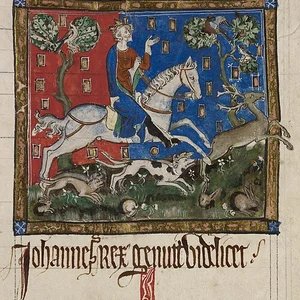

King of England from 1199 to 1216, son of Henry II and Eleanor of Aquitaine. He lost most of the Plantagenet continental possessions to Philip Augustus and was forced to sign Magna Carta in 1215.
John Lackland(1166 — 1216)
John Lackland
royaume d'Angleterre
7 min read
Frequently asked questions
Key Facts
- 1199: Becomes King of England upon the death of his brother Richard the Lionheart
- 1204: Loses Normandy and much of the continental territories to Philip Augustus
- 1209: Excommunicated by Pope Innocent III following the dispute over the appointment of the Archbishop of Canterbury
- 1215: Signs Magna Carta, the first document limiting royal power in England
- 1216: Dies in the midst of the First Barons' War
Works & Achievements
Signed under duress, this charter of 63 articles laid the foundations of constitutional law by curbing arbitrary royal power. It is considered one of the founding texts of British liberties and Western constitutionalism.
John greatly expanded the English royal bureaucracy by systematizing the keeping of chancery rolls. These records are an exceptional historical source and bear witness to a remarkably well-documented centralized government for the period.
John granted a borough charter to Liverpool, then a small fishing village, to develop it into a strategic port for Ireland. This administrative decision laid the groundwork for what would become one of Britain's greatest cities.
John's first major diplomatic act, this treaty recognized Philip II Augustus as overlord of his French lands in exchange for peace. It fixed the borders between the two kingdoms but permanently weakened the Plantagenet position.
Anecdotes
John received the nickname “Lackland” because he was the youngest of Henry II’s sons and stood to inherit no territory at the time of his birth in 1166. His father eventually granted him the lordship of Ireland, but the epithet stuck — a label that clung to him for eternity.
In 1203–1204, Philip Augustus seized almost all of Plantagenet Normandy, including the supposedly impregnable fortress of Château Gaillard built by Richard the Lionheart. John, unable to raise a strong enough army, abandoned his Norman barons to their fate — a humiliation that earned him the mocking nickname “Softsword.”
The mysterious death of Arthur of Brittany, John’s nephew and rival claimant to the throne captured in 1202, remains one of the great unsolved mysteries of the reign. Chroniclers accused John of killing him with his own hands in a fit of rage, and this rumor permanently blackened his reputation among his contemporaries.
On 15 June 1215, cornered by his rebellious barons at Runnymede on the banks of the Thames, John signed Magna Carta — a charter limiting royal power and guaranteeing rights to free men. He repudiated it by autumn, but the document would go on to become one of the cornerstones of British constitutional law.
John Lackland entered legend as the tyrannical king of the Robin Hood tales, the enemy of the poor and the oppressed during his brother Richard’s absence on crusade. Although these stories are largely fictional, they reflect the ill repute he earned through his heavy taxes and authoritarian methods.
Primary Sources
We have granted to all free men of our kingdom, for ourselves and our heirs in perpetuity, all the liberties written below, to have and to hold, them and their heirs, from us and our heirs.
King John, on hearing this news, was seized with such rage and anguish that he committed acts of madness, gnawing at sticks and straws and chewing them like a lunatic.
John was a most faithless and cruel king, an enemy of justice, an oppressor of the nobility, a persecutor of the Church, and a tyrant to his people.
The King of England summoned his barons and asked them to help him recover his lost lands in Normandy, but they refused to cross the sea unless he restored their rights.
Key Places
A meadow on the banks of the Thames where John signed Magna Carta on 15 June 1215, cornered by his rebelling barons. The site is now regarded as a founding location of British constitutional law.
A fortress built by Richard the Lionheart to protect Rouen, which fell to Philip II of France in 1204 after a siege lasting several months. Its capture symbolised the collapse of the Plantagenet empire in France.
A fortified royal residence and symbol of Plantagenet power in England. John stayed there on numerous occasions, and it was there that the rebel barons besieged him at the outset of the First Barons' War.
Capital of the Duchy of Normandy, lost permanently to Philip II of France in June 1204. Its surrender marked the end of Plantagenet dominion over northern France.
Capital of the Lordship of Ireland, the one major territory John received as an appanage — and the one that, ironically, earned him the nickname "Lackland". He led an expedition there in 1210 to reinforce English authority.