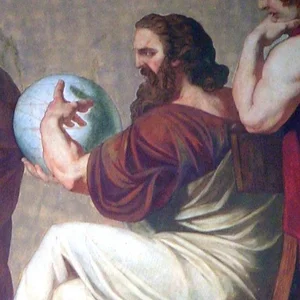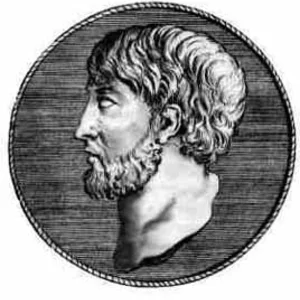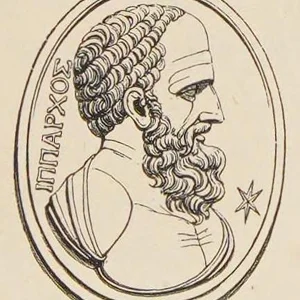

Hipparchus of Nicaea was a Greek astronomer, geographer, and mathematician of the 2nd century BC. Regarded as the greatest astronomer of antiquity, he discovered the precession of the equinoxes and compiled the first major star catalogue. He is also one of the founders of trigonometry.
Hipparchus of Nicaea(189 av. J.-C. — 119 av. J.-C.)
Hipparchus
royaume de Pergame
7 min read
Frequently asked questions
Key Facts
- Born around 190 BC in Nicaea (Bithynia), he worked mainly on the island of Rhodes.
- Discovered the precession of the equinoxes around 130 BC by comparing his observations with those of his predecessors.
- Compiled the first complete star catalogue of antiquity (about 850 stars) and invented the scale of magnitudes.
- Founder of trigonometry: he established the first table of chords.
- Accurately measured the length of the tropical year and the Earth-Moon distance; died around 120 BC.
Works & Achievements
Demonstration of the slow shift of the equinoctial points along the zodiac, one of the greatest discoveries of ancient astronomy.
The first great systematic stellar catalogue, recording the position and brightness of about 850 stars; a model for all later catalogues.
A classification of stars by their brightness, from 1st to 6th magnitude; a system still used today, in modernized form, by astronomers.
The construction of the first tables relating angles to lengths, making Hipparchus one of the founders of trigonometry.
An estimate of the Moon's distance at about 60 Earth radii from the observation of eclipses, a result very close to the true value.
The only work of Hipparchus preserved in full; in it he corrects the descriptions of the sky given by earlier poets and scholars on the basis of observation.
A critique of Eratosthenes' maps and an argument for fixing places by latitude and longitude by means of astronomical observations.
Determination of the length of the tropical year to within a few minutes of the exact value, refining the calendar.
Anecdotes
By comparing his own observations with those of Babylonian astronomers from more than a century earlier, Hipparchus noticed that the positions of the stars had shifted slightly: he had just discovered the precession of the equinoxes, that slow spinning-top motion of Earth's axis which takes about 26,000 years to complete a single turn.
According to Pliny the Elder, it was the appearance of a “new star” in the sky that prompted Hipparchus to compile a vast catalogue of stars: he wanted future generations to be able to check whether other heavenly bodies were being born or vanishing. In this way he recorded nearly 850 stars along with their positions.
Hipparchus invented a scale of “magnitudes” to classify stars according to their brightness, from the 1st magnitude (the brightest) to the 6th (the faintest visible to the naked eye). The idea is so robust that astronomers still use it today, in a modernized form.
To calculate the distance to the Moon, Hipparchus relied on observations of a single solar eclipse seen from two distant locations: total at the Hellespont, partial at Alexandria. His measurement, about 60 Earth radii, is remarkably close to the true value.
Hipparchus is credited with constructing tables of chords, the ancestors of our trigonometric tables. In seeking to measure the heavens, he unknowingly laid the foundations of an entire branch of mathematics: trigonometry.
Primary Sources
Hipparchus, in his work On the Displacement of the Solstitial and Equinoctial Points, concludes from his observations that the sphere of the fixed stars also performs a backward motion along the zodiac.
Hipparchus dared a thing difficult even for a god: to count the stars for posterity and to catalogue them by their names, having invented instruments to mark the position and the magnitude of each one.
On many points, Eudoxus and Aratus depart from what is actually seen in the sky; their indications must therefore be corrected according to observation.
Hipparchus shows that it is impossible for anyone, geographer or not, to know the exact positions of places without resorting to the observation of celestial phenomena, eclipses, and latitudes.
Key Places
Greek city in Asia Minor (today İznik, in Turkey) where Hipparchus was born. His nickname “of Nicaea” recalls this origin.
Island in the Aegean Sea where Hipparchus carried out most of his astronomical observations and probably died. Its clear skies made it an excellent observatory.
Great city of learning in Egypt, home to the Library and the Museum. Hipparchus is said to have observed there and had access to Babylonian and Greek astronomical records.
Major intellectual center preserving Greek treatises and observational data. It provided Hipparchus with the ancient measurements that revealed the precession of the equinoxes.
Typical Objects

A graduated instrument used to measure the position of celestial bodies above the horizon. Hipparchus is thought to have refined such devices in order to establish the coordinates of the stars.

A model made of rings representing the great circles of the sky (equator, ecliptic, meridians). It was used to depict and measure the apparent motion of the celestial bodies.

A simple vertical rod casting a shadow, used to measure the height of the Sun and to identify the solstices and equinoxes. A basic tool of the ancient astronomer.

A numerical table giving the length of chords for different angles, the ancestor of trigonometric tables. Hipparchus is said to have been its pioneer.

A compilation recording the position and brightness (magnitude) of about 850 stars. The first great systematic star catalogue in history.

A writing surface on which Greek scholars recorded calculations, observations and treatises. Hipparchus wrote his works on it, almost all of which are now lost.
School Curriculum
Vocabulary & Tags
Key Vocabulary
Daily Life
Morning
At daybreak, the astronomer rests after a night of observation and records his measurements on papyrus scrolls. The morning is spent on meticulous calculations, comparing his measurements to the Babylonian tables and to the observations of his predecessors.
Afternoon
The afternoon is devoted to mathematical work and to refining his instruments. Hipparchus checks his tables of chords, draws geometric figures, and perhaps discusses matters with other scholars passing through Rhodes.
Evening
As night falls, the essential moment begins: the observation of the sky. From an open terrace, Hipparchus measures the altitude of the stars, notes the appearance of the constellations, and watches for any unusual phenomenon, a comet or a new star.
Food
Like the Greeks of his time, he eats mainly barley or wheat bread, olives, figs, cheese, and dried pulses. Wine diluted with water accompanies the meals, with fish and fruit rounding out the everyday fare of a cultivated man of the Aegean cities.
Clothing
He wears the tunic (*chiton*) of linen or wool, covered by a draped cloak (*himation*) when going out. Leather sandals and a well-kept beard complete the look of the Greek scholar of the Hellenistic era.
Housing
He probably lives in a house of stone and mud brick organized around an inner courtyard, typical of the Greek cities. A terrace or flat roof serves as his observation post, sheltered from the lights and offering an unobstructed view of the horizon.
Historical Timeline
Period Vocabulary
Liens externes & ressources
Références
Œuvres
Découverte de la précession des équinoxes
vers 130 av. J.-C.
Catalogue d'étoiles
vers 129 av. J.-C.
Échelle des grandeurs stellaires
IIe siècle av. J.-C.
Tables de cordes (fondements de la trigonométrie)
IIe siècle av. J.-C.
Mesure de la distance Terre-Lune
IIe siècle av. J.-C.
Commentaire sur les Phénomènes d'Aratos et d'Eudoxe
IIe siècle av. J.-C.
Travaux de géographie critique
IIe siècle av. J.-C.