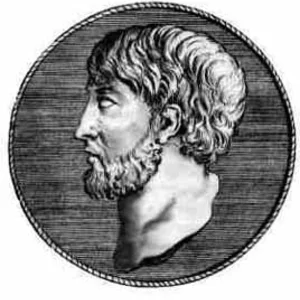

Anaximenes is a Pre-Socratic Greek philosopher of the Milesian school, active in the 6th century BC. A disciple of Anaximander, he held that air (pneuma) was the first principle of all things.
Anaximenes(584 av. J.-C. — 527 av. J.-C.)
Anaximenes
6 min read
Frequently asked questions
Key Facts
- Born around 585 BC in Miletus, died around 525 BC
- Third great figure of the Milesian school after Thales and Anaximander, whose disciple he was
- Posits air (aer) as the single principle (arche) of all things
- Explains the diversity of the world through the rarefaction and condensation of air
- Seeks a natural (rather than mythological) explanation of the phenomena of the cosmos
Works & Achievements
Treatise, now lost and known only through fragments, in which Anaximenes set out his cosmology. Tradition emphasizes that he wrote it in a simple, clear Ionian prose.
Anaximenes makes infinite air the single source of all things, going beyond Anaximander's “indeterminate” with a concrete and observable substance.
First explanation of the transformations of matter through a physical process: the varying density of one and the same substance gives rise to fire, air, wind, water, earth, and stone.
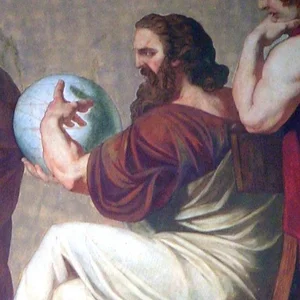
He describes a flat Earth supported by air and heavenly bodies floating like leaves, born from the exhalations of the Earth — an attempt to explain the sky without recourse to the gods.
Anaximenes draws the soul (psychê), the breath that keeps us alive, close to the air that envelops the world, sketching a link between humankind and the cosmos.
Anecdotes
Anaximenes thought the whole universe was made of air, but an air capable of transforming itself: by condensing it became wind, then cloud, then water, then earth and finally stone, and by thinning out it became fire. It was an ingenious way of explaining the diversity of the world from a single substance.
To show that heat and cold depend on the density of air, Anaximenes invited people to observe their own breath: when you blow with your lips pressed together, the air comes out cold (it is compressed); when you blow with your mouth wide open, it comes out warm (it is relaxed). A little experiment that anyone can still try today.
Anaximenes imagined that the Earth was flat like a table and that it floated on the air, carried along like a leaf. He also believed that the Sun, the Moon and the stars were born from vapors rising off the Earth and that they too floated, like leaves of fire.
A disciple of Anaximander, who was himself a disciple of Thales, Anaximenes forms the third link in the famous school of Miletus. These three thinkers are often called the first "physicists" because they sought to explain nature through natural causes rather than through the gods.
Anaximenes lived through the tragic end of Miletus: according to tradition, his activity comes to a close just as the Ionian city falls under Persian rule. The great adventure of the earliest Greek philosophy thus unfolds against the backdrop of the rising Persian empire.
Primary Sources
Anaximenes and Diogenes hold that air is prior to water and is the principle par excellence among the simple bodies.
Anaximenes of Miletus, son of Eurystratus, a companion of Anaximander, says like him that the underlying nature is one and infinite, but not undefined as Anaximander held: he defines it as being air.
Anaximenes thought that what contracts and condenses in matter is cold, whereas what is loose and relaxed — he used this very word — is hot.
Anaximenes declared that the principle is infinite air, from which arise the things that are, that have been and that will be, as well as the gods and divine things, the rest coming from its products.
Key Places
Wealthy Greek city of Ionia, on the coast of Asia Minor, birthplace of the first philosophy. Anaximenes was born, taught, and died there.
Region of the Greek cities along the Aegean coast of Asia Minor, a cultural and commercial hub where the thought of the Presocratics flourished.
Public square where the market and discussions were held; the likely place where Anaximenes exchanged ideas with his students and fellow citizens.
Capital of the kingdom of Lydia and later of the Persian satrapy, a center of regional power that dominated Ionia after 546 BC.
Great sanctuary of Apollo near Miletus, famous for its oracle; a major religious site of the Ionian region in the time of Anaximenes.
Typical Objects

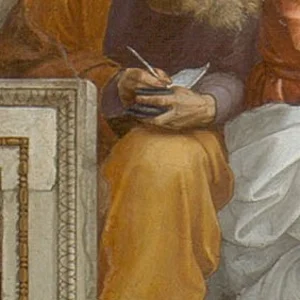
A small wooden tablet coated with wax on which one scratched notes with a stylus to jot down and erase thoughts. The everyday tool of the Greek thinker for sketching out his reasoning.

A writing surface imported from Egypt on which the earliest philosophers recorded their treatises *On Nature*. The book of **Anaximenes** circulated in this form.

A simple rod planted vertically whose shadow makes it possible to measure time and follow the course of the Sun. An astronomical instrument inherited by the Milesians from the Babylonians.

A leather bag swollen with air, a concrete image of **Anaximenes**'s principle: air, invisible yet quite real, able to occupy and support space.

A large piece of wool draped over the body, the characteristic garment of the Greek citizen and philosopher. **Anaximenes** is said to have worn it to teach in the agora.

A small clay lamp burning olive oil, which lit up evenings of study and discussion. For **Anaximenes** the flame illustrated air at its most rarefied turned into fire.
School Curriculum
Vocabulary & Tags
Key Vocabulary
Tags
Daily Life
Morning
At daybreak, Anaximenes most likely heads to the bustling harbor of Miletus or to the agora, observing the sky, the winds, and the sea. The morning is ideal for watching the stars as they fade and for discussion with his students.
Afternoon
The afternoon is spent teaching and exchanging ideas: he comments on nature, perhaps sketches his diagrams of the cosmos on a tablet, and answers his disciples' questions. He carries on the tradition of Anaximander while adding his own ideas.
Evening
In the evening, by the light of an oil lamp, he might write a few lines of his treatise *On Nature* or share a meal among friends. The clear Ionian night offers a magnificent stage for watching the stars.
Food
Like every Greek of his time, he eats mainly barley or wheat bread, olives, goat cheese, dried legumes, and fish, which is plentiful along the coast. Wine diluted with water accompanies the meals.
Clothing
He wears a linen or wool tunic (*chiton*) covered by a large draped cloak (*himation*), with leather sandals. His well-kept beard and hair mark him as a free and respected man.
Housing
He lives in a modest Greek house of mud brick and stone, organized around an inner courtyard. The rooms are plain, opening onto the light of the Mediterranean.
Historical Timeline
Period Vocabulary
Liens externes & ressources
Références
Œuvres
Sur la nature (Peri physeôs)
VIe siècle av. J.-C.
La théorie de l'air comme principe (archè)
VIe siècle av. J.-C.
Le mécanisme de condensation et raréfaction
VIe siècle av. J.-C.
Cosmologie de la Terre et des astres flottants
VIe siècle av. J.-C.
Théorie de l'âme-souffle
VIe siècle av. J.-C.