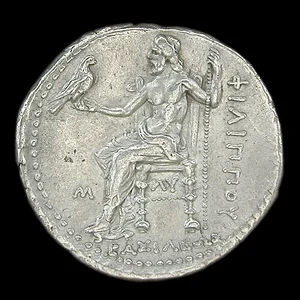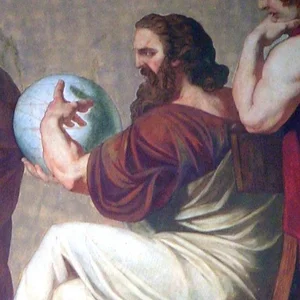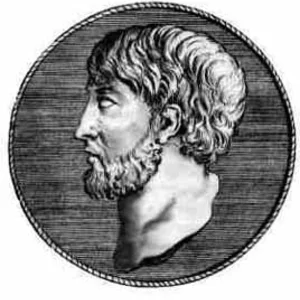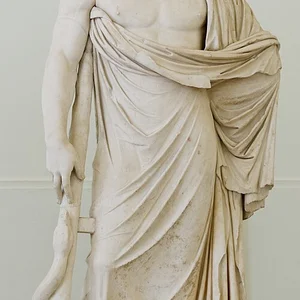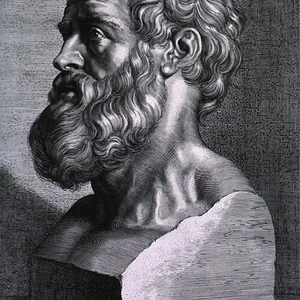

Greek physician of the 5th century BC, considered the "father of medicine". He established a rational and empirical approach to medicine, separating it from religious and magical practices. His body of work, the Hippocratic Corpus, has influenced Western medicine for more than two millennia.
Hippocrates(459 av. J.-C. — 369 av. J.-C.)
Hippocrates
8 min read
Frequently asked questions
Famous Quotes
« Primum non nocere (First, do no harm).»
« Let food be thy medicine.»
« Life is short, art is long, opportunity fleeting, experience treacherous, judgment difficult.»
Key Facts
- Born around 460 BC on the island of Cos (Aegean Sea)
- Founded a school of medicine on Cos, breaking away from temple medicine
- Wrote or inspired the Hippocratic Corpus, a collection of around sixty medical treatises
- Developed the theory of the four humors (blood, phlegm, yellow bile, black bile)
- The Hippocratic Oath, cornerstone of medical ethics, bears his name to this day
- Died around 370 BC in Larissa (Thessaly)
Works & Achievements
The founding text of medical ethics, setting out a physician's duties toward patients: do no harm, respect confidentiality, and refuse any harmful act. Still taken in adapted form by doctors around the world today.
A collection of 412 medical maxims condensing Hippocratic clinical experience, including the famous "Life is short, art is long." One of the most widely read and copied medical texts from Antiquity through the Renaissance.
The first treatise on environmental medicine: Hippocrates demonstrates that climate, water, and geography directly influence health. This text foreshadows modern epidemiology and medical geography.
A groundbreaking treatise arguing that epilepsy, known as the "sacred disease," has a natural cause (the brain) rather than a divine one. It is one of the founding acts in the separation of medicine from religion.
A treatise on the art of predicting the course of a disease through observation of symptoms, notably the famous "Hippocratic facies." It lays the groundwork for systematic and rigorous clinical observation.
A collection of 60 to 70 medical treatises written by Hippocrates and his disciples, covering surgery, dietetics, gynecology, and epidemiology. This medical encyclopedia dominated Western and Arabic medicine for over two thousand years.
Anecdotes
Hippocrates was born around 460 BC on the island of Cos, into a family that claimed descent from the god Asclepius. Yet rather than relying on this divine prestige, he devoted his entire life to proving that disease had natural causes, not supernatural ones — a revolutionary break from the thinking of his time.
He is credited with the careful observation of the 'Hippocratic facies': the face of a dying person shows drawn features, a pinched nose, hollow temples, and sunken eyes. This clinical description, remarkably precise, still appears in modern medical textbooks under that same name.
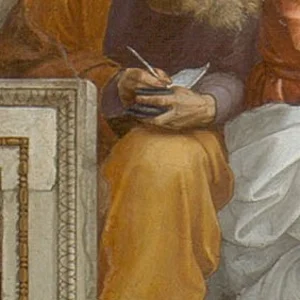
Hippocrates taught outdoors, beneath a large plane tree on the island of Cos. This tree, still visible today (though the current tree is far more recent), has become a symbol of the transmission of medical knowledge. His students took notes on wax tablets as they listened to him observe and comment on his patients.
The famous Hippocratic Oath, still taken by physicians upon entering the profession today, lays down the ethical foundations of medicine: do no harm, respect the patient, maintain medical confidentiality. Ironically, historians debate whether Hippocrates actually wrote it himself or whether it was the work of his disciples.
Hippocrates traveled widely across Greece, Macedonia, Thrace, and possibly as far as Persia, treating patients of all backgrounds. Tradition holds that he refused a considerable sum offered by the Persian king Artaxerxes, who wanted to hire him at his court — preferring instead to care for his fellow Greeks.
Primary Sources
I swear by Apollo the physician, by Asclepius, by Hygieia and Panacea, and by all the gods and goddesses, making them my witnesses, that I will fulfill, according to my ability and judgment, this oath and covenant: [...] I will use treatment to help the sick according to my ability and judgment, and never do harm or injustice to them.
Life is short, art is long, opportunity fleeting, experience deceptive, judgment difficult. (Ars longa, vita brevis)
Whoever wishes to study medicine must first consider the seasons of the year and their respective effects [...] then the warm and cold winds, especially those common to all countries, and those particular to each region.
It seems to me an excellent thing for a physician to practice prognosis. By foreseeing and announcing to patients the present, the past, and the future, and by explaining what they have left out, he will gain their trust.
The so-called sacred disease [epilepsy] appears to me no more divine or sacred than other diseases, but has a natural cause just like all other afflictions. Men attributed a divine nature to it out of ignorance and wonder.
Key Places
The birthplace of Hippocrates and the center of the first great secular medical institution of antiquity, the Asclepion of Cos. It was here that he taught and founded his school, beneath the famous Plane Tree of Cos.
A temple-hospital dedicated to Asclepius, where Hippocrates and his students treated patients and passed on their knowledge. This site blended the religious and the medical, before Hippocrates established rational observation over prayer.
The intellectual capital of the Greek world in the 5th century BC, where Hippocrates is said to have come to treat victims during the great plague of 430 BC. This hub of rational thought — home to Socrates and Sophocles — helped shape the empirical Hippocratic approach.
The city where Hippocrates died, probably around 370 BC, at a very advanced age. His tomb was still venerated there for centuries after his death, a testament to his immense prestige.
A city in Thrace associated with a legendary medical intervention: Hippocrates was called there to examine Democritus, whom his fellow citizens believed to be mad. Hippocrates concluded that the philosopher was perfectly sane.
Typical Objects

Greek physicians recorded their clinical observations on wax-coated tablets that could be scraped clean and reused. Hippocrates used them to note patients' symptoms and progress, laying the groundwork for systematic medical observation.

The Hippocratic Corpus describes the use of bronze scalpels, hooks, and forceps for surgical procedures. These tools reflect a medical practice already highly codified, with precise rules for flame sterilization.

Used in rituals dedicated to Asclepius, god of medicine, before Hippocrates broke away from this religious approach. This ceramic bowl symbolizes the tension between sacred and rational medicine that defined his life's work.

Examining urine — its color, consistency, and sediment — was a central diagnostic technique in Hippocratic medicine. These earthenware flasks were used to collect and study bodily fluids in order to determine the nature of a disease.

Hippocrates prescribed plant-based remedies (hellebore, opium, mandrake) prepared with a mortar and pestle. His approach combined diet, herbal treatments, and rest to restore the balance of the four humors in the body.

The universal symbol of medicine, depicting a serpent coiled around a staff, associated with the healer god Asclepius from whom Hippocrates claimed descent. This symbol has endured through the centuries and remains the emblem of the medical profession.
School Curriculum
Vocabulary & Tags
Key Vocabulary
Daily Life
Morning
Hippocrates rose at dawn, when the daylight allowed him to observe patients with precision. He began with a round of the sick housed at the Asclepion of Cos, noting on wax tablets their complexion, breathing, and secretions. This careful morning observation was, for him, the foundation of any serious diagnosis.
Afternoon
The afternoon was devoted to teaching beneath the great plane tree of Cos, surrounded by students learning to observe and reason rather than to pray. Hippocrates led discussions on the morning's cases, debating the possible causes of illnesses and appropriate treatments. He might also perform minor surgical procedures, write up observations, or prepare herbal remedies.
Evening
The evening was a time for reflection and writing: Hippocrates would dictate or record his observations on tablets, gradually building what would become the Hippocratic Corpus. He sometimes took part in philosophical discussions with other Greek thinkers, as the island of Cos was an intellectual crossroads. He retired early, in keeping with the healthy regimen he prescribed to his own patients.
Food
Hippocrates placed the utmost importance on diet as the foundation of health, as expressed in his saying: 'Let food be thy medicine.' His own diet followed the principles he taught: grains (barley, wheat), vegetables, olives and olive oil, fresh fish from the Aegean Sea, seasonal fruit, and pure water. He avoided excess meat and wine, advocating moderation and adapting one's diet to the season and the patient's constitution.
Clothing
Hippocrates wore the himation, a large white wool cloak draped over the body in the classical Greek manner, symbolizing the dignity and respectability of a physician. Beneath it he wore a light linen chiton, well suited to the Mediterranean climate. His clothing was simple and functional, with no ostentatious ornament, reflecting the ethic of moderation he championed.
Housing
Hippocrates lived and practiced within the iatreion, a medical office attached to the Asclepion of Cos, set on the heights of the island overlooking the Aegean Sea. This space combined living quarters, a consultation room, and a teaching area, with an inner courtyard shaded by a great plane tree. White stone walls, beaten-earth or simple mosaic floors, and the building's natural coolness embodied his medical ideal of a healthy, well-ventilated environment.
Historical Timeline
Period Vocabulary
Visual Style
Style grec classique du Ve siècle av. J.-C. : architecture en marbre blanc, lumière méditerranéenne dorée, tonalités ocre et blanche, compositions épurées et harmonieuses inspirées de la céramique et des fresques antiques.
Sound Ambience
Ambiance sonore de l'île de Cos au Ve siècle av. J.-C. : mer Égée, vent méditerranéen, bruits de port et de préparation de remèdes à base de plantes dans un sanctuaire de soin.
Liens externes & ressources
Références
Œuvres
Serment d'Hippocrate
Ve-IVe siècle av. J.-C.
Aphorismes
Ve-IVe siècle av. J.-C.
Des airs, des eaux et des lieux
Ve siècle av. J.-C.
De la maladie sacrée
Ve siècle av. J.-C.
Du pronostic
Ve siècle av. J.-C.
Le Corpus hippocratique (ensemble)
Ve-IIIe siècle av. J.-C.