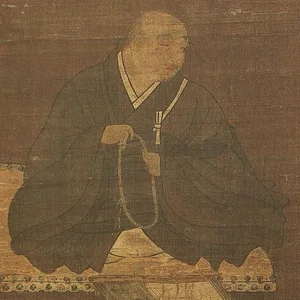

Hōnen was a Japanese Buddhist monk who founded the Pure Land school (Jōdo-shū). He taught that simply reciting the nembutsu, the invocation of Amida Buddha, was enough to achieve salvation, making the practice accessible to everyone.
Frequently asked questions
Key Facts
- Born in 1133 in Mimasaka Province, Japan
- Trains at the monastery on Mount Hiei, the center of Tendai Buddhism
- Founds the Jōdo-shū (Pure Land) school in 1175, advocating the recitation of the nembutsu
- Is exiled in 1207 following opposition from the established Buddhist schools
- Dies in 1212; his disciple Shinran would later found the Jōdo-shinshū school
Works & Achievements
The first independent Japanese Buddhist school centered solely on the nembutsu, opening salvation to laypeople as well as monks.
A major treatise asserting that reciting Amida's name is the practice chosen by the Buddha's original vow; a foundational doctrinal text.
A spiritual testament dictated just before his death, summing up in a few lines the essence of the nembutsu, accessible to all.
Preaching addressed to nobles as well as peasants, warriors, and outcasts, turning Buddhism into a popular religion.
Teaching disciples such as Shinran, who would found Jōdo Shinshū, giving Pure Land Buddhism a lasting legacy.
A public confrontation in which Hōnen defended the path of the nembutsu against the masters of the established schools, securing his reputation.
Anecdotes
When Hōnen was nine years old, armed men attacked the family home and his father, a local official, was mortally wounded. According to tradition, the dying father forbade the child from taking any revenge and instead asked him to become a monk to seek the salvation of all beings — a vow that shaped his entire life.
Nicknamed “the sage of Mount Hiei” at a very young age, Hōnen was renowned for having read the entire Buddhist canon several times over. Yet he judged this vast knowledge incapable of saving ordinary people, and he eventually gave it all up for the sole recitation of the nembutsu.
His decisive encounter was with a book: while reading a commentary by the Chinese master Shandao, he came upon the sentence affirming that reciting the name of Amida ensures rebirth in the Pure Land. He later recounted that he shed tears of joy, convinced he had found the path accessible to all.
In 1207, his teaching so disturbed the established schools that he was defrocked and exiled to the island of Shikoku, at over 70 years of age. Stripped of his status as a monk, he was given a layman's name, but he continued to preach the nembutsu to the fishermen and peasants he met along the way.
Two days before his death in 1212, he wrote his spiritual testament on a single sheet of paper, the Ichimai-kishōmon (“One-Sheet Document”), summarizing his entire doctrine: it is enough to sincerely recite the nembutsu, without any particular erudition, to be reborn in Amida's paradise.
Primary Sources
If one wishes to escape quickly from the sufferings of birth and death, then of the two excellent doctrines, let one set aside the Path of the Sages and choose to enter through the Path of the Pure Land.
The nembutsu of which I speak is not the contemplation practiced by the sages of China and Japan, nor a recitation grounded in the study and understanding of its meaning. It consists simply in reciting Namu-Amida-Butsu, without the slightest doubt, certain of thus being reborn in the Pure Land.
Whether one is learned or ignorant, observing the precepts or breaking them, of high or of low station, all are reborn alike by reciting the nembutsu, for they rely on the original vow of the Buddha Amida.
Key Places
Rural region of Japan where Hōnen was born in 1133. The temple Tanjō-ji there commemorates his birthplace today.
Great monastic complex of the Tendai school overlooking Kyoto, where Hōnen studied and trained for decades before breaking with its doctrine.
Hōnen's hermitage in the eastern hills of Kyoto, from which he spread the teaching of the nembutsu and welcomed his disciples.
Coastal region of Shikoku where Hōnen was exiled in 1207 after the persecution of the nembutsu, and where he continued to preach.
Site where Hōnen spent his final days and died in 1212; it later became the head temple of the Jōdo-shū school.
Typical Objects

A string of threaded beads used to count recitations of the nembutsu. Hōnen and his disciples used it to set the rhythm of the repeated invocation of Amida's name.

A depiction of Amida Buddha, often shown welcoming the faithful. The center of Pure Land devotion, before which the nembutsu is recited.

A draped robe worn by Japanese Buddhist monks. During his exile in 1207, Hōnen was symbolically stripped of his kesa when he was defrocked.

A scroll manuscript of Hōnen's major work setting out the exclusive choice of the nembutsu. A foundational text that was at first circulated only in a restricted way.

A painting depicting Amida and his bodhisattvas coming to welcome the deceased and lead them to the Pure Land. A key image of the piety of the Kamakura period.

A small metal instrument struck to punctuate services and sessions of collective nembutsu recitation in hermitages and temples.
School Curriculum
Vocabulary & Tags
Key Vocabulary
Daily Life
Morning
Hōnen rose before dawn for the first services, bowing before the image of the Buddha Amida. He would then begin his thousands of daily recitations of the nembutsu — said to reach sixty or seventy thousand a day.
Afternoon
The afternoon was devoted to receiving visitors and disciples, from court nobles to humble folk, and to answering their questions about salvation. He also wrote letters and texts explaining his doctrine in simple terms.
Evening
In the evening he continued reciting the nembutsu and reading the sutras by the light of an oil lamp. Before sleeping, he would gather himself once more before Amida.
Food
As a monk, he followed a plain vegetarian diet: rice, vegetables, miso soup, gruel, and sometimes a little fruit. He avoided meat and fish in keeping with the Buddhist precepts.
Clothing
He wore the dark robe of the monks with the kesa draped over it, a sign of his religious status. After his defrocking in 1207, he was for a time compelled to wear lay clothing.
Housing
He lived in plain monastic buildings, first on Mount Hiei, then in his hermitage at Yoshimizu in Kyoto — simple wooden structures furnished with a mat, an altar, and scrolls of sacred texts.
Historical Timeline
Period Vocabulary
Liens externes & ressources
Références
Œuvres
Fondation de l'école Jōdo-shū (Terre pure)
1175
Senchaku hongan nembutsu shū (Senchakushū)
1198
Ichimai-kishōmon (Document d'une seule feuille)
1212
Diffusion du nembutsu auprès du peuple
1175-1212
Formation de disciples majeurs
vers 1190-1207
Débat doctrinal d'Ōhara
1186