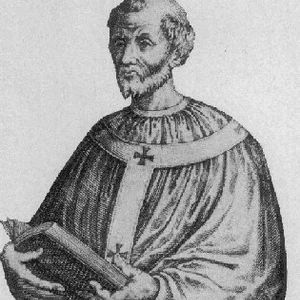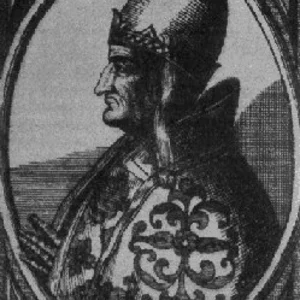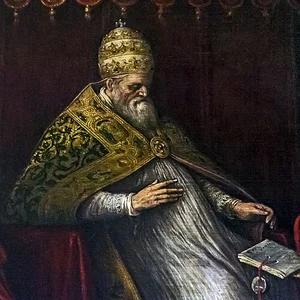

177th pope of the Catholic Church from 1216 to 1227. A skilled diplomat, he approved the emerging mendicant orders and worked to organize the Fifth Crusade.
Honorius III(1148 — 1227)
Honorius III
6 min read
Frequently asked questions
Key Facts
- Elected pope on 18 July 1216, succeeding Innocent III
- Officially approved the Rule of the Friars Minor (Franciscans) through the bull Solet annuere in 1223
- Confirmed the order of the Friars Preachers (Dominicans) in 1216
- Organized and supported the Fifth Crusade (1217-1221)
- Crowned Peter of Courtenay and negotiated with Emperor Frederick II; died on 18 March 1227
Works & Achievements
Definitive legal recognition of Saint Francis's Order of Friars Minor, a major step in the rise of the mendicant orders.
Approval of Saint Dominic's Order of Preachers, devoted to preaching and combating heresy.
Diplomatic and financial mobilization of the Christian princes to reconquer the Holy Land by way of Egypt.
Crowning of the Holy Roman Emperor in Rome, meant to seal the alliance between the papacy and the Empire for the crusade.
The first official collection of decretals promulgated by a pope, a foundation of university teaching in canon law.
Encouragement of the evangelization of Prussia and the Baltic and regulation of the young universities of Bologna and Paris.
Anecdotes
Elected pope at Perugia in July 1216, the elderly cardinal Cencio Savelli took the name Honorius III at a time when the Church awaited a successor capable of continuing the work of the powerful Innocent III. Known as gentle and conciliatory, he surprised everyone by proving to be a tenacious organizer of the crusade.
In 1223, Honorius III officially approved the rule of Saint Francis of Assisi through the bull *Solet annuere*, giving legal birth to the Order of Friars Minor. Two years earlier, he had also confirmed the Order of Preachers of Saint Dominic: under his pontificate the two great mendicant orders came into being.
Honorius III crowned **Frederick II** Holy Roman Emperor in Rome in 1220, hoping to make him the armed instrument of the crusade. But the emperor kept postponing his departure, and the pope died in 1227 without seeing Frederick keep his promise, leaving it to his successor **Gregory IX** to excommunicate him.
Much later, during the Renaissance, a sinister forgery was attributed to him: the *Grimoire of Pope Honorius*, a manual of black magic supposedly written by him to summon demons. This grimoire, printed mainly in the 17th century, obviously has no real connection to the medieval pope, but for a long time it turned his name into a figure of occult legend.
A patient diplomat, Honorius III sought to Christianize Northern and Eastern Europe: he supported missions in Prussia and the Baltic lands, and encouraged the formation of the emerging universities such as **Bologna** and **Paris** by regulating the teaching of canon law.
Primary Sources
Honorius, bishop, servant of the servants of God… By our apostolic authority we confirm the rule of your order, approved here by our predecessor Pope Innocent.
Considering that the brothers of your order shall be the champions of the faith and the true lights of the world, we confirm your order.
Official collection of decretals promulgated by Honorius III and sent to the University of Bologna to serve in the teaching of canon law.
The pope urges the Christian princes to come to the aid of the Holy Land and to honor their crusade commitments.
Key Places
Seat of the papacy where Honorius III resided, crowned Frederick II, and died in 1227. Center of government of the Catholic Church.
City in Umbria where he was elected pope in July 1216, shortly after the death of Innocent III, who was there at the time.
Birthplace of Saint Francis and of the Order of Friars Minor, whose rule Honorius III approved in 1223.
University city to which Honorius III sent the Compilatio quinta for the teaching of canon law, and where Saint Dominic died.
Port in the Nile Delta and the main objective of the Fifth Crusade organized by Honorius III: captured in 1219, then lost again in 1221.
Typical Objects

Headdress worn by the pope, a symbol of his spiritual and temporal authority in the Middle Ages. In the time of Honorius III, it began to be adorned with an ornate crown.

Lead seal hung from the pope's official letters, which gives papal “bulls” their name. It authenticated decisions such as the approval of the mendicant orders.

Ring worn by the pope, engraved with Saint Peter hauling in his nets. It was used to seal the pontiff's private correspondence.

Collections of papal letters and decisions carrying the force of law within the Church. Honorius III had one compiled, the *Compilatio quinta*, for the faculties of law.

Pastoral staff topped with a triple-barred cross, specific to the pope. It represents the role of shepherd guiding the flock of the faithful.

A spurious manual of black magic attributed, long after his death, to Honorius III, claiming to teach the summoning of demons. It belongs entirely to legend and has no connection to the real pope.
School Curriculum
Vocabulary & Tags
Key Vocabulary
Daily Life
Morning
The pope began his day very early with prayer and the celebration of Mass in his private chapel at the Lateran Palace. This was followed by the recitation of the liturgical offices with his clergy.
Afternoon
The afternoon was devoted to governing the Church: audiences, the reading of petitions arriving from all of Christendom, and the dictation of hundreds of letters and bulls to the papal chancery.
Evening
The evening blended further prayers, spiritual readings, and conversations with the cardinals of the curia. Honorius III, known for being sober and studious, devoted time to the study of law and the Scriptures.
Food
The diet of a medieval pope remained relatively modest on ordinary days but was lavish during banquets: bread, fish, meats, vegetables, and wine. The many days of fasting and Lent required abstinence from meat.
Clothing
Honorius III wore the pontifical liturgical vestments: a white alb, an embroidered chasuble and cope, a mitre or tiara during major ceremonies, and the Fisherman's Ring on his hand.
Housing
He resided in the Lateran Palace in Rome, the vast residence of the popes, also staying in other cities of the Papal States such as Perugia, Viterbo, or Rieti.
Historical Timeline
Period Vocabulary
Liens externes & ressources
Références
Œuvres
Approbation de la règle des Franciscains (Solet annuere)
1223
Confirmation de l'ordre des Dominicains
1216
Organisation de la cinquième croisade
1217-1221
Couronnement impérial de Frédéric II
1220
Compilatio quinta
1226
Soutien aux missions baltes et aux universités
1216-1227