 flip
flipMarbled Tea Eggs (茶叶蛋, cháyèdàn)
Marbled Tea Eggs (茶叶蛋, cháyèdàn)
Why this dish? The tea egg is China's quintessential portable snack: found at every train station, on trains, and in neighborhood shops. For a player who spends her life traveling — Gibraltar, Oxford, international opens — it's the snack that transports, keeps, and can be nibbled between rounds.
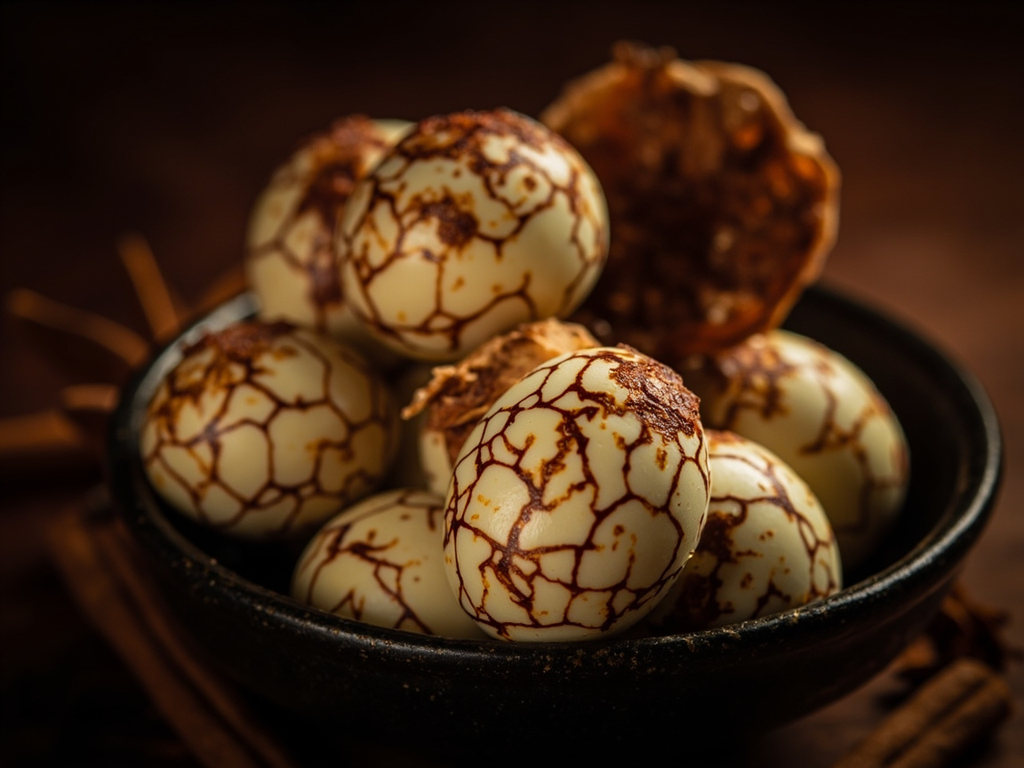
Hard-boiled eggs, cracked and then long-infused in a broth of black tea, soy sauce, and five-spice. The cracked shell creates fine marbling on the white, and the egg takes on a salty, fragrant, and lightly spiced flavor.
When you travel all the time, you learn to bring food along. Tea eggs — I've eaten them on how many trains and in how many hotel lobbies… You boil the eggs, gently tap the shell to crack it — that's what makes the pretty patterns — then let them soak overnight in tea and spices. The next day, they're ready to slip into a bag. Between rounds, it's better than any candy bar: it fills you up without making you sleepy.
- •Chicken eggs — half a dozen (base)
- •Black tea — a handful of leaves (infusion, color, bitterness)
- •Soy sauce — a bowl (saltiness and color)
- •Star anise, cinnamon, clove (five-spice) — a few pieces (spiced aroma)
- •Salt — a pinch (seasoning)
Marbled Tea Eggs (茶叶蛋, cháyèdàn)
Hard-boiled eggs, cracked and then long-infused in a broth of black tea, soy sauce, and five-spice. The cracked shell creates fine marbling on the white, and the egg takes on a salty, fragrant, and lightly spiced flavor.
Why this dish? The tea egg is China's quintessential portable snack: found at every train station, on trains, and in neighborhood shops. For a player who spends her life traveling — Gibraltar, Oxford, international opens — it's the snack that transports, keeps, and can be nibbled between rounds.
When you travel all the time, you learn to bring food along. Tea eggs — I've eaten them on how many trains and in how many hotel lobbies… You boil the eggs, gently tap the shell to crack it — that's what makes the pretty patterns — then let them soak overnight in tea and spices. The next day, they're ready to slip into a bag. Between rounds, it's better than any candy bar: it fills you up without making you sleepy.
Ingredients (period version)
- Chicken eggs — half a dozen (base)
- Black tea — a handful of leaves (infusion, color, bitterness)
- Soy sauce — a bowl (saltiness and color)
- Star anise, cinnamon, clove (five-spice) — a few pieces (spiced aroma)
- Salt — a pinch (seasoning)
Ingredients
- Eggs — 6 (base)
- Black tea (2 bags or 2 tbsp loose leaf) — for 800 ml (infusion)
- Dark soy sauce — 4 tbsp (color and saltiness)
- Light soy sauce — 2 tbsp (saltiness)
- Star anise — 2 (signature spice)
- Cinnamon stick — 1 (warm aroma)
- Five-spice powder — 1/2 tsp (spice)
- Sugar — 1 tsp (balance)
Method
- Hard-boil the eggs for 8 min, cool under cold water.
- Gently tap each shell with the back of a spoon to crack it all over without removing it.
- Prepare the broth: water, tea, both soy sauces, star anise, cinnamon, five-spice, sugar. Bring to a simmer for 5 min.
- Submerge the cracked eggs in the broth, simmer covered for 30 min.
- Turn off heat and let soak at least overnight in the fridge: the longer they marinate, the more pronounced the marbling.
- Peel just before eating to reveal the marbling — perfect for travel.
How it was made : Tea eggs are an ancient Chinese snack, long sold by street vendors and in tea houses. The cracking of the shell before infusion, which creates the characteristic marbling, is a trick passed down to let the flavor penetrate the white.
The contemporary twist : Served split in half like two camps on a board, the dark marbled white against the pale yellow yolk: a little edible chessboard.
Hou Yifan · Charactorium