 flip
flipNiger Fish Dried with Grains of Paradise
Niger Fish Dried with Grains of Paradise
Why this dish? Al-Saadi served as secretary and traveled between Timbuktu, Djenné, and Gao, along the Niger and by the tracks of the pashalik. On these roads, one did not carry a pot: one carried the dried, salted fish of the river, light, which keeps for weeks and is nibbled on the way or thrown into a sauce at the stop.
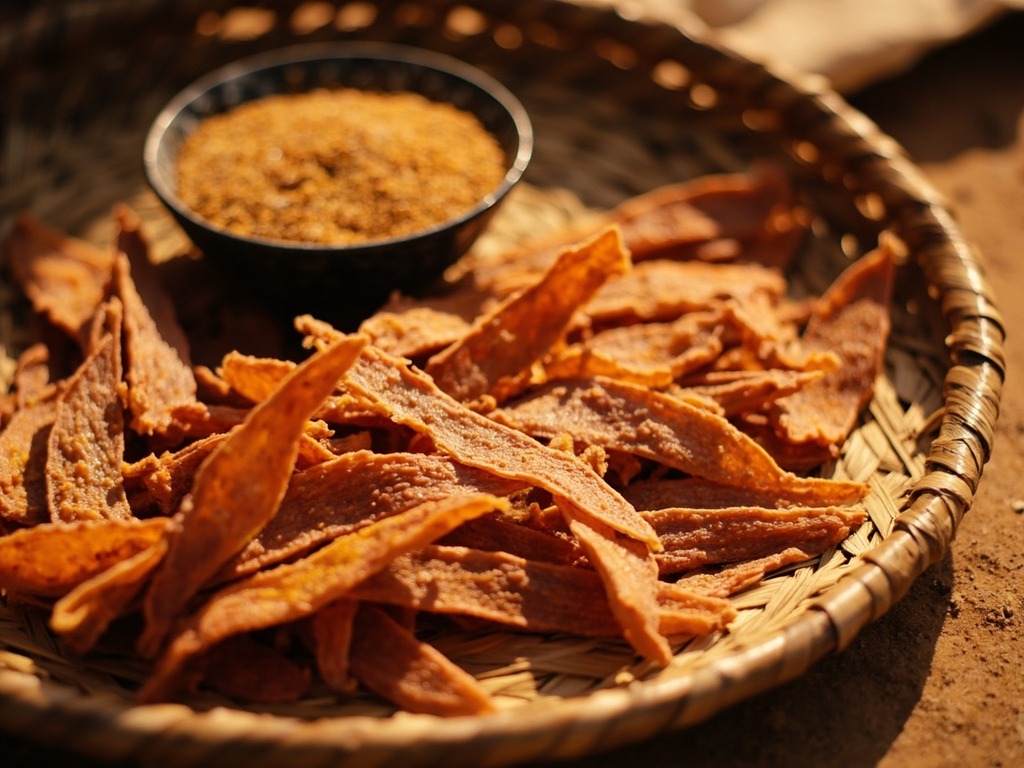
Thin strips of river fish, salted, rubbed with West African spices, and long-dried in the dry Sahel air. Salty, fragrant with spices, concentrated: the traveler's preserve and the natural stock cube of the stopover.
Before taking the road to Gao, prepare this, traveler, and you will not know hunger between two villages. Slice the fish thin as a manuscript leaf, rub it with caravan salt and crushed grains of paradise, then entrust it to the sun and the desert wind. Three days, and it is hard and light as parchment — you chew it walking, or break it into hot water in the evening, and there is a sauce. God protects he who travels with his provision.
- •Lean Niger fish in thin strips — as much as you wish to keep (base)
- •Taghaza salt — generously (preservation)
- •Grains of paradise — crushed (spice and preservation)
- •Dried pounded ginger — a pinch (aromatic)
Niger Fish Dried with Grains of Paradise
Thin strips of river fish, salted, rubbed with West African spices, and long-dried in the dry Sahel air. Salty, fragrant with spices, concentrated: the traveler's preserve and the natural stock cube of the stopover.
Why this dish? Al-Saadi served as secretary and traveled between Timbuktu, Djenné, and Gao, along the Niger and by the tracks of the pashalik. On these roads, one did not carry a pot: one carried the dried, salted fish of the river, light, which keeps for weeks and is nibbled on the way or thrown into a sauce at the stop.
Before taking the road to Gao, prepare this, traveler, and you will not know hunger between two villages. Slice the fish thin as a manuscript leaf, rub it with caravan salt and crushed grains of paradise, then entrust it to the sun and the desert wind. Three days, and it is hard and light as parchment — you chew it walking, or break it into hot water in the evening, and there is a sauce. God protects he who travels with his provision.
Ingredients (period version)
- Lean Niger fish in thin strips — as much as you wish to keep (base)
- Taghaza salt — generously (preservation)
- Grains of paradise — crushed (spice and preservation)
- Dried pounded ginger — a pinch (aromatic)
Ingredients
- Lean white fish fillets (perch, tilapia, cod) — 500 g (base)
- Fine salt — 3 tbsp (preservation and flavor)
- Ground grains of paradise — 1 tsp (signature spice)
- Ground ginger — ½ tsp (aromatic)
- Black pepper (optional) — ½ tsp (heat)
Method
- Slice the fish into the thinnest possible strips (approx. 3-4 mm).
- Mix salt and spices, rub each strip thoroughly on both sides.
- Arrange without overlapping on a rack; let purge 1 h then pat dry.
- Dry in a dehydrator at 60°C for 6-8 h, or in an oven with the door ajar at 70°C for 4-6 h, until dry and brittle.
- Store in a cloth or dry jar. Nibble as is, or rehydrate 10 min in a broth to flavor a sauce.
How it was made : Drying and salting Niger fish is an ancient delta industry: in this form, fish traveled the caravan routes toward the Sahara and the Maghreb, a trade currency against salt and manuscripts. The dry climate made preservation possible without smoking. Grains of paradise, a native spice from the Gulf of Guinea, traveled to Europe under the name 'grains of paradise'.
The contemporary twist : Grind part of the dried fish into a fine powder in a mortar: a 'Sahelian umami' to sprinkle over roasted vegetables or rice, a nod to today's stock cube.
Sources : Ethnographic studies on the Bozo and Somono fishermen of the Niger Delta · Historical documentation on trans-Saharan caravan trade
Abd al-Rahman al-Saadi · Charactorium