 flip
flipFul Medames for Ftour, Fava Beans Simmered with Cumin and Lemon
Ful Medames for Ftour, Fava Beans Simmered with Cumin and Lemon
Why this dish? This is the dish of the Egyptian workers who dug with Carter in the Valley of the Kings, and the one he himself ate in the field: simple, nourishing, taken at dawn. The fava beans simmered all night fed the hundreds of men of the Tutankhamun excavation.
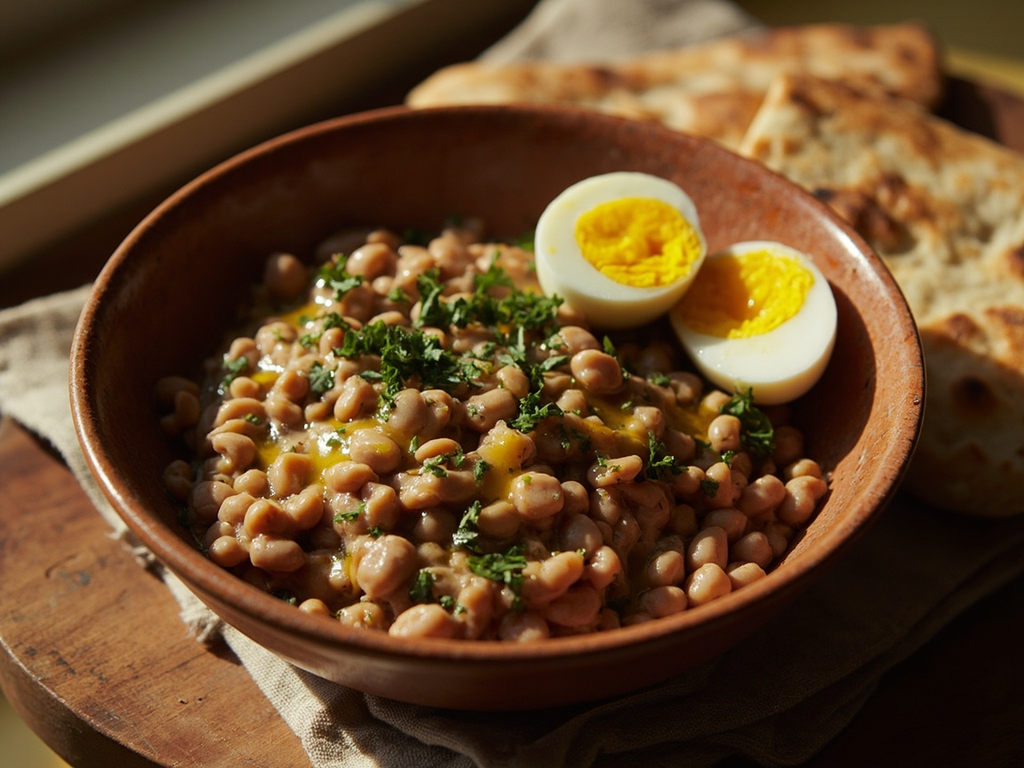
Brown fava beans long simmered until melting, coarsely mashed, drizzled with olive oil and lemon, perfumed with cumin and garlic. Eaten warm, dipping flat baladi bread, with some herbs and a hard-boiled egg.
You see, my dear reader, before the sun turned the Valley into a furnace, the workmen would sit in the dust and share a pot of these brown beans — the ful, which they cooked overnight over a slow fire. I confess I grew quite accustomed to it: a squeeze of lemon, that cumin whose scent never leaves you, and you can stand until noon. Dip your flatbread in it, eat with your fingers as my reis did, and you will understand why this humble-looking dish has sustained Egypt since the pharaohs.
- •Dried brown fava beans (ful hammam) — a large bowl (nourishing base)
- •Olive oil from Upper Egypt — a good drizzle (binding and richness)
- •Yellow lemon from Luxor — a few, squeezed (bright acidity)
- •Garlic — a few crushed cloves (aromatic)
- •Ground cumin (kammoun) — generously (signature)
- •Salt — to taste (seasoning)
- •Flat baladi bread — as needed (edible utensil)
Ful Medames for Ftour, Fava Beans Simmered with Cumin and Lemon
Brown fava beans long simmered until melting, coarsely mashed, drizzled with olive oil and lemon, perfumed with cumin and garlic. Eaten warm, dipping flat baladi bread, with some herbs and a hard-boiled egg.
Why this dish? This is the dish of the Egyptian workers who dug with Carter in the Valley of the Kings, and the one he himself ate in the field: simple, nourishing, taken at dawn. The fava beans simmered all night fed the hundreds of men of the Tutankhamun excavation.
You see, my dear reader, before the sun turned the Valley into a furnace, the workmen would sit in the dust and share a pot of these brown beans — the ful, which they cooked overnight over a slow fire. I confess I grew quite accustomed to it: a squeeze of lemon, that cumin whose scent never leaves you, and you can stand until noon. Dip your flatbread in it, eat with your fingers as my reis did, and you will understand why this humble-looking dish has sustained Egypt since the pharaohs.
Ingredients (period version)
- Dried brown fava beans (ful hammam) — a large bowl (nourishing base)
- Olive oil from Upper Egypt — a good drizzle (binding and richness)
- Yellow lemon from Luxor — a few, squeezed (bright acidity)
- Garlic — a few crushed cloves (aromatic)
- Ground cumin (kammoun) — generously (signature)
- Salt — to taste (seasoning)
- Flat baladi bread — as needed (edible utensil)
Ingredients
- Brown fava beans (canned, ful medames type) — 2 cans (800 g) (base)
- Olive oil — 4 tbsp (binding)
- Lemon — 2, squeezed (acidity)
- Garlic — 2 crushed cloves (aromatic)
- Ground cumin — 1.5 tsp (signature)
- Flat-leaf parsley — a few sprigs, chopped (freshness)
- Hard-boiled eggs — 2 (accompaniment)
- Pita or baladi bread — 4 (for dipping)
Method
- Drain the fava beans, reserving a little of their liquid, then pour them into a saucepan with a splash of water.
- Warm gently for 10 minutes, then coarsely mash with a fork (keep some texture).
- Off the heat, add garlic, cumin, salt, lemon juice, and olive oil; stir.
- Pour into a shallow dish, drizzle with more oil, sprinkle with parsley.
- Serve warm with halved hard-boiled eggs and warm bread for dipping.
How it was made : Ful medames is one of the oldest living dishes of Egypt: fava beans were already cooked in earthenware jars buried under embers, over a very low fire all night, in public ovens. In the morning, each person came to fill their bowl. On excavation sites, the same method was adapted with large tin pots.
The contemporary twist : Serve it 'Valley of the Kings style' in a small terracotta bowl, topped with a runny soft-boiled egg and a pinch of cumin dry-roasted at the last second to revive the aroma.
Sources : Claudia Roden, A Book of Middle Eastern Food, 1968 · Howard Carter & A. C. Mace, The Tomb of Tut-ankh-Amen, 1923
Howard Carter · Charactorium