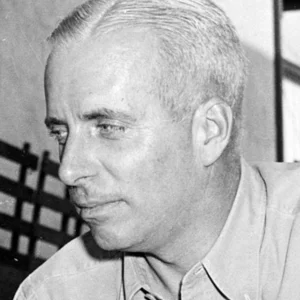

Howard Hawks was an American director, producer, and screenwriter, a major figure of Hollywood's Golden Age. A jack-of-all-trades across genres (western, film noir, comedy, war film), he is regarded as one of the great auteurs of classic cinema.
Howard Hawks(1896 — 1977)
Howard Hawks
États-Unis
7 min read
Frequently asked questions
Famous Quotes
« A good movie is three good scenes and no bad ones.»
Key Facts
- Born May 30, 1896, in Goshen (Indiana), died December 26, 1977, in Palm Springs
- Directed "Scarface
- (1932)
- an iconic gangster film from the early sound era
- Directed "The Big Sleep
- (1946) with Humphrey Bogart and Lauren Bacall
- a pinnacle of film noir
- Made the western "Rio Bravo
- (1959) with John Wayne
- Received an Honorary Oscar in 1975 for his lifetime achievement
Works & Achievements
A gangster film inspired by Al Capone that became a classic of the genre. Its violence sparked a long tug-of-war with the censors.
A zany screwball comedy starring Katharine Hepburn and Cary Grant, plus a leopard named Baby. A model of the genre, long misunderstood when it was first released.
A newsroom comedy famous for its ultra-fast, overlapping dialogue. A feat of pacing and writing.
An adventure film based on Hemingway that introduced Lauren Bacall alongside Humphrey Bogart. The birth of a legendary screen couple.
A film noir based on Raymond Chandler, featuring detective Philip Marlowe. Famous for its deliberately labyrinthine plot.
An epic Western about a massive cattle drive, starring John Wayne and Montgomery Clift. A benchmark of the genre.
A flamboyant musical comedy with Marilyn Monroe and Jane Russell. Hawks shows off his sense of tempo and humor.
A Western with John Wayne, conceived as a response to “High Noon.” It became one of the most admired and imitated Westerns of all time.
Anecdotes
For the film noir “The Big Sleep” (1946), the plot was so convoluted that no one on set knew who had killed the Sternwoods' chauffeur. Howard Hawks sent a telegram to the author of the novel, Raymond Chandler, to ask him the question: Chandler replied that he didn't know himself! The film remains a masterpiece all the same, proof that for Hawks, mood and characters mattered more than the logic of the story.
It was Hawks's wife, nicknamed “Slim,” who spotted an unknown 19-year-old, Lauren Bacall, on the cover of a fashion magazine. Hawks gave her her debut in “To Have and Have Not” (1944) opposite Humphrey Bogart. During filming, the two actors genuinely fell in love and married the following year — one of Hollywood's most famous couples was born.
Hawks hated the western “High Noon” (1952), in which the sheriff spends the whole film begging for help. To answer it, he made “Rio Bravo” (1959) with John Wayne: this time, a self-assured sheriff turns down the help of amateurs. Hawks thus turned a filmmaker's disagreement into one of the most beloved westerns in history.
Before the cinema, Hawks was a daredevil: an airplane pilot during the First World War and a passionate race-car driver. This taste for risk and machines reappears in his aviation films such as “Only Angels Have Wings,” where he films the pilots with a precision he knew from experience.
In 1975, at the end of his career, Hawks received an Honorary Oscar from the hands of John Wayne, the actor he had directed so often. The Academy hailed him as “a master American filmmaker.” Yet, surprisingly, Hawks had been nominated only once for Best Director, for “Sergeant York” in 1941.
Primary Sources
Self-evidence is the mark of Hawks's genius.
We didn't know who had killed the chauffeur. I sent a telegram to Chandler to ask him, and he replied that he didn't know either.
A master American filmmaker whose creative efforts hold a distinguished place in world cinema.
Key Places
Town in the American Midwest where Howard Hawks was born in 1896. His family, made wealthy by the paper industry, would later move to California.
Hawks studied mechanical engineering here, which fueled his passion for machines, airplanes, and race cars. This technical background would resurface in his films.
World capital of cinema where Hawks built his career during the golden age of the studios. He shot films for most of the major studios there, from the silent era to the 1960s.
Region of East Africa where Hawks shot “Hatari!” (1962), a film about hunters capturing wild animals. Filming on location was a real adventure.
California desert resort where Hawks spent his final years and died in 1977. The place was a favorite among Hollywood stars.
Typical Objects

Heavy studio camera (Mitchell type) mounted on a tripod, which exposes the film frame by frame. It is the central tool that captures the scenes shot by the director.
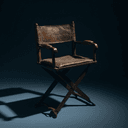
Folding canvas seat often bearing the director's name. It has become the symbol of the director's authority on the set.

Notebook detailing the story, scenes and dialogue of the film. Hawks liked to rewrite it up to the last moment and have his actors improvise.

Slate fitted with a hinged arm clapped in front of the camera at the start of each take. It is used to identify the scene and to synchronize the image with the sound.
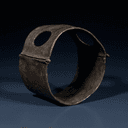
Roll of 35 mm photographic film on which the images are recorded. Once developed and edited, the film is projected in theaters.

Cone-shaped loudhailer used by the director to give instructions on a noisy set. Like the chair, it has become an iconic image of the film director.
School Curriculum
Vocabulary & Tags
Key Vocabulary
Tags
Daily Life
Morning
During filming, Hawks arrived at the studio early and reread the pages planned for the day. He liked to rewrite scenes at the last minute and discuss the dialogue with his screenwriters, sometimes over a coffee on the set.
Afternoon
The afternoon was devoted to the actual shooting. Hawks directed his actors with an apparent calm, favored long takes, and looked above all for chemistry and naturalness between the performers rather than spectacular effects.
Evening
In the evening, he watched the “rushes” (the footage shot during the day) in the screening room. A great lover of gambling, hunting, fishing, and car racing, he also frequented clubs and card games once the day was over.
Food
Like the studio professionals, Hawks often ate at the studio cafeteria (the “commissary”). His cuisine was that of well-off mid-20th-century America: meats, hearty dishes, and cocktails at society parties.
Clothing
Tall and distinguished, nicknamed “the Silver Fox” because of his prematurely gray hair, Hawks took care of his appearance. He readily wore elegant suits and glasses, looking more like a gentleman than a bohemian artist.
Housing
He lived in comfortable homes in the affluent neighborhoods of Los Angeles, leading a luxurious lifestyle. His gambling and car-racing debts sometimes put his finances to a severe test despite his successes.
Historical Timeline
Period Vocabulary
Liens externes & ressources
Références
Œuvres
L'Impossible Monsieur Bébé (Bringing Up Baby)
1938
La Dame du vendredi (His Girl Friday)
1940
La Rivière rouge (Red River)
1948
Les hommes préfèrent les blondes (Gentlemen Prefer Blondes)
1953