
An aquatic monster from Greek mythology, the Lernaean Hydra was a multi-headed serpent whose heads would grow back two-fold whenever they were cut off. It was slain by Heracles during his second labor, with the help of his nephew Iolaus.
Lernaean Hydra
Lernaean Hydra
8 min read
Frequently asked questions
Key Facts
- The Lernaean Hydra lived in the swamps of Lerna, in the Peloponnese
- Each severed head would regenerate, giving rise to two new ones
- The second labor imposed on Heracles by King Eurystheus
- Heracles prevailed by cauterizing each neck stump after cutting off the head, with the help of his nephew Iolaus
- One central head was immortal; Heracles buried it beneath a boulder
Works & Achievements
The first literary text to mention the Lernaean Hydra, the Theogony establishes its monstrous lineage as the offspring of Typhon and Echidna. This foundational poem places the Hydra among the great threats overcome by gods and heroes.
These marble sculptures depicting the twelve labors of Heracles are among the earliest monumental representations of the battle against the Hydra. Preserved in the Archaeological Museum of Olympia, they illustrate the visual storytelling of the myth.
A tragedy by Euripides that references the battle against the Hydra to underscore the hero's greatness and tragic fate. The text emphasizes the lasting consequences of the Hydra's venom throughout Heracles' life.
A mythographic compilation offering the most complete and detailed account of the battle against the Hydra, including a description of the nine heads, the role of Iolaus, and the burial of the immortal head. An essential reference for historians.
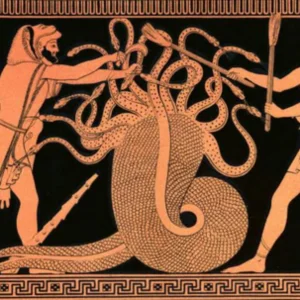
Numerous Greek amphorae and kraters depict Heracles facing the Hydra, sometimes with Iolaus holding torches. These vases, exported throughout the Mediterranean, spread the myth on a very wide scale.
Ptolemy includes the Hydra constellation in his Almagest, designating it as the largest constellation in the sky. The Hydra's immortalization among the stars reflects the enduring power of the myth in ancient culture.
Anecdotes
The Lernaean Hydra did not always have nine heads: ancient accounts vary between five, seven, nine, and even fifty heads depending on the author. Hesiod, who mentions it in the Theogony around 700 BCE, emphasizes above all its immortal nature and its venomous breath capable of killing at a distance.
The Hydra's deadly trick lay in its central head, the only one that was truly immortal. Heracles had to bury this head beneath an enormous rock after severing it, because even separated from the body, it continued to bite and spit its venom.
After his victory, Heracles dipped his arrows in the Hydra's corrosive blood, making them deadly at the slightest touch. This choice would have dramatic consequences: those same arrows would cause the death of Chiron, the wise centaur, and would play a role in Heracles' own tragic end, through the shirt of Nessus.
The swamps of Lerna, the Hydra's lair, were considered by the ancient Greeks to be an entrance to the Underworld. Its stagnant waters and pestilential vapors were said to be lethal, which made Heracles' feat all the more remarkable in the eyes of his contemporaries.
Eurystheus, the king who imposed the labors on Heracles, refused to count the victory over the Hydra among the twelve official labors. He argued that the help of Iolaus, Heracles' nephew who cauterized the stumps after each decapitation, made the feat unfair. Heracles had to complete a thirteenth labor as a replacement.
Primary Sources
And she bore another monster, irresistible and terrible, great and swift-footed, the Lernaean Hydra, which the goddess white-armed Hera nourished, being angry with the mighty Heracles.
The second labor Eurystheus commanded him to perform was to kill the Lernaean Hydra. This creature had been raised in the swamps of Lerna and would emerge onto the plain to ravage the flocks and the countryside. It had an enormous body and nine heads, eight of which were mortal, while the ninth, in the middle, was immortal.
He destroyed the hundred-headed Hydra, that monster of the waters of Lerna, and dipped his war arrows in its blood, with which he would later pierce the flanks of the two-natured centaur.
The Hydra had the ability to grow back its heads in double the number as soon as one was cut off. Heracles understood that he could not defeat the monster by strength alone, and asked Iolaus to cauterize each wound with fire immediately after each decapitation.
Lerna with its deadly waters, the marsh alive with the hissing of the Hydra, whose stench poisoned the surrounding fields — the lair of that ancient monster with its ever-renewing heads.
Key Places
The legendary lair of the Hydra, these swamps near Argos were believed to be an entrance to the Underworld. The archaeological site of Lerna, excavated in the 20th century, reveals human occupation dating back to 3500 BCE.
The royal city of Eurystheus, the ruler who imposed the twelve labors on Heracles. It was from Mycenae that the order was given to destroy the Lernaean Hydra.
A major city near Lerna, whose inhabitants suffered the Hydra's devastation of their livestock and farmland. It was also a center of the cult of Hera, the goddess who had raised the monster.
On the east pediment of the Temple of Zeus at Olympia, built around 460 BCE, sculpted reliefs depict the twelve labors of Heracles, including his battle against the Lernaean Hydra.
Liens externes & ressources
Références
Œuvres
Théogonie — Hésiode
vers 700 av. J.-C.
Métopes du temple de Zeus à Olympie
vers 460 av. J.-C.
Hercule furieux (Héraclès Mainomenos) — Euripide
vers 415 av. J.-C.
Bibliothèque (Bibliotheca) — Pseudo-Apollodore
Ier-IIe siècle ap. J.-C.
Les Travaux et les Jours — Représentations céramiques (vases à figures noires et rouges)
VIe-Ve siècle av. J.-C.
Constellation Hydra — cataloguée par Ptolémée
IIe siècle ap. J.-C.