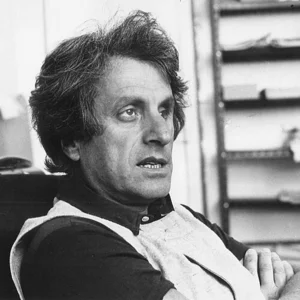

French-Greek composer, mathematician and architect, a pioneer of algorithmic and stochastic music. He applied mathematics and probability theory to musical composition, revolutionizing the music of the 20th century.
Iannis Xenakis(1922 — 2001)
Iannis Xenakis
Grèce, France
5 min read
Frequently asked questions
Key Facts
- Born in 1922 in Romania to Greek parents, died in Paris in 2001
- Worked as an engineer in Le Corbusier's studio and designed the Philips Pavilion at the 1958 Brussels World's Fair
- Composed Metastaseis (1953-1954), a foundational work applying mathematical principles to the orchestra
- Theorized stochastic music based on probability theory in his book Formalized Music (1963)
- Invented the UPIC (1977), a computer system that allows composing by drawing
Works & Achievements
Work for orchestra based on geometric glissandos; the birth certificate of his language blending music and mathematics.
First major stochastic work: the sounds of the strings are organized like clouds of particles governed by probabilities.
Building designed for the 1958 Brussels World's Fair, with shells in hyperbolic paraboloids, the pinnacle of the encounter between his architecture and his music.
A score calculated entirely from statistical laws, an illustration of his stochastic composition method.
A show of light and sound for the World's Fair, inventing a form of total art in space.
A work for six percussionists arranged around the audience, premiered near Persepolis, which spatializes the sound throughout the auditorium.
A computer system for composition through drawing, allowing hand-drawn curves to be transformed into music.
A major theoretical work in which he lays out the mathematical foundations of stochastic music.
Anecdotes
In 1945, during the street fighting in Athens in the Greek Civil War, the young Xenakis was gravely wounded in the face by a shell fragment: he lost his left eye and was left with a deep scar. Having joined the resistance against the occupying forces and then the armed struggle, he narrowly escaped death.
Sentenced to death in absentia by the Greek regime, Xenakis fled his country with false papers and arrived in Paris in 1947. He would not be able to return to Greece until 1974, after the fall of the dictatorship of the colonels.
For twelve years, Xenakis worked in the studio of the architect Le Corbusier as an engineer. He largely designed the Philips Pavilion for the 1958 Brussels World's Fair, a structure of spectacular curves made of hyperbolic paraboloids.
His orchestral piece *Metastaseis* (1953-54) is built on glissandos tracing straight lines that form curved surfaces: exactly the same geometric principle as the shells of the Philips Pavilion. With Xenakis, music and architecture are born of the same mathematics.
To compose, Xenakis applied probability theory, game theory, and logic: he called this approach “stochastic” music. In the 1970s, he invented the UPIC, a machine on which one draws curves that a computer transforms into sounds.
Primary Sources
Introducing the laws of probability into musical composition makes it possible to escape both strict determinism and the arbitrariness of pure chance.
Stochastic music is defined by the mastery of chance: its sonic events are governed by laws of probability rather than by a note-by-note will.
For me, architecture and music are two manifestations of the same thought: both organize space and time on the basis of abstract structures.
Key Places
Danube port city where Xenakis was born in 1922, within the local Greek community.
Where he spent his youth and studied, but also the site of the 1945 fighting in which he was gravely wounded in the face.
City of exile and of his entire career: here he worked for Le Corbusier, composed, and died in 2001.
Structure he designed for the 1958 World's Fair, a showcase for his geometric ideas.
At 35 rue de Sèvres, the firm where Xenakis worked as an engineer for twelve years and forged his spatial language.
Typical Objects

Sketch in which the glissandos are drawn as oblique straight lines forming curved surfaces. The score looks as much like an architect's blueprint as a page of music.

A drawing board connected to a computer: curves traced by hand are converted into sounds. An invention that lets you compose without knowing how to read music.

A scale model of the structure of hyperbolic paraboloids designed for the 1958 Brussels World's Fair. It illustrates the direct link between his musical forms and his built forms.

Technical drawing instruments used in Le Corbusier's studio. Xenakis uses them to trace mathematical curves that he then transposes into music.

A book in which Xenakis explains how probability, game theory and logic can be used to compose. A work that blends pages of music with mathematical formulas.

Arrays of synchronized lights and sounds deployed through space during his multimedia shows. The audience is plunged into the heart of an architecture of sound and light.
School Curriculum
Vocabulary & Tags
Key Vocabulary
Daily Life
Morning
During his years at Le Corbusier's studio, Xenakis spent his mornings at his engineer's drafting table, ruler and compass in hand, calculating concrete structures. An early riser, he devoted the first hours of the day to mathematics and blueprints.
Afternoon
In the afternoon, he switched from architecture to music, filling his pages with curves, figures and probabilities. To him, the two activities were part of the same work: organizing space and time.
Evening
In the evening, he carried on composing late into the night, checking his calculations and transferring the results into notes on the score. He also frequented concerts and Parisian avant-garde circles.
Food
Like many Greek exiles in Paris, he kept a taste for simple Mediterranean cooking. His diet remained the modest fare of a hardworking immigrant, split between canteens and frugal meals.
Clothing
He wore the plain suit of the mid-twentieth-century engineer and intellectual. His scarred face and lost left eye immediately revealed his past as a fighter.
Housing
Exiled at first without resources, he lived modestly in Paris before settling there for good. His adopted city would remain the center of his life and work until his death.