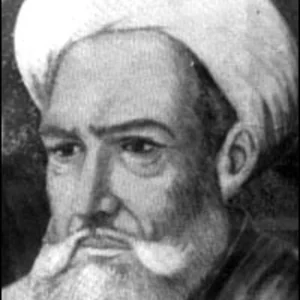

Persian philosopher, logician, and music theorist who wrote in Arabic, regarded as the “Second Teacher” after Aristotle. A major figure of medieval Islamic philosophy, he was a transmitter of Greek thought and a leading political thinker.
Frequently asked questions
Key Facts
- Born around 872 (probably in Farab, in present-day Kazakhstan/Central Asia) and died around 950–951 in Damascus.
- Nicknamed the “Second Teacher” (al-Muʿallim al-thānī) in reference to Aristotle, the “First Teacher.”
- Author of the treatise on political philosophy “The Opinions of the Inhabitants of the Virtuous City” (Mabādiʾ ārāʾ ahl al-madīna al-fāḍila), inspired by Plato's Republic.
- Wrote the “Great Book of Music” (Kitāb al-mūsīqā al-kabīr), a reference work on Arabic music theory.
- A commentator on and transmitter of Aristotle and Plato, he had a lasting influence on Avicenna, Averroes, and Maimonides.
Works & Achievements
A major work of political philosophy, inspired by Plato's Republic, describing the ideal city governed by a philosopher-prophet. A foundational text of Islamic political thought.
A systematic classification of all the sciences of his time, from language to metaphysics. It had a lasting influence on the organization of knowledge in both the East and the West.
A landmark treatise on musical theory, acoustics, and instruments. Considered one of the most important works on music of the Middle Ages.
A treatise on ethics and politics setting out how human beings attain happiness through virtue and philosophical knowledge.
A series of commentaries on Aristotle's treatises on logic that earned Al-Fârâbî the title of “Second Master” and made him the leading authority on logic in the Islamic world.
An essay seeking to reconcile the philosophies of Plato and Aristotle, revealing the depth of his reading of the Greeks.
A treatise on the origins of language and of philosophical concepts, exploring the relationship between language, logic, and metaphysics.
Anecdotes
Al-Fârâbî was nicknamed the “Second Master,” meaning the second after Aristotle himself, who was considered the “First Master.” No other philosopher received such a title in the medieval Islamic world, which shows the immense respect that his commentaries on Aristotle inspired.
According to early biographers, Al-Fârâbî led a life of great simplicity, indifferent to wealth and luxury. It is said that he lived on the modest sums paid to him by the prince of Damascus, Sayf al-Dawla, and that he preferred to meditate in gardens, beside streams, rather than frequent the splendor of the court.
Al-Fârâbî was a recognized music theorist, and legend has it that he was also an excellent musician. A famous anecdote tells that, playing his instrument before the court, he was able in turn to make the audience laugh, then weep, then fall asleep — thus demonstrating the power of the musical modes over the human soul.
It is said that Al-Fârâbî read Aristotle's treatise *On the Soul* more than a hundred times and the *Physics* forty times, so eager was he to grasp their meaning. This perseverance made him the great transmitter of Greek thought, which he passed on to later generations such as Avicenna and, still later, to the scholars of the Latin West.
An exceptional polyglot, Al-Fârâbî was said to have mastered a great many languages. Born in the region of Farab (Central Asia), he wrote his entire body of work in Arabic, the scholarly language of his time, helping to make Baghdad and then Damascus great crossroads of knowledge.
Primary Sources
The city in which men come together to help one another in acquiring happiness is the virtuous city, and the society in which men help one another to attain happiness is the virtuous society.
Happiness is the good sought for its own sake, which is never sought as a means to attain something else; there is nothing greater beyond which a person can reach.
The art of music encompasses the knowledge of sounds, of their causes, and of everything related to them, so that the soul may find in it pleasure and perfection.
We propose to enumerate the known sciences, science by science, and to make known the parts of which each of those that have parts is composed.
Key Places
Birthplace of Al-Fārābī, in what is now southern Kazakhstan, on the Silk Road. His very name comes from this oasis town.
Abbasid capital and great center of learning, where Al-Fārābī studied logic and philosophy under Christian masters. There he composed a major part of his work.
City where Al-Fārābī spent his final years at the court of Emir Sayf al-Dawla, and where he died in 951.
Capital of the Hamdanid emir Sayf al-Dawla, patron of Al-Fārābī, whose court was a brilliant literary and scientific center.
According to some biographers, Al-Fārābī traveled to Egypt toward the end of his life before returning to Damascus.
Typical Objects
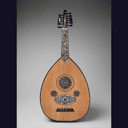
A pear-shaped plucked string instrument, ancestor of the European lute. Al-Fârâbî, a great music theorist, analyzed its sounds and intervals.
📷 CC0 · Wikimedia Commons ↗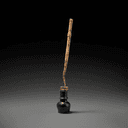
A cut reed dipped in ink, the writing tool of medieval Arab scholars. Al-Fârâbî used it to compose his dozens of treatises.

Hand-copied volumes containing the commentaries on Aristotle and original works. Paper, introduced into the Islamic world, encouraged the massive spread of texts.
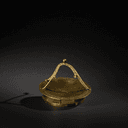
A brass astronomical instrument used to measure the altitude of celestial bodies and calculate the time. An emblem of the science of the Islamic Golden Age that Al-Fârâbî frequented.

Aristotle's Organon translated into Arabic, on which Al-Fârâbî wrote celebrated commentaries. These texts made him the master of logic in the Islamic world.
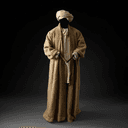
A loose wool or cotton garment worn by men of science and philosophers. Al-Fârâbî, known for his simplicity, dressed plainly.
School Curriculum
Vocabulary & Tags
Key Vocabulary
Tags
Daily Life
Morning
Al-Fârâbî began his day early, devoting the morning to reading and studying Greek manuscripts translated into Arabic. Renowned for his concentration, he tirelessly reread the same treatises by Aristotle to grasp every nuance.
Afternoon
The afternoon might be devoted to teaching and to discussions with other scholars, Christians and Muslims alike, in the intellectual circles of Baghdad or Damascus. There he debated logic, metaphysics, and politics.
Evening
In the evening, Al-Fârâbî liked to withdraw to write his own treatises by the light of an oil lamp. It is also said that he played music, putting into practice his theories on the power of sounds over the soul.
Food
His diet, simple and frugal like his life, consisted of the common foods of the time: bread, vegetables, dried fruits, dates, and a little meat. He scorned the luxury of the table and made do with little.
Clothing
He wore the plain garments of men of learning: a long robe (*qamîs*) of wool or cotton, sometimes a cloak and a turban. His reputation for simplicity contrasted with the splendor of the courts he frequented.
Housing
Al-Fârâbî lived modestly, sometimes lodged thanks to the generosity of his patrons such as **Sayf al-Dawla**. He is described as preferring the solitude of gardens and the banks of streams to the riches of princely dwellings.