 flip
flipHerbed Pease Pottage
Herbed Pease Pottage
Why this dish? Contemporaries report that Newton forgot to eat and contented himself with bread, cheese, and a few vegetables. Pease pottage, the most common and nourishing dish on English tables, exactly matches this distracted frugality of a man bent over his calculations all day at Trinity College.
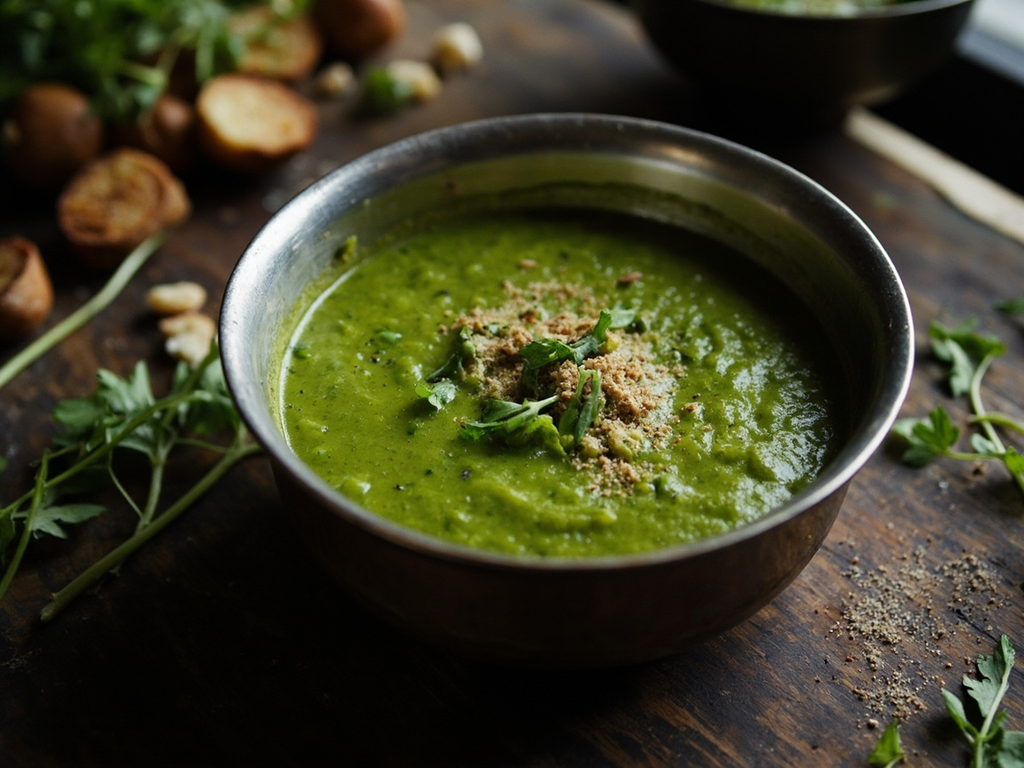
A thick purée-soup of dried peas simmered with an onion and garden herbs, bound with a little butter and served with brown bread. Hearty, simple, unpretentious: the food of a scholar who eats not to enjoy but to keep from fainting.
Sir, expect no sumptuousness: I hold that the body is sustained at little cost, and the mind gains what the table loses. Mistress Bartlett would set these peas over a slow fire all morning, and I would find them cold in the evening, having forgotten the dinner hour, my mind detained by my optics. A crust of bread, a wedge of cheese, and this warm purée: that is enough for a man to live on for weeks without further thought. Grate a grain of nutmeg over it — that is all the luxury I allow myself.
- •Dried split peas — a good bowlful (nourishing base of the pottage)
- •Onion — one, stuck with a few herbs (aromatic foundation)
- •Savory and marjoram from the garden — a handful (herb fragrance)
- •Fresh butter — a knob (binding and smoothness)
- •Salt — to taste (seasoning)
- •Brown bread — slices (accompaniment)
Herbed Pease Pottage
A thick purée-soup of dried peas simmered with an onion and garden herbs, bound with a little butter and served with brown bread. Hearty, simple, unpretentious: the food of a scholar who eats not to enjoy but to keep from fainting.
Why this dish? Contemporaries report that Newton forgot to eat and contented himself with bread, cheese, and a few vegetables. Pease pottage, the most common and nourishing dish on English tables, exactly matches this distracted frugality of a man bent over his calculations all day at Trinity College.
Sir, expect no sumptuousness: I hold that the body is sustained at little cost, and the mind gains what the table loses. Mistress Bartlett would set these peas over a slow fire all morning, and I would find them cold in the evening, having forgotten the dinner hour, my mind detained by my optics. A crust of bread, a wedge of cheese, and this warm purée: that is enough for a man to live on for weeks without further thought. Grate a grain of nutmeg over it — that is all the luxury I allow myself.
Ingredients (period version)
- Dried split peas — a good bowlful (nourishing base of the pottage)
- Onion — one, stuck with a few herbs (aromatic foundation)
- Savory and marjoram from the garden — a handful (herb fragrance)
- Fresh butter — a knob (binding and smoothness)
- Salt — to taste (seasoning)
- Brown bread — slices (accompaniment)
Ingredients
- Split peas — 250 g (base)
- Yellow onion — 1 (aromatic)
- Savory (or thyme) and marjoram — 1 tsp each, dried (herbs)
- Butter — 30 g (binding)
- Water or vegetable broth — 1 litre (cooking liquid)
- Salt and grated nutmeg — to taste (seasoning)
- Country bread — 4 slices (serving)
Method
- Rinse the split peas and place them in a pot with the water (or broth) and the onion cut in half.
- Bring to a simmer and cook over low heat for 45 minutes to 1 hour, skimming, until the peas fall apart.
- Remove the onion, add the herbs, salt, and mash coarsely with a pestle or whisk to obtain a thick purée-soup.
- Off the heat, stir in the butter, grate a little nutmeg, and serve very hot with the bread.
- If the pottage thickens too much as it cools (as in Newton's forgotten pot!), thin it with a little hot water.
How it was made : Pottage was THE everyday English dish since the Middle Ages: peas or barley were simmered for hours in the great cauldron hung from the chimney crane, with herbs from the kitchen garden. In a modest household, it served as a whole meal; in Cambridge colleges, it simply opened the course before the meats.
The contemporary twist : Served warm in a small glass with a drizzle of herb oil and a golden crouton, the 'pease pottage' of the distracted genius becomes a pretty seasonal starter soup.
Isaac Newton · Charactorium