
Princess of Brittany, daughter of Duke Hoël, in the medieval legend of Tristan and Iseult. Tristan marries her because her name resembles that of Iseult the Fair, his true love, but he never consummates the marriage.
Iseult of the White Hands
Iseult of the White Hands
6 min read
Frequently asked questions
Key Facts
- Character from the legend of Tristan and Iseult, set down in writing in the 12th century (Béroul, Thomas of Britain)
- Daughter of Duke Hoël of Brittany and sister of Kaherdin
- Married by Tristan because she shares a name with Iseult the Fair, whom he truly loves
- The marriage remains unconsummated, Tristan staying faithful to his love for Iseult the Fair
- According to Thomas's version, she lies to the dying Tristan about the colour of the ship's sails, causing his death
Works & Achievements
Courtly version that establishes the role of Iseult of the White Hands and her unconsummated marriage to Tristan.
More archaic “common” version, centred on the passion of Tristan and Iseult the Fair.
First complete German version, preserving the episode of the Breton wife.
Brief lyric poem on the love of Tristan and Iseult, with the image of the honeysuckle entwining the hazel tree.
Pinnacle of German courtly literature, in which Isolde of the White Hands embodies unrequited love.
Old Norse translation that transmits the legend throughout the Scandinavian world.
Vast French romance linking Tristan to the Round Table, widely circulated until the Renaissance.
Anecdotes
In the legend, Tristan marries Iseult of the White Hands only because she bears the same first name as his true love, Iseult the Fair, queen of Cornwall. This marriage of spite is never consummated: Tristan remains faithful in his heart to the other Iseult.
Her epithet “of the White Hands” serves to distinguish her from Iseult the Fair in the tales. Medieval storytellers used such epithets freely (the Fair, of the White Hands) to tell apart characters who shared the same name.
The most tragic moment of the legend falls to her: as Tristan, mortally wounded, awaits a ship with white sails that would signal the coming of Iseult the Fair, arriving to heal him, Iseult of the White Hands, out of jealousy, lies to him and says the sails are black. Tristan then lets himself die of despair.
In the poem by Thomas of Britain (around 1170), Iseult of the White Hands is torn between her love for Tristan and the humiliation of an unconsummated marriage. Her jealousy is not pure malice but the fruit of an intimate grief, which makes her a nuanced character for the time.
Her brother Kaherdin is Tristan's loyal friend: in several versions, it is he who sets off to fetch Iseult the Fair, hoisting the white sails. The Breton family of Duke Hoël is thus closely bound to the hero's tragic fate.
Primary Sources
Tristan marries Iseult of the White Hands for the beauty of her name and her person, hoping that this marriage will help him forget the love that consumes him for Iseult the queen.
The tale depicts the forbidden love of Tristan and Iseult the Fair, around which revolves the figure of the neglected Breton wife.
Tristan takes as his wife Isolde of the White Hands, daughter of the king of Brittany, but his heart remains wholly devoted to the other Isolde.
A Norse adaptation commissioned by King Haakon IV, which preserves the episode of Tristram's marriage to Ísodd of the White Hands, daughter of the duke of Brittany.
Key Places
Duchy of Iseult's father, Duke Hoël, where Tristan finds refuge and marries the princess of the white hands.
Breton city traditionally associated with the court of Duke Hoël and the domain of Kaherdin, Iseult's brother.
Kingdom of King Mark and homeland of Iseult the Fair, the rival who haunts Tristan's heart and prevents any true marriage.
Legendary castle of Cornwall linked to the court of King Mark and to the love between Tristan and Iseult the Fair.
The dwelling where the wounded Tristan awaits the ship of Iseult the Fair; it is there that Iseult of the White Hands tells her fatal lie about the colour of the sails.
Typical Objects

In the final episode, the color of the sail (white or black) is meant to signal whether Iseult the Fair is coming to save Tristan. Iseult of the White Hands lies about this color, bringing about the hero's death.

Symbol of the union concluded between Tristan and Iseult of the White Hands, a marriage never consummated that remains an empty promise.

The court attire of a duke's daughter in the 12th century, made of precious fabrics, which marks Iseult's rank at the court of her father Hoël.

The weapon of the knight Tristan, present on the wedding night where, according to one version, it is laid between the spouses as a symbol of the marriage's chastity.

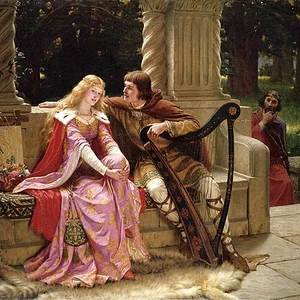
An instrument that Tristan plays with virtuosity; courtly music accompanies the loves and sorrows of the legend's heroes.

A magic drink mistakenly consumed by Tristan and Iseult the Fair, the source of their irrepressible passion; it indirectly explains why Iseult of the White Hands cannot be loved.
School Curriculum
Vocabulary & Tags
Key Vocabulary
Tags
Daily Life
Morning
Daughter of Duke Hoel, Iseult wakes in a chamber of the Breton castle and attends morning Mass in the manorial chapel. A princess's day begins with prayer and grooming assisted by her attendants.
Afternoon
The afternoon is spent at needlework, embroidery, and weaving — the noble pursuits of court ladies. She may also stroll through the gardens or listen to the jongleurs who sing of chivalrous exploits.
Evening
In the evening, the great hall comes alive with banquets where harpists and storytellers hold the company's attention. It is in this courtly setting that Tristan, a refugee in Brittany, charms the court with his music and eloquence.
Food
At the ducal table are served white bread, roasted meats (game, poultry), the sea fish so abundant in Brittany, all washed down with wine and mead. Spices, rare and costly, signal one's noble rank.
Clothing
Iseult wears long gowns (the *bliaut*) laced at the waist, made of silk and fine wool, draped with a fur-trimmed mantle. Veils and braids adorn her hair, and her white, well-tended hands earn her her nickname.
Housing
She lives in a Breton stronghold with walls of stone, made up of towers, a great hall (the *aula*), and private chambers (the *chambre*). Tapestries and wooden chests furnish an austere interior warmed by vast fireplaces.
Historical Timeline
Period Vocabulary
Liens externes & ressources
Références
Œuvres
Tristan de Thomas d'Angleterre
vers 1170
Tristan de Béroul
vers 1180
Tristrant d'Eilhart von Oberg
vers 1170-1190
Lai du Chèvrefeuille de Marie de France
vers 1185
Tristan de Gottfried de Strasbourg
vers 1210
Saga de Tristram et Ísönd
1226
Tristan en prose
vers 1230