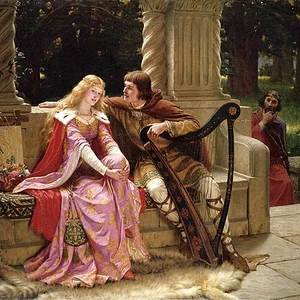

Iseult the Fair is the heroine of the medieval legend of Tristan and Iseult. An Irish princess who became the wife of King Mark of Cornwall, she lives a fatal, adulterous passion with the knight Tristan after accidentally drinking a love potion. Her story is one of the great love myths of the Matter of Britain.
Iseult
Iseult the Fair
7 min read
Frequently asked questions
Key Facts
- Central figure of the legend of Tristan and Iseult, drawn from Celtic traditions
- Major written versions in the 12th century by Béroul and Thomas of Britain
- Daughter of the King of Ireland, she marries King Mark of Cornwall
- The love potion drunk by mistake with Tristan seals their irrepressible passion
- Adapted by Gottfried von Strassburg in the early 13th century, then reworked by Wagner (opera Tristan and Isolde, 1865)
Works & Achievements
One of the oldest surviving versions in Old French; it establishes the episodes of the love potion, the flight into the Morrois forest, and the lovers' clever ruses.
A courtly version focused on the analysis of feelings, which develops the episode of the two Iseults and the tragic ending of the black sail.
A short poem that immortalizes the image of the honeysuckle and the hazel tree, inseparable, as a symbol of the love between Iseult and Tristan.
The poetic pinnacle of the legend in German, which makes Iseult a heroine of exceptional psychological intensity.
A vast prose adaptation that incorporates the lovers into the Arthurian cycle and ensures the European spread of their story.
A major opera that reinvents the legend in the 19th century and makes Iseult/Isolde a central figure of Romantic passionate love.
A scholarly reconstruction of the medieval fragments, which became the reference version through which the general public discovers Iseult.
Anecdotes
In the legend, everything is turned upside down because of a love potion: Iseult's mother had prepared a magic drink meant for Iseult and King Mark, to ensure their marital happiness. But on the ship carrying her to Cornwall, Iseult and the knight Tristan drink it by mistake, thinking it is wine, and fall into an irresistible passion.
Before becoming Tristan's lover, Iseult is first the one who saves him: skilled in medicine and herbs, she heals his poisoned wounds twice, without knowing that he has killed her uncle the Morholt. When she discovers in his sword the notch that matches a splinter found in the Morholt's skull, she nearly kills him in his bath.
The legend plays cruelly on two Iseults. Far from his beloved, Tristan marries another princess in Brittany, Iseult of the White Hands, but remains faithful at heart to Iseult the Fair. This shared name brings about the tragic ending: the sail of Iseult the Fair's ship, coming to heal him, is announced as black out of jealousy, and Tristan dies of despair just before her arrival.
In the 12th century, the poetess Marie de France devoted a short tale to Iseult and Tristan, the *Lai du Chèvrefeuille* (Lay of the Honeysuckle): Tristan carves his name on a hazel branch left on the path, a secret signal for Iseult to join him in the forest. The honeysuckle entwined around the hazel tree becomes the image of the lovers who cannot live without each other.
The legend enjoyed a spectacular second life in the 19th century. The composer Richard Wagner drew from it the opera *Tristan und Isolde* (1865), and in 1900 the scholar Joseph Bédier reconstructed a complete narrative from the medieval fragments: it is this version, *Le Roman de Tristan et Iseut* (The Romance of Tristan and Iseult), that millions of readers still read today.
Primary Sources
« Bele amie, si est de nus : / ni vus sanz mei, ni mei sanz vus. » (Sweet love, so it is with us: neither you without me, nor me without you.)
An Old French account of the love between Tristan and Queen Iseult, of their flight into the Morrois forest, and of the love potion whose effect, according to Béroul, was meant to last three years.
A “courtly” version of the legend, focused on the inner suffering of the lovers and on the final episode of the two Iseults and the black sail.
A vast Middle High German adaptation inspired by Thomas, regarded as the poetic summit of the legend; it remained unfinished at the author's death.
A French prose compilation that links Tristan and Iseult to the world of King Arthur and the Round Table, ensuring a very wide circulation for the legend.
Key Places
Native kingdom of Iseult, daughter of the king of Ireland, where she learns the art of healing and tends to the wounded Tristan. It is from here that she sets out to marry King Mark.
Castle and court of King Mark, where Iseult becomes queen. A place of official life and of the schemes of jealous barons who keep watch over the lovers.
The crossing aboard the ship where Iseult and Tristan unwittingly drink the love potion. This stretch of sea marks the turning point of the entire legend.
A wild forest where Iseult and Tristan take refuge to live out their love freely, far from the court. There they lead a life of wandering and hardship.
The land where Tristan, in exile, marries Iseult of the White Hands and where he lies dying. Iseult the Fair arrives there by sea too late to save him and dies of grief by his side.
Typical Objects

Magical drink prepared by Iseult's mother to bind her daughter forever to King Mark. Drunk by mistake by Iseult and Tristan, it triggers their incurable passion and forms the central driving force of the legend.

Weapon whose nick exactly matches the splinter found in the skull of the Morholt, slain by Tristan. It allows Iseult to recognize the killer of her uncle.

Ring that Iseult gives Tristan as a pledge of love and a token of recognition. When shown, it proves that a messenger truly comes on behalf of the queen.

Hazel twig on which Tristan inscribes his name and which he lays on Iseult's path, in the Lay of the Honeysuckle. It serves as a secret message between the lovers.

Agreed-upon signal on the ship coming from Cornwall: a white sail if Iseult is aboard, a black one otherwise. The lie about its color brings about Tristan's death.

Royal insignia of Iseult, who has become King Mark's wife. It symbolizes her official status, in constant tension with her clandestine passion for Tristan.

Instrument associated with the courtly world of the legend, played by Tristan, himself an accomplished musician, to charm the court and draw near to Iseult. Music connects the two lovers.
School Curriculum
Vocabulary & Tags
Key Vocabulary
Daily Life
Morning
Princess of Ireland and later Queen of Cornwall, Iseult begins her day in the ladies' quarters of the castle. We can picture her rising, praying and being dressed by her faithful attendant Brangwen, before appearing at the king's court.
Afternoon
Her days are divided between the duties of a queen — receiving guests, presiding, embroidering — and her skills as a healer, inherited from her mother, which make her an expert in plants and remedies. It is also the time for secret messages exchanged with Tristan.
Evening
In the evening, the court gathers for feasts, harp music and storytelling. Behind the appearance of a royal wife, Iseult lives in fear of the treacherous barons who spy on her clandestine meetings with Tristan.
Food
At the medieval royal table evoked by the legend, game, fish, white bread and wine served in goblets are on the menu. During the flight into the Morrois forest, however, the lovers make do with venison and whatever the forest provides.
Clothing
Iseult “the Fair” is described adorned in rich fabrics, fitted bliauts and fur-lined cloaks, her long golden hair being her distinguishing feature. In the forest, this finery gives way to clothes worn down by life in the wild.
Housing
She lives in the kings' stone castles, such as Mark's fortress in Cornwall, with its great halls and ladies' chambers. The Morrois episode, by contrast, shows her living in a hut of leaves in the heart of the woods.
Historical Timeline
Period Vocabulary
Liens externes & ressources
Références
Œuvres
Le Roman de Tristan (Béroul)
vers 1150-1190
Tristan (Thomas d'Angleterre)
vers 1170-1175
Lai du Chèvrefeuille (Marie de France)
vers 1170-1180
Tristan (Gottfried von Strassburg)
vers 1210
Le Roman de Tristan en prose
vers 1230-1240
Le Roman de Tristan et Iseut (Joseph Bédier)
1900