
Mordred is a character from Arthurian legend, the incestuous son of King Arthur and his half-sister. A traitor to the kingdom of Camelot, he brings about Arthur's downfall at the Battle of Camlann, where the two slay each other.
Mordred
Mordred
6 min read
Frequently asked questions
Key Facts
- Appears as early as Geoffrey of Monmouth's Historia Regum Britanniae (around 1138) under the name Modredus
- Presented as the incestuous son of Arthur and his half-sister (often Morgan) in the romances of the Vulgate Cycle (13th century)
- Takes advantage of Arthur's absence (gone to fight Lancelot) to usurp the throne and Queen Guinevere
- Slays and is slain by Arthur at the Battle of Camlann, marking the end of the kingdom of Camelot
- A central figure in La Mort le roi Artu (around 1230), the tale of the fall of the Round Table
Works & Achievements
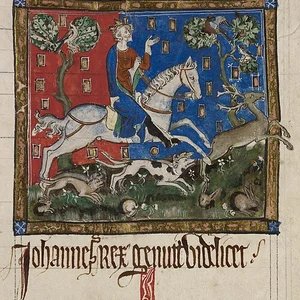
The first elaborate literary portrayal of Mordred, presented by Geoffrey of Monmouth as the usurping nephew whose treachery brings about Arthur's death.
Wace sets down Mordred's betrayal in the French language, tying it to the world of the Round Table, which he introduces.
Here Mordred acquires his incestuous birth and his dimension as a cursed son, the driving force behind the fall of the kingdom of the Grail.
The central account of the final betrayal and the deadly duel between Arthur and Mordred at Camlann.
Thomas Malory makes him the leader of the revolt that destroys the fellowship of the Round Table, the definitive English-language version.
Alfred Tennyson reinterprets Mordred in the Victorian era as the embodiment of the evil gnawing at Arthur's ideal kingdom.
Anecdotes
In the Arthurian tradition, Mordred is born of incest: King Arthur, unaware of the blood ties between them, lies with his half-sister (Morgause or Anna, depending on the version). This original sin foretells the kingdom's downfall, like a tragic curse hanging over Camelot.
According to legend, Arthur was warned of a prophecy that a child born on the 1st of May would bring about his ruin. He is said to have ordered all the kingdom's newborns gathered into a boat and set adrift at sea. Mordred, the sole survivor of the shipwreck, thus escapes death — an echo of the biblical Massacre of the Innocents.
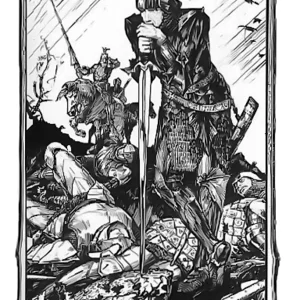
In the final battle of Camlann, Mordred and Arthur face each other in single combat. Arthur runs his son through with his lance, but Mordred, with a last surge of strength, slides along the shaft to deal his father a mortal wound to the head. The two enemies kill each other.
The character of Mordred evolves over the centuries: in Geoffrey of Monmouth (12th century), he is above all a usurper who seizes the throne and Queen Guinevere in Arthur's absence. Later, in the prose romances such as the Lancelot-Grail, his incestuous birth becomes central and heightens his role as a cursed traitor.
In several versions, Mordred does not merely betray: he marries or tries to marry Guinevere, Arthur's wife, sealing his rebellion. The queen then takes refuge in a tower of London to escape him.
Primary Sources
Arthur had entrusted the defence of Britain and of Queen Guinevere to his nephew Mordred; but the latter, treacherously, had himself crowned king and took the queen as his wife, in defiance of divine law.
Mordred was the most disloyal of men; he betrayed his uncle and his lord, he loved the queen and took her despite his sworn oath.
King Arthur struck Mordred so hard that he ran the lance through his body; but Mordred, feeling that he was mortally wounded, struck his father on the helmet with such force that he split the bone of his head.
The Battle of Camlann, in which Arthur and Medraut fell.
Key Places
Legendary city and seat of Arthur's kingdom, where Mordred first holds his place as a knight of the Round Table before plotting against the king.
Legendary battlefield where Arthur and Mordred face off and kill each other, sealing the fall of the kingdom. Its real location remains unknown.
Fortress where, in several versions, Queen Guinevere takes refuge and barricades herself to escape the forced marriage Mordred wants to impose on her.
Shore where Arthur's army lands on its return from the continent to face Mordred's rebel forces. The knight Gawain meets his death here in some accounts.
Mythical isle where Arthur, mortally wounded by Mordred, is carried away to be healed. The Arthurian otherworld associated with Morgan and the fairies.
Typical Objects

The weapon with which Mordred fights and mortally wounds Arthur at Camlann. It symbolises the son's rebellion against the father and the breakdown of the chivalric order.

The crown Mordred places upon his own head as he proclaims himself king of Britain during Arthur's absence on the Continent fighting his wars. It embodies usurpation and political betrayal.

The spear with which King Arthur runs Mordred through during their fatal duel. In several versions, Mordred drives himself up the shaft to strike his father.

The war helmet worn by Mordred and the knights at Camlann. The tale dwells on Arthur's helm, split open by the final blow of the dying Mordred.

In several tales, Mordred spreads the false rumour of Arthur's death to justify his coronation and his marriage to Guinevere. The false news is the instrument of his treachery.

The shield bearing Mordred's coat of arms, a knight of the Round Table before his betrayal. It recalls his original membership in the chivalry of Camelot.
School Curriculum
Vocabulary & Tags
Key Vocabulary
Daily Life
Morning
As a Knight of the Round Table before his betrayal, Mordred begins his day with Mass and weapons training in the courtyard of Camelot. He practises with the sword, the lance and horsemanship like every knight of the Arthurian tale.
Afternoon
The afternoon is devoted to quests, tournaments and the service of the king. But Mordred, gnawed by ambition, also uses this time to weave intrigues and plot against Arthur in the shadows.
Evening
In the evening, the court gathers for the feast in the great hall, around the Round Table where each knight has his place. Mordred takes part in it, masking his treachery beneath the appearance of loyalty.
Food
Like the nobles of medieval tales, Mordred feeds on roasted meats (game, poultry, pork), bread, and drinks wine and mead at the banquets. These feasts are key moments of Arthurian court life.
Clothing
Mordred wears a knight's gear: a coat of mail, a helm, a surcoat bearing his coat of arms and a cloak. In times of peace, he dons the rich fabrics and furs of the lords of the court.
Housing
He resides in the castles and fortresses of the realm, at the heart of Camelot. When he usurps the throne, he settles into the strongholds of Britain and attempts to hold London.
Historical Timeline
Period Vocabulary
Liens externes & ressources
Références
Œuvres
Personnage de l'Historia Regum Britanniae
vers 1136
Figure du Roman de Brut
vers 1155
Rôle dans le cycle Lancelot-Graal (Vulgate)
vers 1215-1235
La Mort le roi Artu
vers 1230-1235
Antagoniste du Morte d'Arthur de Malory
vers 1469-1470
Personnage des Idylls of the King
1859-1885