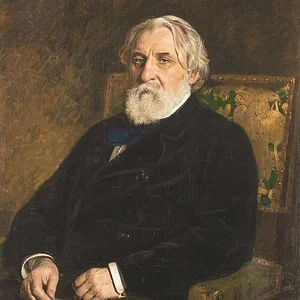

Ivan Turgenev was a 19th-century Russian writer, novelist, and playwright. A major figure of Russian realism, he is the author of *Fathers and Sons* and helped introduce Russian literature to Western Europe.
Ivan Turgenev(1818 — 1883)
Ivan Turgenev
Empire russe
5 min read
Frequently asked questions
Famous Quotes
« Russia can do without any one of us, but none of us can do without her.»
Key Facts
- Born in 1818 in Oryol, into a family of the Russian landed gentry
- Published *A Sportsman's Sketches* (1852), denouncing the conditions of serfdom
- Released his most famous novel, *Fathers and Sons* (1862), which popularized the figure of the nihilist Bazarov
- Lived much of his life in Western Europe (France, Germany), close to Flaubert and the French writers
- Died in 1883 in Bougival, near Paris
Works & Achievements
A collection of short stories that portrays the lives of serfs and peasants with great humanity, contributing to the debate on the abolition of serfdom.
A psychological play, regarded as a step toward the inner drama that would later inspire Chekhov.
Turgenev's first novel, the portrait of an irresolute idealist, the archetype of the “superfluous man” of Russian literature.
A melancholy novel about the Russian rural nobility, one of his greatest successes with readers.
A largely autobiographical novella about the stirrings and disillusionments of youth.
A masterpiece in which the character of Bazarov embodies nihilism and the clash of generations in the Russia of the reforms.
His last great novel, devoted to the populist movement of young revolutionaries “going to the people.”
A collection of short lyrical and meditative texts, including the famous tribute to the Russian language.
Anecdotes
It was Turgenev who popularized the word “nihilist” through his hero Bazarov in *Fathers and Sons* (1862). The novel stirred such controversy that young revolutionaries and conservatives alike felt insulted: each was convinced they were the ones being caricatured.
In 1852, Turgenev published a glowing obituary of the writer Gogol, even though the censors had banned it. He was arrested, spent a month in prison, and was then placed under house arrest on his estate at Spasskoye for nearly eighteen months.
In 1843, he met the French opera singer Pauline Viardot and conceived a love for her that would last his entire life. He followed her family across Europe — Baden, London, Paris — and never married, often settling close by her side.
In 1861, a violent argument with Leo Tolstoy nearly escalated into a pistol duel. The two giants of Russian literature remained estranged for seventeen years before reconciling in 1878.
His *A Sportsman's Sketches* (1852) portrayed the life of the serfs with such humanity that, according to a persistent tradition, reading it is said to have helped move Russian public opinion and the future Tsar Alexander II, who abolished serfdom in 1861.
Primary Sources
A nihilist is a man who bows before no authority, who accepts no principle as an article of faith, however much that principle may be revered.
In days of doubt, in days of painful brooding over the fate of my homeland, you alone are my stay and my support, O great, mighty, truthful and free Russian tongue!
The passionate hunter alone knows those secluded places where one hears the murmur of springs and the rustling of leaves, where man and earth still seem to live on in silence.
I have no other nest than the edge of another's nest. Where she is, there is my homeland.
Key Places
City in central Russia where Turgenev was born in 1818, at the heart of a region of noble estates.
Family estate near Mtsensk where Turgenev grew up, was placed under house arrest, and wrote part of his work.
Turgenev studied philosophy here from 1838 to 1841 and was shaped by the Western ideas that would mark his thinking.
German spa town where the writer settled in the 1860s to live near the Viardot family.
Literary capital where Turgenev mixed with Flaubert, Zola, and the Goncourts, becoming a bridge between Russian and French letters.
Town on the banks of the Seine where the writer owned a villa and where he died in 1883.
Typical Objects

The novelist's everyday writing instruments; he drafted his manuscripts by hand before revising them at length.

Turgenev was a passionate hunter who roamed the Russian countryside with his weapon and his dog. These hunting trips inspired his *A Sportsman's Sketches*.

A notebook in which the writer recorded his novels and short stories before publication. Turgenev constantly reworked his texts.

Turgenev was a renowned chess player who frequented the Parisian clubs and even presided over an international chess congress.

A Russian metal urn used to prepare tea, a central feature of domestic life in the homes of the nobility.

Found in the Viardot household that Turgenev frequented, it accompanied the musical evenings where the singer Pauline Viardot performed.
School Curriculum
Vocabulary & Tags
Key Vocabulary
Daily Life
Morning
On his Spasskoye estate, Turgenev rose early and devoted his mornings to writing, pen in hand, patiently reworking his pages. On his leisure days, he set off hunting in the surrounding woods and fields with his dog.
Afternoon
The afternoon was often given over to reading, to abundant correspondence with his writer friends, and to walking. In town, he would call on literary circles or play chess.
Evening
Evenings were spent in the salons: in Baden or in Paris, he attended the concerts held at Pauline Viardot's home, listened to music, and conversed with the great French authors of his day.
Food
Like the Russian nobility, he enjoyed tea served from the samovar, soups (such as borscht or shchi), black bread, and game. In France, he savoured with relish the refined cuisine of the literary dinners.
Clothing
Turgenev wore the dress of the cultured nineteenth-century man: a dark frock coat, a waistcoat, a high-collared shirt, and a cravat. His great height and white beard commanded respect in the salons.
Housing
He lived in the vast family manor of Spasskoye, surrounded by servants and serfs, then in comfortable villas and apartments in Germany and France, always close to the Viardot family.
Historical Timeline
Period Vocabulary
Liens externes & ressources
Références
Œuvres
Récits d'un chasseur (Mémoires d'un chasseur)
1852
Un mois à la campagne
1855
Un nid de gentilhomme
1859
Premier amour
1860
Pères et Fils
1862
Terres vierges
1877