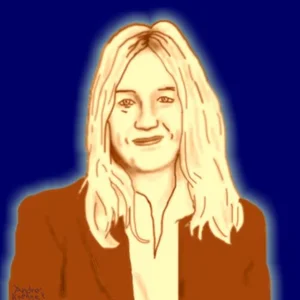

J.K. Rowling is a British novelist born in 1965, author of the Harry Potter saga (1997-2007), one of the best-selling literary series in history. A single mother at the time she wrote the first volume, she became a major figure in children's and young adult literature worldwide.
J.K. Rowling
J.K. Rowling
5 min read
Frequently asked questions
Famous Quotes
« It is impossible to live without failing at something, unless you live so cautiously that you might as well not have lived at all.»
Key Facts
- Born on 31 July 1965 in Yate, England
- Publishes Harry Potter and the Philosopher's Stone in 1997, the first volume of the saga
- Completes the series in 2007 with Harry Potter and the Deathly Hallows (7 volumes)
- The novels are adapted into eight successful films between 2001 and 2011
- Later writes crime novels under the pen name Robert Galbraith
Works & Achievements
The first volume of the saga; it unveils the world of Hogwarts and launches a worldwide literary phenomenon.
The second volume, which confirms the series' success with young readers.
The third volume, often praised for its darker plot and masterful storytelling.
The fourth volume, much longer, marking the saga's shift toward weightier themes.
The fifth volume; its release prompted midnight bookstore openings around the world.
The sixth volume, which broke sales records on its very first day.
The seventh and final volume, which brings the saga to a close and became the fastest-selling book in a single day.
A crime novel published under a pseudonym, proving she could be read without relying on her fame.
Anecdotes
In 1990, the idea for Harry Potter came to her suddenly on a delayed train between Manchester and London. Having no pen with her, she let her imagination work throughout the journey and mentally composed the character of the young orphaned wizard.
Before being published, J.K. Rowling endured a dozen rejections from publishers. Bloomsbury finally accepted the manuscript after the chairman's eight-year-old daughter, Alice Newton, demanded to read more after finishing the first chapter.
Her publisher advised her to sign with her initials rather than her first name, fearing that boys would not buy a book written by a woman. Having no middle name, she borrowed the “K” from her grandmother Kathleen: thus “J.K. Rowling” was born.
A single mother living on welfare in Edinburgh, she wrote part of the first volume in the city's cafés, taking advantage of the warmth and quiet while her daughter napped. Ten years later, she was among the most widely read authors in the world.
In 2008, invited to deliver the commencement address at Harvard University, she chose as her theme the virtues of failure, recalling that she had once considered herself one of the biggest “failures” she knew before bouncing back.
Primary Sources
Mr and Mrs Dursley, of number four, Privet Drive, were proud to say that they were perfectly normal, thank you very much.
Rock bottom became the solid foundation on which I rebuilt my life.
Imagination is not only the uniquely human capacity to envision that which is not, and therefore the fount of all invention and innovation.
Key Places
Town near Bristol where Joanne Rowling was born on 31 July 1965.
Here she studied French and Classics before working for a time in London.
Here she taught English in the early 1990s and continued writing the first chapters of Harry Potter.
In the mid-1990s, a young mother of modest means, she wrote much of the first book in the city's cafés.
The end of the journey on which she came up with the idea for the novel; the station would inspire the saga's famous Platform 9¾.
Liens externes & ressources
Références
Œuvres
Harry Potter à l'école des sorciers
1997
Harry Potter et la Chambre des secrets
1998
Harry Potter et le Prisonnier d'Azkaban
1999
Harry Potter et la Coupe de feu
2000
Harry Potter et l'Ordre du Phénix
2003
Harry Potter et le Prince de sang-mêlé
2005
Harry Potter et les Reliques de la Mort
2007