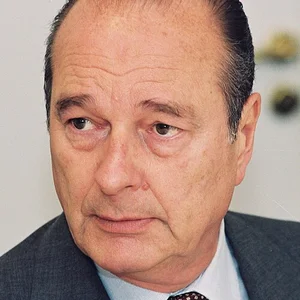

French statesman, President of the Republic from 1995 to 2007. A major figure of the Gaullist right, he was also Prime Minister and Mayor of Paris over a long political career.
Jacques Chirac(1932 — 2019)
Jacques Chirac
France
6 min read
Frequently asked questions
Famous Quotes
« Our house is burning down and we are looking elsewhere.»
« The French have had enough of what is commonly called the social divide.»
« Yes, the criminal folly of the occupier was assisted by French people, by the French State.»
Key Facts
- Prime Minister from 1974 to 1976 under Valéry Giscard d'Estaing, then from 1986 to 1988 in a power-sharing arrangement with François Mitterrand
- Mayor of Paris from 1977 to 1995
- Founded the Rally for the Republic (RPR) in 1976
- Elected President of the Republic in 1995, re-elected in 2002 against Jean-Marie Le Pen
- In 1995 acknowledged the French State's responsibility in the Vél' d'Hiv Roundup, and in 2003 refused to commit France to the war in Iraq
Works & Achievements
Official recognition of the French State's responsibility in the deportation of Jews. A major act of remembrance in the history of the Republic.
France refuses to support the American intervention, asserting the independence of its diplomacy at the UN. A stance praised across much of the world.
Parisian museum dedicated to the arts of Africa, Asia, Oceania and the Americas, championed by Chirac, who was passionate about these civilizations. Today it bears his name.
Chirac sets in motion the professionalization of the armed forces and the end of conscription. A profound change in the lives of young French people.
Adopted by referendum, it replaces the seven-year term and brings the presidential election closer to the legislative ones. A lasting institutional reform.
Enshrined in the Constitution, it recognizes the right to a healthy environment. It reflects the ecological commitment championed by Chirac.
Created after his presidency to work for peace, development and access to water and medicine. It awards a prize for conflict prevention.
Anecdotes
Jacques Chirac loved fine dining and had a particular fondness for *tête de veau* (calf's head), a dish he often ordered. This image of a man who enjoyed good food and patted the rumps of cows at the Agricultural Show shaped his reputation as a politician close to ordinary French people.
On 16 July 1995, during the commemoration of the Vél' d'Hiv Roundup, Chirac became the first French president to officially acknowledge the responsibility of the French State in the deportation of Jews during the Occupation. This speech marked a historic break with his predecessors.
In 2003, as the United States prepared to invade Iraq, Chirac's France firmly opposed the move at the UN. The speech delivered by his minister Dominique de Villepin was applauded — an extremely rare event at the Security Council — and made Chirac very popular in the Arab world.
As a young man, before becoming a Gaullist politician, Chirac had worked as a bartender and signed the “Stockholm Appeal” against atomic weapons. He had also crossed the Atlantic on a cargo ship and worked in a restaurant in the United States during his studies.
In 1995, shortly after his election, Chirac decided to resume French nuclear testing in the Pacific, sparking a wave of international protests. He brought it to a definitive end a few months later in 1996.
Primary Sources
These dark hours forever sully our history and are an insult to our past and our traditions. Yes, the criminal madness of the occupier was assisted by the French, by the French State.
I have decided to dissolve the National Assembly. Legislative elections will be held at the end of May and the beginning of June.
Our house is burning and we are looking elsewhere.
In this temple of the United Nations, we are the guardians of an ideal, we are the guardians of a conscience.
Key Places
Jacques Chirac was born here on 29 November 1932, at the Geoffroy-Saint-Hilaire clinic. He would later become mayor of this very city.
Official residence and workplace of the President of the Republic, occupied by Chirac from 1995 to 2007. It was here that he made his major decisions.
Seat of the Paris municipal government, where Chirac served as mayor from 1977 to 1995. There he built much of his political power.
Village in the Corrèze region from which Chirac's family originated; he made the Corrèze his electoral stronghold and served there as departmental councillor and then as a member of parliament.
Jacques Chirac has rested here since his death on 26 September 2019. His grave has become a place of remembrance.
Typical Objects

An insignia worn by Chirac during his eighteen years as Mayor of Paris. It symbolizes municipal authority and the Republic.

Tools of universal suffrage by which Chirac was elected and re-elected president. They embody the democratic workings of the country.

From the Élysée Palace, Chirac addressed the French people during solemn televised speeches. The lectern bearing the presidential emblem stages the voice of the State.

The instrument with which the president enacts the laws passed by Parliament. It gives physical form to the final act of executive power in the making of the law.

The euro became the everyday currency of the French in 2002, under Chirac's presidency, replacing the franc. A concrete change experienced by the entire population.

Television was the main way the French discovered Chirac's speeches and debates. It turned politics into a spectacle that entered every home.
School Curriculum
Vocabulary & Tags
Key Vocabulary
Daily Life
Morning
At the Élysée, Chirac's day began early with reading the press review and the advisers' briefing notes. He moved from one work meeting to the next, including the traditional Wednesday morning Council of Ministers.
Afternoon
The afternoon was devoted to audiences with ministers, diplomats and foreign heads of state, as well as official trips within France or abroad. Chirac was especially fond of working the crowds, shaking hands and chatting with ordinary people.
Evening
The evening might be taken up by state dinners, televised addresses or preparing the next day's files. A lover of good food, he enjoyed a convivial meal and knew how to unwind.
Food
Chirac loved generous, traditional cooking: tête de veau (calf's head), charcuterie and regional country dishes. At the Agricultural Show, he happily sampled the produce and drank beer, a down-to-earth image that brought a smile to the French.
Clothing
As president, he wore the classic dark suit of statesmen, often with an understated tie. Tall and elegant, he took care over his bearing during official ceremonies.
Housing
During his two terms, he lived at the Élysée Palace, in the heart of Paris. He was also attached to the Château de Bity, in Corrèze, his beloved home region where he liked to recharge.
Historical Timeline
Period Vocabulary
Liens externes & ressources
Références
Œuvres
Discours du Vél' d'Hiv
1995
Opposition à la guerre en Irak
2003
Création du musée du quai Branly
2006
Abolition du service militaire obligatoire
1997-2001
Réduction du mandat présidentiel à 5 ans (quinquennat)
2000
Charte de l'environnement
2004-2005
Fondation Chirac
2008