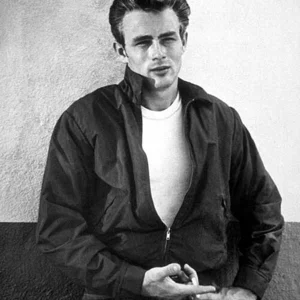

Iconic American actor of the 1950s, James Dean embodied youth rebellion in three cult films. Dying at 24 in a car crash, he became an immortal cultural icon.
James Dean(1931 — 1955)
James Dean
États-Unis
8 min read
Frequently asked questions
Famous Quotes
« Dream as if you'll live forever. Live as if you'll die today.»
« Live fast, love hard, and die young.»
Key Facts
- 1931: Born in Marion, Indiana
- 1955: Role in East of Eden, his first major box-office success
- 1955: Filming of Rebel Without a Cause, a defining film for an entire generation
- September 30, 1955: Died in a car accident at age 24
- The only actor to receive two posthumous Academy Award nominations
Works & Achievements
James Dean's first major film, adapted from John Steinbeck's novel and directed by Elia Kazan. Dean plays Cal Trask, a young man desperate for his father's love — a role that earned him a posthumous Oscar nomination.
Nicholas Ray's film in which Dean plays Jim Stark, a rebellious and misunderstood teenager. His red jacket and brooding presence made him a worldwide icon of 1950s youth.
An epic saga directed by George Stevens, filmed in Texas, in which Dean plays an ambitious oil worker across several decades. Released after his death, the film earned him a second posthumous Oscar nomination.
A stage role that caught Elia Kazan's attention and launched Dean's film career. His performance in this adaptation of André Gide's novel landed him the role of Cal in East of Eden.
Anecdotes
James Dean grew up in Fairmount, Indiana, raised by his aunt and uncle after his mother died when he was just nine years old. This childhood wound deeply shaped his acting, particularly in 'Rebel Without a Cause', where he portrays a teenager misunderstood by his parents.
A passionate speed enthusiast, James Dean pursued auto racing alongside his acting career. He had purchased a Porsche 550 Spyder he nicknamed 'Little Bastard'. It was behind the wheel of that car that he died on September 30, 1955, on Route 46 in California, at just 24 years old.
Dean was the first actor in history to receive two posthumous Oscar nominations for Best Actor: for 'East of Eden' (1956) and for 'Giant' (1957). Despite only three films, his impact on world cinema remains immense.
A student at the Actors Studio in New York, James Dean practiced the Stanislavski method, immersing himself completely in his characters. To prepare for his role in 'Giant', he learned to ride horses and carry himself like a Texas cowboy, going so far as to adopt the accent and mannerisms of local ranchers.
Outside of cinema, James Dean played bongos, drew, and had an interest in bullfighting. He regularly corresponded with fans and friends by letter, revealing a sensitivity and artistic depth that his rebel image did not necessarily suggest.
Primary Sources
I want to be a director. I want to do it my way. Acting is an art, and I want to be in control of the whole picture someday.
I've finally landed a real role on Broadway. I know I'm going to make it. Don't worry about me — I'm working hard and learning every day.
James Dean burst onto the Hollywood scene like a comet. His instinctive, visceral style of acting is shaking up the conventions of classical American cinema.
Jimmy was one of a kind. There was something both animal and vulnerable about him. You couldn't direct him like an ordinary actor — you had to let him find the character on his own.
The Porsche 550 Spyder registered to James Byron Dean collided with a Ford Tudor at the intersection of Route 46 and Route 41. Driver Dean was pronounced dead on arrival at the hospital.
Key Places
James Dean's hometown, where he grew up with his uncle Marcus and aunt Ortense after his mother's death. Visitors can explore the James Dean Memorial and the museum dedicated to him.
The legendary Manhattan theater school where Dean trained in the Stanislavski method alongside Marlon Brando and other future stars of American cinema.
The world capital of cinema, where Dean shot his three iconic films between 1954 and 1955, becoming an international star in less than two years.
The site of James Dean's fatal accident on September 30, 1955. A sculpted steel memorial was erected near the Jack Ranch Café restaurant in tribute to the actor.
A small town in the Texas desert where 'Giant' (1955), Dean's final film, was shot. Filming lasted several months, and the town still bears traces of this historic production today.
Typical Objects

Worn by Dean in 'Rebel Without a Cause' (1955), this red jacket became one of the most powerful symbols of teenage rebellion. It is now preserved at the Warner Bros. Museum and has been reproduced worldwide.

The sports car Dean had nicknamed 'Little Bastard' embodied his passion for speed and his taste for risk. It was behind the wheel of this vehicle that he met his death in 1955 on a California road.

A symbol of American counter-culture in the 1950s, the jeans Dean wore in his films helped popularize this working-class garment among young people worldwide, much to the dismay of many parents at the time.

Often photographed with a cigarette on his lips, Dean turned it into a prop for his image as a cool, nonchalant rebel, reflecting the codes of masculinity among American youth in the 1950s.

Dean played bongo drums in his leisure time, an instrument associated with the beatnik and bohemian culture of Greenwich Village in New York, where he lived during his early days as an actor.

A passionate photographer, Dean loved capturing everyday life and his friends. Several of his photos have been preserved and reveal a personal artistic eye that extended beyond his acting career.
School Curriculum
Vocabulary & Tags
Key Vocabulary
Tags
Daily Life
Morning
James Dean was a late riser, a true bohemian artist. He often started his day with black coffee and a few cigarettes in his New York apartment or his dressing room in Hollywood. He read extensively — novels, poetry, plays — to fuel his inspiration before rehearsals or shooting.
Afternoon
Afternoons were devoted to filming, often long and intense sessions, or to rehearsals at the Actors Studio. Between takes, Dean liked to play guitar or bongos backstage. On weekends, he would head to racetracks to compete in car races, his great passion.
Evening
In the evenings, Dean haunted jazz clubs and cafés in Greenwich Village in New York, or the trendy restaurants along the Sunset Strip in Hollywood. He hung out with fellow artists and actors, talking cinema and philosophy late into the night. He also photographed his friends and the city streets.
Food
Dean had a simple, unstructured diet typical of a young man of his era and circumstances: hamburgers, milkshakes, and sandwiches at American diners. Growing up in Indiana, he had been raised on traditional Midwestern home cooking — meat, potatoes, and homemade pies.
Clothing
Dean's image is inseparable from his clothes: faded Levi's 501 jeans, white T-shirt, leather or denim jacket. He also wore cowboy boots on the set of Giant. His working-class, casual style was a sharp contrast to the polished elegance of classic Hollywood stars, and became a template for an entire generation.
Housing
In New York, Dean lived in small, modest Manhattan apartments, particularly in Greenwich Village, surrounded by artists and Beatnik intellectuals. In Hollywood, he rented houses near the studios. He had grown up on the family farm in Fairmount, Indiana, amid fields of corn.
Historical Timeline
Period Vocabulary
Visual Style
Esthétique cinématographique américaine des années 1950 mêlant noir et blanc dramatique et premiers Technicolor, portraits en clair-obscur d'un jeune homme rebelle sur fond de paysages immenses.
Sound Ambience
Un mélange de rock'n'roll naissant, de moteurs rugissants et de l'effervescence des studios hollywoodiens des années 1950, reflet de l'Amérique d'après-guerre en pleine mutation culturelle.