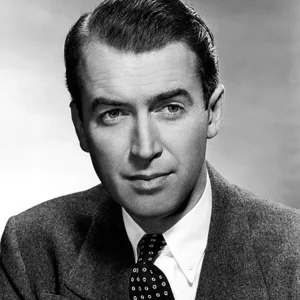

James Stewart was one of the most popular actors of classic Hollywood cinema. An embodiment of the ordinary, upright American, he worked under the direction of Frank Capra and Alfred Hitchcock from the 1930s to the 1970s.
James Stewart(1908 — 1997)
James Stewart
États-Unis
6 min read
Frequently asked questions
Key Facts
- Born on May 20, 1908, in Indiana, Pennsylvania, and died on July 2, 1997, in Los Angeles
- Won the Academy Award for Best Actor in 1941 for *The Philadelphia Story*
- Played the role of George Bailey in Frank Capra's *It's a Wonderful Life* (1946)
- Worked with Alfred Hitchcock on *Rear Window* (1954) and *Vertigo* (1958)
- A bomber pilot during the Second World War, he reached the rank of brigadier general in the reserve
Works & Achievements
Frank Capra film in which Stewart plays an idealistic young senator fighting corruption single-handedly. Here he established his persona as the honest, ordinary American.
A polished comedy alongside Katharine Hepburn and Cary Grant that earned Stewart his only Academy Award for Best Actor.
A Frank Capra Christmas tale that became a worldwide classic, in which a despairing man discovers the value of his life. Stewart's favorite role.
A comedy in which Stewart plays a gentle man whose best friend is an invisible giant rabbit. The role became one of the most beloved of his career.
An Alfred Hitchcock thriller in which Stewart, a photographer immobilized by a broken leg, suspects a neighbor of murder while spying on him through the window.
Hitchcock's masterpiece about obsession and vertigo, often cited today among the greatest films in the history of cinema.
A courtroom film in which Stewart plays a small-town lawyer; a realistic, nuanced role that reinvented his image.
A John Ford Western reflecting on legend and truth in the conquest of the West, with John Wayne at his side.
Anecdotes
During World War II, James Stewart did more than play heroes on screen: he genuinely enlisted in the United States Army Air Forces and piloted bombers on combat missions over Germany. He ended his military career with the rank of brigadier general, one of the highest ever achieved by a movie star.
When he won the Academy Award for Best Actor in 1941 for *The Philadelphia Story*, he sent the statuette to his father in their small Pennsylvania town. His father proudly displayed it in the window of the family hardware store, where it remained on view for years.
Stewart and the actor **Henry Fonda** were friends for nearly fifty years. As broke young actors, they shared an apartment and spent their evenings building model airplanes and miniature kites. Despite holding sharply opposing political views, they remained inseparable until Fonda's death in **1982**.
When it was released in **1946**, *It's a Wonderful Life* was a commercial failure. Only decades later, thanks to Christmas television broadcasts, did the film become one of the most beloved in the history of American cinema and Stewart's own favorite role.
In 1981, on a television program hosted by **Johnny Carson**, Stewart read a poem he had written for his dog Beau, who had recently died. His trembling voice and his tears moved the entire audience: that moment revealed the sensitive man behind the figure of the American hero.
Primary Sources
Every time a bell rings, an angel gets his wings.
The great causes worth fighting for are always lost causes, because you have to defend them against everyone.
Stewart speaks of his gratitude for the acting profession and the good fortune of having worked with great directors such as Capra and Hitchcock.
Stewart reads aloud, live, a poem he wrote for his late dog, breaking off as he is overcome with emotion.
Key Places
Small town where James Stewart was born and raised, and where his father ran a family hardware store. The town honors him today with a museum.
Prestigious university in New Jersey where Stewart studied architecture before turning to theater and then film.
District of Los Angeles at the heart of the American film industry, where Stewart shot most of his films under contract with the major studios.
American air base in England from which Stewart took off for his bombing missions during World War II.
Affluent residential district of Los Angeles where Stewart lived with his family and where he died in 1997.
Large cemetery in the Los Angeles area where many Hollywood stars are buried, including James Stewart.
Typical Objects

Heavy film camera used on Hollywood studio sets to film actors. It recorded the image on silver film 35 millimeters wide.

Small gilded statue awarded each year by the American film Academy. Stewart received one in 1941 for “The Philadelphia Story.”

Lined leather flight jacket worn by bomber pilots during the Second World War. Stewart wore one as a genuine air force pilot.

Large American four-engine aircraft used for bombing raids in Europe. Stewart commanded squadrons of this type during combat missions.

Large painted or printed poster put up outside theaters to announce a film and its star actor. It was used to draw in audiences.

Microphone hung from a long pole above the actors to capture their dialogue while filming talking pictures. It stayed out of the camera's frame.

Booklet of pages containing the dialogue and acting directions the actor had to learn. Stewart annotated it to prepare his roles.
School Curriculum
Vocabulary & Tags
Key Vocabulary
Tags
Daily Life
Morning
On a shooting day, Stewart would get up early to reach the studio before dawn. He first went through makeup and wardrobe, then reviewed his lines over a cup of coffee before the first takes.
Afternoon
Afternoons were spent on set, running through takes under the scorching lights, sometimes filming the same scene a dozen times. Between takes, he chatted with the director and the crew in a patient working atmosphere.
Evening
In the evening, after the shoot, he would return home to Beverly Hills to be with his wife and children. A discreet, stay-at-home man, he preferred a quiet family evening to Hollywood's society parties.
Food
Stewart enjoyed simple, no-frills American cooking, such as steak, potatoes, and pie. He nonetheless had to watch his diet to keep the famous tall, slender figure he was known for on screen.
Clothing
Around town, he wore understated, elegant suits, fitting the image of the ordinary man he portrayed. For his roles, he donned everything from the suit of the model citizen to the hat and gun belt of the Western cowboy.
Housing
He lived in a comfortable Beverly Hills house surrounded by a garden where he grew flowers. Far from the ostentatious luxury of some stars, he led an orderly and peaceful family life.
Historical Timeline
Period Vocabulary
Liens externes & ressources
Références
Œuvres
Indiscrétions (The Philadelphia Story)
1940
La vie est belle (It's a Wonderful Life)
1946
Fenêtre sur cour (Rear Window)
1954