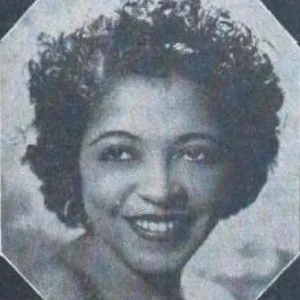

Valaida Snow (1904-1956) was an African American jazz trumpeter, singer, and bandleader. Nicknamed “the Queen of the Trumpet,” she enjoyed an international career between the two World Wars before the Second World War shattered her trajectory.
Valaida Snow(1904 — 1956)
Valaida Snow
États-Unis
6 min read
Frequently asked questions
Key Facts
- Born on June 2, 1904, in Chattanooga, Tennessee, she was one of the few female jazz trumpeters of her time.
- Nicknamed “Little Louis” in reference to Louis Armstrong, she was hailed as a virtuoso of the trumpet in the 1920s and 1930s.
- A multi-instrumentalist, she toured across the United States, Europe, and Asia (Shanghai, the Middle East) during the interwar years.
- Detained in Denmark during the German occupation in the early 1940s, she was repatriated to the United States in 1942, an ordeal that left a lasting mark on her health.
- She died on May 30, 1956, in New York and remains a pioneering figure among women instrumentalists in jazz.
Works & Achievements
Eubie Blake and Noble Sissle's show where she got noticed, at the height of the Harlem Renaissance.
A run of concerts that made her one of the few African-American artists to travel the world so early.
A series of jazz and swing records that captured her voice and her trumpet for posterity.
A showcase recording summing up her three strengths: elegance, the trumpet, and rhythm.
An upbeat swing number that became one of her best-known songs.
A recording made in Copenhagen, a window onto her European career just before the war.
Anecdotes
At a time when the trumpet was considered a “man's instrument,” Valaida Snow established herself as an acclaimed virtuoso. Her playing resembled that of Louis Armstrong so closely that audiences nicknamed her “Little Louis,” and it is said that Armstrong himself ranked her among the finest trumpeters of his day. She was also known as “the Queen of the Trumpet.”
Raised in a family of musicians, Valaida Snow learned at a very young age to play a great many instruments: violin, cello, banjo, accordion, clarinet, saxophone... The posters for her shows boasted of her mastery of half a dozen instruments, which she would play one after another on stage to dazzle the audience.
As early as the 1920s, Valaida Snow traveled the world far beyond what most American artists did: she performed in Shanghai, across Asia, in the Near East, and then throughout Europe. At a time when traveling so far was rare and costly, she became a true international star.
Valaida Snow cultivated a dazzling stage image built around her favorite color, orchid: mauve gowns, and even, so the story goes, an orchid-colored automobile driven by a chauffeur in a matching uniform. She played a golden trumpet, which legend holds was given to her by a distinguished admirer in Europe.
Having gone to Europe to sing, she found herself trapped there by the war. Arrested and interned in Nazi-occupied Denmark, she was not repatriated to the United States until 1942, during a prisoner exchange. Weakened and scarred by the ordeal, she would later struggle to recapture her prewar fame.
Primary Sources
The very title of this record — “High Hat, Trumpet and Rhythm” — sums up her art: elegance, the trumpet, and swing. On it, Valaida Snow alternates between singing and trumpet solos, showcasing her dual talent.
A humorous swing number she cut in Europe, where her voice trades phrases with her muted trumpet. The record captures the energy of her danceable music.
Cut in Scandinavia on the eve of the war, this track attests to Valaida Snow's European career and the popularity of hot jazz in northern Europe.
In the mid-1930s, settled in London, Valaida Snow appeared in brief musical films that rank among the rare filmed records showing her sing and play on stage.
Key Places
Birthplace of Valaida Snow, in the segregated South where she grew up in a family of musicians.
A major hub of 1920s-1930s jazz where she performed, notably in the wake of the great orchestras of the swing era.
A stop on her Asian tours, where African American musicians enlivened the cabarets of the cosmopolitan city.
The city where she settled in the mid-1930s, triumphing in the music halls and recording for Parlophone.
She recorded here in the late 1930s, then found herself trapped and interned during the Nazi occupation.
The city where she continued her career after the war and where she died in 1956, shortly after a concert.
Typical Objects

Iconic instrument of Valaida Snow, who played a gold-plated trumpet, a symbol of her nickname the “Queen of the Trumpet.”

A small accessory slipped into the trumpet's bell to dampen and color the sound; she used it for her very jazzy “wah-wah” effects.

A glamorous outfit matching her signature color, orchid mauve, which was part of her image as an international star.

She was said to own a car painted in her favorite color, driven by a chauffeur in matching livery — a symbol of her spectacular lifestyle.

A fragile shellac disc onto which her 1930s recordings were cut, which made her voice and trumpet known.

A document essential to her career of world tours, from Shanghai to London, at a time when few artists traveled so widely.
School Curriculum
Vocabulary & Tags
Key Vocabulary
Tags
Daily Life
Morning
A touring musician's mornings were devoted to working on her instrument: trumpet exercises, sight-reading scores, and rehearsals with the orchestra to break in new arrangements.
Afternoon
Afternoons were split between traveling from one city to another, costume fittings, sound checks in the hall, and professional obligations with her manager and the cabaret directors.
Evening
Evening was showtime: under the spotlights of cabarets and music halls, she sang, played the trumpet, and sometimes conducted the orchestra, often late into the night.
Food
Life on tour meant meals taken at irregular hours, in hotels or backstage. Traveling from Shanghai to Europe, she sampled a wide variety of cuisines depending on the countries she passed through.
Clothing
On stage, she wore long, sparkling gowns, often in her signature color, orchid. Around town, she cultivated a refined elegance befitting an international star.
Housing
With no fixed home during her tours, she lived mostly in hotel rooms and rented apartments, in London and the major European cities where she stayed for extended periods.