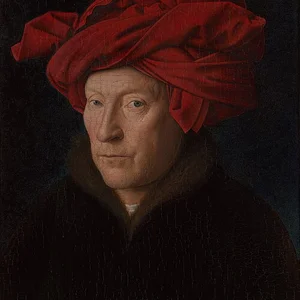

Flemish painter of the early 15th century, a leading figure of the Early Netherlandish painters. A master of portraiture and meticulous realism, he raised oil painting to an unprecedented level of refinement.
Jan van Eyck(1390 — 1441)
Jan van Eyck
Pays-Bas méridionaux
7 min read
Frequently asked questions
Famous Quotes
« Als ich kann (As best I can)»
Key Facts
- Born around 1390 in the County of Loon (present-day Belgium), died in 1441 in Bruges
- Painter and valet de chambre to Duke Philip the Good of Burgundy from 1425
- Completed in 1432 the polyptych of The Ghent Altarpiece (The Adoration of the Mystic Lamb) for Saint Bavo's Cathedral in Ghent
- Painted in 1434 The Arnolfini Portrait, famous for its convex mirror and meticulous detail
- Perfected the technique of oil painting (glazing), long wrongly credited as its inventor
Works & Achievements
A monumental polyptych in Saint Bavo's Cathedral in Ghent, the pinnacle of Flemish painting, completed with his brother Hubert. A work of revolutionary iconographic richness and realism.
A double portrait of a couple in a bourgeois interior, famous for its convex mirror and its extraordinary attention to detail and symbolism.
A probable self-portrait of the artist, one of the first in the history of Western painting, bearing his motto “Als ik kan”.
An altarpiece of striking realism, in which the elderly canon is depicted with almost medical precision, testifying to van Eyck's mastery of portraiture.
A painting pairing a powerful statesman with the Virgin in a setting whose distant landscape has unprecedented depth, held in the Louvre.
A portrait of the painter's wife, a rare intimate depiction of an ordinary woman, dated and signed with his motto.
A small devotional panel of great delicacy depicting the Virgin in a garden, one of his last dated works.
Anecdotes
Van Eyck signed some of his paintings with a mysterious motto:
ALS IK KAN
(
As best I can
)
a play on his own name. This signature
rare at a time when painters often remained anonymous
reflects the pride he took in his art.
In the famous "Arnolfini Portrait
a convex mirror at the back of the room reflects the entire scene, including two figures standing in the doorway. Above the mirror, van Eyck inscribed in Latin "Johannes de eyck fuit hic
(
Jan van Eyck was here
)
as if bearing witness to the scene.
For a long time, people believed that van Eyck had outright invented oil painting. That's not true: the technique existed before him, but he perfected it so much—layering thin translucent coats (the glazes)—that he achieved luminous colors and details of astonishing realism.
Duke Philip the Good of Burgundy valued van Eyck so highly that he entrusted him with secret missions: the painter notably traveled to Portugal in 1428-1429 to paint the portrait of Isabella of Portugal, the duke's future wife, so that he could judge her appearance before the marriage.
The gigantic "Ghent Altarpiece
(also known as the *Adoration of the Mystic Lamb*)
made up of twelve panels
has been the most stolen artwork in history: coveted by Napoleon and then by the Nazis (who hid it in a salt mine)
it has been the target of thirteen thefts or attempts
and one of its panels
stolen in 1934
has never been recovered.
Primary Sources
“Hubertus eeyck maior quo nemo repertus / incepit pondus que Johannes arte secundus / perfecit” — Hubert van Eyck, the greatest who ever lived, began the work, and Jan, second in art, completed it.
“Johannes de eyck fuit hic 1434” — Jan van Eyck was here, 1434.
“ALS IXH XAN” (Als ik kan, “As best I can”) inscribed on the frame, along with the date.
The Italian humanist describes Jan van Eyck as “the foremost painter of his time,” praising his knowledge of letters and geometry, and the perfection of his works.
Jan van Eyck is mentioned there as the duke's “varlet de chambre and painter,” receiving wages and diplomatic missions, from 1425 onward.
Key Places
Small town in the Prince-Bishopric of Liège (in present-day Belgium) regarded as the likely birthplace of Jan van Eyck.
Wealthy merchant city in Flanders where van Eyck settled, worked for the Duke of Burgundy, and died. He bought a house there and ran his workshop in the city.
Flemish city home to Saint Bavo's Cathedral, which houses the Ghent Altarpiece (Adoration of the Mystic Lamb), his most famous work.
City where van Eyck lived when he entered the service of Philip the Good of Burgundy around 1425, before moving to Bruges.
Destination of the Burgundian embassy of 1428–1429, where van Eyck painted the portrait of Isabella of Portugal in view of her marriage to the duke.
City where van Eyck served John of Bavaria, Count of Holland, around 1422–1424, at the start of his documented career.
Typical Objects

A technique that involves diluting pigments in oil (linseed or walnut) to apply thin, translucent layers one over another. Van Eyck brought it to an unmatched level of refinement, achieving remarkable depth and luminosity.

A large painted work made of several hinged panels, placed behind the altar of a church. The *Ghent Altarpiece* has twelve, which fold shut to reveal different scenes.

A small curved mirror, a luxury object in the 15th century, that reflects an entire room while distorting it. Van Eyck makes it a marvel of virtuosity in the *Arnolfini Portrait*.

The painter's tools: extremely fine brushes (sometimes just a few hairs) and costly pigments such as ground lapis lazuli for ultramarine blue. They made possible the minutely detailed rendering of fabrics and jewels.

A wooden support (often Baltic oak) covered with a smooth white coating (the gesso) on which the painter drew his design before applying the layers of oil.

Flemish bourgeois clothing of the 15th century: the wrapped cloth turban and the *houppelande*, a long, full robe trimmed with fur, signs of wealth depicted in his portraits.
School Curriculum
Vocabulary & Tags
Key Vocabulary
Daily Life
Morning
Van Eyck began his day in his workshop in Bruges, where the northern light—soft and constant—was ideal for painting. He would prepare his oak panels or grind his pigments with his apprentices before returning to a work in progress.
Afternoon
The afternoon was spent patiently applying thin layers of glaze, painstaking work that demanded hours of concentration. As a court painter, he also received wealthy patrons and emissaries of the duke.
Evening
In the evening, as the light faded, precision work became impossible. Van Eyck, a learned and respected man, could then converse with humanists, manage the workshop's accounts, or prepare the next day's commissions.
Food
At the table of a prosperous Flemish painter, one would find rye or wheat bread, herring and sea fish, cheese, vegetables, and beer, the everyday drink. On feast days, meats, game, and imported wine enriched the meals.
Clothing
A wealthy court painter, van Eyck wore high-quality clothing: a fine wool tunic, a fur-lined houppelande, and a chaperon or cloth turban—marks of his rank as “varlet de chambre” to the Duke of Burgundy.
Housing
In Bruges, Van Eyck owned a comfortable stone house that served as both his home and his workshop. His income as a court painter ensured him a prosperous way of life, rare for a craftsman of the era.
Historical Timeline
Period Vocabulary
Liens externes & ressources
Références
Œuvres
Le Portrait des époux Arnolfini
1434
Portrait de Margareta van Eyck
1439
La Madone au chancelier (Vierge à la fontaine)
1439