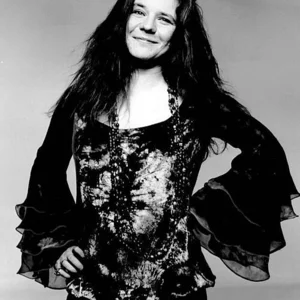

American rock and blues singer, icon of the countercultural movement of the 1960s. Known for her powerful voice and psychedelic style, she remains one of the most influential artists of the 20th century.
Janis Joplin
Janis Joplin
8 min read
Frequently asked questions
Famous Quotes
« Don't compromise yourself. You are all you've got.»
« Freedom's just another word for nothing left to lose.»
Key Facts
- Born on January 19, 1943 in Port Arthur, Texas
- Landmark performance at the Woodstock Festival in 1969
- Posthumous album *Pearl* (1971), her greatest commercial success
- Member of Big Brother and the Holding Company from 1966
- Died on October 4, 1970 at the age of 27, a member of the 27 Club
Works & Achievements
Janis's first major commercial breakthrough, reaching number one on the American charts. The comic-strip cover art by Robert Crumb became an icon of psychedelic counterculture art.
The standout track from the Cheap Thrills album, this cover of Erma Franklin's song became one of the most defining songs of the psychedelic rock era and a symbol of Joplin's powerful, gut-wrenching voice.
Janis's first solo album with her new band, the Kozmic Blues Band. It marked a shift toward a fuller soul and brass sound, showcasing the singer's versatility and artistic ambition.
Widely regarded as her masterpiece, this album was completed after her death by producer Paul Rothchild. It features 'Me and Bobby McGee' and 'Cry Baby,' both of which topped the charts in 1971.
A song written by Kris Kristofferson whose version by Janis Joplin became a posthumous number-one hit. It embodies themes of freedom and the open road that were central to the counterculture generation she represented.
A cover of Big Mama Thornton's song, this filmed performance at the Monterey Pop Festival is considered one of the greatest live performances in rock history and introduced Joplin to the world.
Anecdotes
Born on January 19, 1943, in Port Arthur, Texas, Janis Joplin grew up in an industrial, conservative city in the Deep South. As a teenager, she was regularly mocked by her peers for her appearance and her artistic tastes, which were considered eccentric. It was by listening to 78 rpm records by Bessie Smith and Lead Belly that young Janis discovered her true musical calling and found refuge from social rejection.
In 1962, while a student at the University of Texas at Austin, Janis was nominated by classmates for the provocative title of "ugliest man on campus" — a deliberate public humiliation. Rather than breaking her, this cruelty strengthened her resolve; she soon left Texas for San Francisco, where her talent would finally be recognized and celebrated.
In June 1967, at the Monterey Pop Festival, Janis Joplin made her explosive entrance onto the national stage. Her performance of 'Ball and Chain' with Big Brother and the Holding Company left the audience speechless and was filmed by documentarian D.A. Pennebaker. Audience members later recalled that the crowd was in a state of shock, so far did Janis's vocal power surpass anything they had ever heard.
Passionate about her Porsche 356C purchased in 1968, Janis had it painted from top to bottom with colorful floral and psychedelic patterns by artist Dave Richards, a member of the Grateful Dead community. This iconic car, a living symbol of the counterculture, is now on display at the Rock and Roll Hall of Fame in Cleveland.
Janis Joplin died on October 4, 1970, at age 27, of an accidental heroin overdose in a Hollywood hotel — just sixteen days after the death of Jimi Hendrix. She thus joined the infamous '27 Club.' At the time, she was recording her album *Pearl*, retrospectively considered her masterpiece, which was completed and released posthumously.
Primary Sources
Janis Joplin declares: 'On stage, I make love to twenty-five thousand people, and then I go home alone.' She also talks about her relationship with the blues, her Texan roots, and her hunger to be loved and recognized.
In her preserved letters, Janis writes from San Francisco to reassure her family about her life and tell them about her band Big Brother and the Holding Company, expressing her joy at finally being accepted for her musical talent.
Janis declares: 'I always wanted to be an artist, whatever that was, like other chicks want to be stewardesses.' She describes her admiration for Bessie Smith, Odetta, and Big Mama Thornton as the foundations of her vocal style.
The official program describes Big Brother and the Holding Company's performance as one of the most extraordinary moments of the festival, specifically citing Janis Joplin's vocal performance as the revelation of the event.
Key Places
Janis Joplin's hometown, where she was born on January 19, 1943. An industrial and conservative city in the American South, its stifling atmosphere and the social rejection young Janis experienced there drove her to flee to San Francisco.
The iconic neighborhood where Janis settled in 1966, which became the world capital of hippie counterculture. It was here that she joined Big Brother and the Holding Company and forged her unique artistic identity.
The site of the Monterey Pop Festival in June 1967, where Janis's performance marked a turning point in her career. Her rendition of "Ball and Chain," filmed by D.A. Pennebaker, remains one of the most iconic moments in rock history.
The site of the Woodstock festival in August 1969, where Janis Joplin performed before more than 400,000 people. Her two-hour nighttime set remains one of the most electrifying performances of that legendary festival.
The hotel where Janis Joplin was found dead on October 4, 1970, the victim of an accidental heroin overdose. She was at the time recording the album *Pearl* at the nearby Sunset Sound studios, just days away from completing the record.
Typical Objects

The central instrument of Janis's stage performances, which she grabbed, shook, and embraced like a dance partner. Her physical, visceral relationship with the mic was emblematic of her style of total, fully inhabited performance.

Janis was photographed with this American bourbon so often that she became its unofficial icon. The brand gifted her a fur coat in recognition, and the bottle in her hand became one of the defining images of her concerts.

Purchased in 1968 and covered entirely in colorful floral designs, this car became one of the most iconic objects of the American counterculture. It is now on display at the Rock and Roll Hall of Fame in Cleveland.

Signature accessories of Janis's personal style, blending hippie, bohemian, and blues influences. These extravagant adornments reinforced her image as a free-spirited, flamboyant woman who defied convention.

Janis collected recordings by the great blues singer of the 1920s–30s, whom she considered her primary influence. She helped fund the restoration of Bessie Smith's neglected grave in Philadelphia.

The instrument Janis used to accompany her early folk and blues songs during her beginnings in Texas. She taught herself to play by ear, guided by her records, before shifting her focus exclusively to singing.
School Curriculum
Vocabulary & Tags
Key Vocabulary
Tags
Daily Life
Morning
In San Francisco in 1967–1968, Janis would wake up late, often after noon, following nights of concerts or communal gatherings. She shared collective housing in Haight-Ashbury with other musicians and artists, in the fraternal atmosphere of everyday life that was typical of hippie counterculture.
Afternoon
Afternoons were devoted to rehearsals with Big Brother and the Holding Company in garages or makeshift spaces around the neighborhood. Janis worked intensely on her voice, experimenting with new blues tonalities, and collaborated closely with her bandmates to arrange songs and prepare for the evening's shows.
Evening
Her evenings were spent on stage at legendary venues such as the Fillmore Auditorium and the Avalon Ballroom, where she performed several times a week before enraptured audiences. After the concerts, she would plunge back into the vibrant social life of San Francisco's countercultural community.
Food
Janis had an unstructured diet, typical of touring musicians of the 1960s. She drank heavily, with Southern Comfort bourbon being her signature drink. In quieter moments, she enjoyed the Texan food of her childhood, such as barbecue and spicy Southern dishes.
Clothing
Janis was famous for her extravagant, colorful wardrobe: fringed dresses, feather boas, layered bead necklaces, round metal-framed glasses, and velvet clothing in psychedelic patterns. Her style deliberately blended Bohemian, blues, and hippie influences to create an immediately recognizable visual identity.
Housing
In San Francisco, Janis lived in shared apartments in the Haight-Ashbury neighborhood with other band members or artist friends. These non-hierarchical communal homes, decorated with psychedelic posters and handcrafted objects, were at the heart of the countercultural lifestyle she embodied.