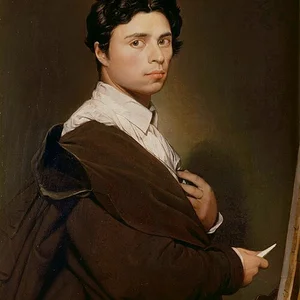

French Neoclassical painter (1780–1867), student of David and rival of Delacroix. Master of drawing and portraiture, he defended the classical ideal against the emerging Romantic movement.
Jean-Auguste-Dominique Ingres(1780 — 1867)
Jean-Auguste Dominique Ingres
France
10 min read
Frequently asked questions
Famous Quotes
« Drawing is the probity of art.»
« Color adds ornament to painting, but it is only its lady's maid.»
Key Facts
- 1780: born in Montauban
- 1801: Prix de Rome awarded for The Ambassadors of Agamemnon
- 1814: scandal and success of La Grande Odalisque
- 1824: The Vow of Louis XIII establishes his reputation in Paris
- 1867: died in Paris, bequeathing his collection to Montauban (future Musée Ingres)
Works & Achievements
A reclining female nude seen from behind, commissioned by Queen Caroline Murat, this work with its deliberately elongated back embodies the tension between classical ideal and formal freedom. It is held at the Musée du Louvre and remains one of the most recognizable images of the 19th century.
A large religious composition depicting Louis XIII placing France under the protection of the Virgin, created for the cathedral of Montauban. Its triumph at the Salon of 1824 earned Ingres the Légion d'honneur and established him as the leader of the classical school.
A ceiling painting commissioned for the Louvre depicting Homer crowned by Victory, surrounded by the greatest creators from Antiquity to the Renaissance. A pictorial manifesto of Neoclassicism, it asserts the primacy of ancient values in art.
A portrait of the powerful director of the *Journal des Débats*, seated in a pose of quiet authority that captures the bourgeois power of the July Monarchy. Considered one of the pinnacles of 19th-century realist portraiture.
A standing female figure holding an urn from which water flows, begun in Florence around 1820 and completed in Paris. An allegory of purity and youth, it met with immediate success and became an iconic image of academic art.
A large-format tondo depicting a harem of nude women bathing, synthesizing fifty years of research into the female nude. Completed at the age of eighty-two, the painting is at once an artistic testament and a work of unsettling modernity, held at the Louvre.
Ingres's first major submission from Rome, this painting depicts Oedipus in dialogue with the Sphinx, a model of balance between the ancient ideal and psychological characterization. It reveals, from the very start of his Roman stay, the artist's mastery of draughtsmanship and sensitivity to the nude.
Anecdotes
Ingres was a passionate amateur violinist who had played in the Capitole de Toulouse orchestra from adolescence. This intense musical practice gave rise to the French expression “violon d’Ingres”, denoting a secondary passion cultivated with as much care as one’s main activity. In 1924, the photographer Man Ray immortalized the expression by painting violin f-holes on the back of a nude woman, creating one of the most famous images of Surrealism.
The Grande Odalisque, exhibited at the 1819 Salon, unleashed a storm of criticism: anatomists claimed the figure’s back contained two or three extra vertebrae. Far from defending himself, Ingres embraced his deliberate distortions in the name of ideal beauty, believing that formal elegance takes precedence over anatomical accuracy. This principle of expressive distortion would become one of the recognizable hallmarks of his art.
The rivalry between Ingres and Delacroix symbolized the great artistic battle of the 19th century between line and color. Their supporters clashed violently in salons, newspapers, and at the École des Beaux-Arts. Ironically, the two painters maintained a more nuanced relationship in private, marked by mutual admiration mixed with incomprehension.
Ingres remained in Rome and Florence for eighteen years after his submissions from Rome had been coldly received in Paris. On his return in 1824 with The Vow of Louis XIII, intended for the cathedral of Montauban, he achieved an immediate triumph at the Salon: King Charles X awarded him the Légion d’honneur and critics hailed him as the leader of French classical painting.
The Turkish Bath, begun around 1852 and completed in 1862 when Ingres was eighty-two years old, represents a kind of artistic testament. The painter reworked the square-format canvas into a tondo — a circular format inherited from the Italian Renaissance — and filled it with dozens of female figures drawn from his earlier works. Acquired by Prince Napoleon and then returned to Ingres as it was deemed too licentious, the painting did not enter the Louvre until after his death.
Primary Sources
Drawing is the probity of art. To draw does not simply mean to reproduce contours; drawing is not merely line: drawing is also expression, inner form, plane, and modeling.
I am working relentlessly, my dear friend. Rome is an incomparable school; every monument speaks, every stone teaches. I am not satisfied with myself, and yet I feel that I am making progress.
Raphael is the supreme model. He must be studied tirelessly — not to be slavishly copied, but to absorb his spirit and his method. The Antique and Raphael: these are the two pillars upon which every artist who aspires to greatness must build.
I sought to gather around Homer all those who, from Antiquity to our own day, have paid homage to the genius of the first of poets. It is a didactic painting, in the noblest sense of the term, intended to remind young artists of the hierarchy of eternal values.
Key Places
Ingres's birthplace, where he was born on August 29, 1780, and to which he returned in thought throughout his life. The Musée Ingres-Bourdelle now holds the largest collection of his works and drawings.
Home of the French Academy in Rome, where Ingres stayed as a resident scholar (1806–1820) and later as director (1834–1841). This place was decisive in shaping and confirming his Neoclassical style through close study of the Renaissance masters.
Ingres lived in Florence from 1820 to 1824, deepening his admiration for the Italian Primitives and Raphael. The Tuscan city helped refine his approach to portraiture and draughtsmanship.
In Paris, Ingres ran a highly sought-after studio where many students trained. There he created his major mature works and took part in the artistic debates that pitted Classicists against Romantics.
It was in Toulouse that Ingres received his first artistic training between 1791 and 1796, under the guidance of local sculptors and painters. The city also gave him his first musical experience, playing in the Capitole orchestra.
Typical Objects

Ingres's tool of choice, the graphite pencil mounted on a pencil holder allowed him to trace the precise, supple contours that underpin his style. He produced thousands of preparatory drawings before undertaking a painting.

Ingres practiced the violin assiduously from childhood, going so far as to play in an orchestra in Toulouse as a teenager. His passion for the instrument is the origin of the French expression *violon d'Ingres*, used to describe a hobby or secondary passion pursued alongside one's main vocation.

Ingres filled countless sketchbooks with drawings from life, copies of ancient works, and preparatory compositions. These sketchbooks, preserved at the Musée Ingres in Montauban, bear witness to a daily and methodical drawing practice.

Ingres used a carefully selected palette and very fine brushes to achieve the velvety glazing characteristic of his oil paintings. His pictorial technique prized the precision of contour and the softness of modelling.

Like all artists trained at the Academy, Ingres honed his skills by drawing from plaster casts reproducing Greek and Roman sculptures. These casts served as the canonical references for the Neoclassical ideal of beauty.

An indispensable work garment in the studio, the apron protected Ingres's clothes from paint and charcoal stains during long working sessions. It also marked the master's status within the studio space.
School Curriculum
Vocabulary & Tags
Key Vocabulary
Daily Life
Morning
Ingres rose early and spent his mornings in his studio, systematically beginning with drawing exercises before tackling painting. This daily discipline, inherited from the academic tradition, allowed him to maintain the precision of line that was his hallmark.
Afternoon
The afternoon was devoted to posing sessions with his models and to receiving his students, to whom he passed on his method based on the absolute priority of drawing over color. He also visited public collections and took part in the lively debates of the Parisian or Roman art world.
Evening
In the evenings, Ingres relaxed by playing the violin, alone or in the company of musician friends, nurturing a musical passion that balanced the pressures of the artist's life. He also read the ancient authors — Virgil, Homer — whose stories fed his imagination and his painting subjects.
Food
Like most artists of the Parisian bourgeoisie in the nineteenth century, Ingres led a moderate lifestyle with no particular dietary excess, and appreciated the regional cooking of the South-West inherited from his childhood in Montauban. He was happy to welcome students and friends to his table in a warm atmosphere.
Clothing
In public life, Ingres wore the bourgeois dress of his era — dark frock coat, cravat, top hat — reflecting his social respectability and his status as a recognized official artist. In his studio, he wore the traditional painter's apron that protected his clothes from splashes of paint and charcoal.
Housing
In Rome, Ingres lived in the premises of the Villa Medici and later in apartments in the historic center. In Paris, he had spacious studios that he furnished with care, covering the walls with reproductions of ancient and Renaissance works that served as a constant source of inspiration.
Historical Timeline
Period Vocabulary
Liens externes & ressources
Références
Œuvres
La Grande Odalisque
1814
Le Vœu de Louis XIII
1824
L'Apothéose d'Homère
1827
Portrait de M. Bertin l'aîné
1832
La Source
1856