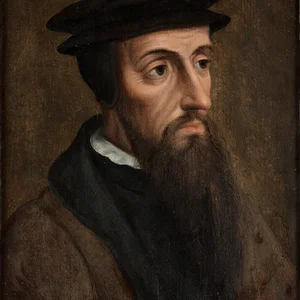

French Protestant reformer (1509–1564) who founded Calvinism, a major branch of the Protestant Reformation. He settled in Geneva, where he established a strict religious community and profoundly influenced European Protestantism.
Jean Calvin(1509 — 1564)
Jean Calvin
royaume de France, république de Genève
8 min read
Frequently asked questions
Famous Quotes
« True piety does not consist in fearing God as a tyrant, but in loving him as a father.»
Key Facts
- 1509: Born in Noyon, Picardy
- 1534: Embraces the Protestant Reformation and flees France
- 1541–1564: Settles in Geneva and imposes his religious and moral reform there
- 1559: Founds the Geneva Academy, a center of Calvinist teaching
- 1564: Dies in Geneva; Calvinism had spread across Western Europe and North America
Works & Achievements
The theological masterpiece of the Reformation, this work systematizes Protestant doctrine (predestination, grace, sacraments). It is also a landmark of French Renaissance prose.
The founding document of the organization of the Genevan Reformed Church, defining four ministries (pastors, doctors, elders, deacons) and establishing the consistory to oversee moral discipline.
A religious instruction manual in dialogue form intended for children and catechumens, translated into several languages and distributed throughout all the Reformed Churches of Europe.
Calvin commented on nearly all the books of the Bible (New Testament and Old Testament). These commentaries, renowned for their philological clarity and exegetical rigor, remain references in Protestant theology.
A satirical pamphlet in which Calvin denounces the Catholic veneration of relics as idolatrous superstition. The work, incisive and ironic, achieved wide circulation and great success.
A series of 159 sermons delivered in Geneva, collected and published. They illustrate Calvin's method of continuous preaching (lectio continua) and his reflection on divine Providence.
Anecdotes
Calvin was initially destined for an ecclesiastical career, but his father redirected him toward law. It was during his studies in Orléans and Bourges that he encountered evangelical humanists and began to distance himself from the Catholic Church. His 'sudden conversion', as he himself called it, took place around 1533–1534.
In October 1534, the Affair of the Placards erupted in France: violently anti-Roman pamphlets were posted as far as the door of the royal chamber of Francis I. The repression was so brutal that Calvin had to flee Paris and go into hiding, travelling under the false name of Charles d'Espeville.
In 1536, Calvin planned only to spend one night in Geneva while travelling to Strasbourg. Guillaume Farel, the Genevan reformer, implored him with great urgency to stay and help with the reform of the city. Calvin relented, interpreting this insistence as a divine call, and Geneva became the centre of his life's work for the rest of his days.
Calvin and his supporters were expelled from Geneva in 1538 following conflicts with the civil authorities. He then settled in Strasbourg, where he led a congregation of French refugees for three years. It was during this period that he married Idelette de Bure, the widow of a converted Anabaptist, in 1540.
Calvin suffered from numerous illnesses throughout his life: chronic migraines, digestive problems, gout, and tuberculosis, which claimed his life at the age of 54. Despite this, he produced a considerable theological body of work, preaching almost every day and responding to countless letters from across Protestant Europe.
Primary Sources
All right knowledge of God is drowned and choked in us by our ingratitude and malice. There is no one so coarse or brutal as not to be touched by some sense of the divine.
It is not without reason, most Christian King, that I have dedicated this book to Your Majesty… For I see that many persons of good will are falsely accused of rebellion, sedition, and other heinous crimes.
There are four orders of offices which our Lord has instituted for the government of his Church: firstly the pastors, then the doctors, thereafter the elders, fourthly the deacons.
Faith is a firm and certain knowledge of God's benevolence toward us, which, being founded on the free promise given in Jesus Christ, is revealed to our minds and sealed in our hearts by the Holy Spirit.
I confess that I have lived in much wretchedness, and that all my vices and faults have always displeased God, but that through his grace he has forgiven me... I have faithfully taught his Word.
Key Places
Calvin's birthplace, in France. He was born there in 1509 and received his early education in a family connected to clerical circles.
Calvin studied scholastic theology there in the 1520s. He encountered Renaissance humanism and the first evangelical ideas circulating in France.
It was in this humanist city that Calvin wrote and published the first edition of the Institutes of the Christian Religion in 1536, after fleeing France.
The heart of Calvin's pastoral activity from 1541 to 1564. It was from this pulpit that he preached and spiritually governed the Genevan city-state.
Calvin's place of refuge and theological development between 1538 and 1541. He led the French church of refugees there and was mentored by Martin Bucer.
Founded by Calvin in 1559, it trained Calvinist pastors and theologians sent throughout Europe and France. It would become the present-day University of Geneva.
Typical Objects

Calvin insisted on the direct reading of Scripture by the faithful. The Bible in French, translated notably by his collaborators, was the central tool of Calvinist pedagogy.

Calvin was a tireless writer and correspondent. He wrote thousands of letters, sermons, biblical commentaries, and theological treatises that spread Calvinism throughout Europe.

In the Calvinist Reformation, the pulpit replaced the altar as the center of sacred space. Calvin preached at Saint-Pierre Cathedral in Geneva several times a week.

Written by Calvin in 1542, this pedagogical booklet in question-and-answer form was used to instruct children and new converts in the Reformed faith.

The psalms set to music by Claude Goudimel on texts adapted by Clément Marot and Théodore de Bèze were sung in Calvinist assemblies; Calvin placed great importance on the congregational singing of the faithful.

The plain, dark garment of the Calvinist pastor symbolized the rejection of Catholic pomp and ostentation. This vestimentary austerity was a theological statement.
School Curriculum
Vocabulary & Tags
Key Vocabulary
Tags
Époque
Daily Life
Morning
Calvin rose early and began the day with prayer and reading of the Scriptures. Several times a week — sometimes daily — he preached at Saint Peter's Cathedral before an assembly of burghers, craftsmen, and religious refugees. His fragile health made these efforts physically exhausting.
Afternoon
The rest of the day was devoted to writing: biblical commentaries, theological treatises, and above all an extensive correspondence with reformers, princes, and pastors from across Europe. He also received visitors, presided over consistory meetings, and taught courses at the Academy.
Evening
Evenings were sober, devoted to reading, revising his manuscripts, and discussions with his close collaborators such as Theodore Beza. Calvin did not indulge in the entertainments condemned by the consistory (card games, dancing) and led a withdrawn life, in keeping with the discipline he preached.
Food
Calvin's diet was frugal, partly out of theological conviction (rejection of luxury and gluttony) and partly due to his chronic digestive ailments. He ate simply: bread, vegetables, legumes, occasionally meat or fish. In his later years he often ate only one meal a day.
Clothing
Calvin wore the black robe characteristic of Reformed pastors, a symbol of sobriety and rejection of Catholic splendor. He sometimes wore a square cap. His appearance was intentionally austere, in stark contrast to the richly embroidered vestments of the Catholic clergy.
Housing
Calvin lived in a modest house in the heart of Geneva, made available to him by the city. The interior was plain: a few pieces of furniture, an extensive library, and a writing table. In keeping with his principles, he refused all ostentatious luxury, even though his position as Geneva's spiritual leader afforded him a high social standing.
Historical Timeline
Period Vocabulary
Visual Style
Une esthétique de la rigueur et du dépouillement protestants : intérieurs épurés, portraits sévères, palette sombre dominée par les noirs, bruns et gris, contrastant avec la clarté froide de la lumière alpine.
Sound Ambience
L'ambiance sonore de Genève calviniste mêle le chant collectif des psaumes, les sermons tonnants depuis la chaire, le travail silencieux des scribes et le bruit des presses imprimant les textes réformés.
Liens externes & ressources
Références
Œuvres
Institution de la religion chrétienne
1536 (latin), 1541 (français), édition définitive 1560
Ordonnances ecclésiastiques de Genève
1541
Catéchisme de l'Église de Genève
1542
Commentaires bibliques (série complète)
1540-1564
Traité des reliques
1543
Sermons sur le livre de Job
1554-1555