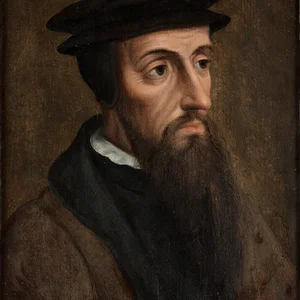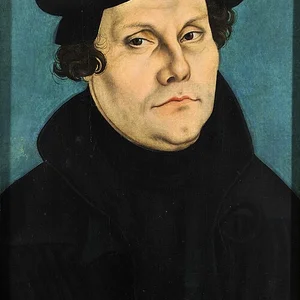

German theologian and monk (1483–1546), Martin Luther is the founder of Protestantism. In 1517, he criticized abuses within the Catholic Church, particularly the sale of indulgences, triggering the Protestant Reformation and splitting Western Christianity.
Martin Luther(1483 — 1546)
Martin Luther
Saint-Empire romain germanique
8 min read
Frequently asked questions
Famous Quotes
« Here I stand; I can do no other, so help me God.»
Key Facts
- 1517: posting of the 95 Theses criticizing the sale of indulgences on the door of the Castle Church in Wittenberg
- 1521: excommunication by Pope Leo X following his heretical positions
- 1521: Diet of Worms, where Luther refused to recant before Emperor Charles V
- 1534: complete translation of the Bible into German, making sacred texts accessible to ordinary people
- 1546: death in Eisleben, leaving a reform movement established across several regions of Europe
Works & Achievements
The founding text of the Protestant Reformation, criticizing the sale of indulgences and the pope's authority over salvation. Widely disseminated thanks to the printing press, it triggered an unprecedented crisis within the Catholic Church.
A treatise expounding the central principle of Lutheran theology: justification by faith alone (sola fide), independent of works. This text stands as one of the most important doctrinal declarations of the Reformation.
A pamphlet addressed to the German princes calling on them to reform the Church without waiting for Rome. In it, Luther challenges the three 'walls' protecting papal power.
A theological treatise in which Luther reduces the Catholic sacraments from seven to two (baptism and the Eucharist), overturning medieval sacramental doctrine.
Completed in eleven weeks at Wartburg Castle, this translation made the Bible accessible to all German speakers. It played a major role in the standardization and enrichment of the German language.
A complete translation of the Bible into German, the fruit of twelve years of collective work. Considered a monument of German literature, it allowed every believer to read the Scriptures directly.
Religious instruction manuals — one intended for pastors, the other for laypeople and children. These texts structured Protestant theological education for centuries.
Anecdotes
In October 1517, Luther posted his 95 Theses on the door of the Castle Church in Wittenberg, criticizing the sale of indulgences by the Church. This practice allowed the faithful to purchase their forgiveness, and Luther saw in it a profound corruption of the Christian faith. Thanks to the printing press, his theses spread across all of Europe within a few weeks.
In 1521, summoned before the Diet of Worms by Emperor Charles V, Luther refused to recant. Facing the assembled princes and prelates, he declared: 'Here I stand, I can do no other, so help me God.' He was then placed under the Imperial Ban, which made him an outlaw whom anyone could kill with impunity.
After the Diet of Worms, Elector Frederick the Wise had Luther secretly abducted to protect him and hid him in Wartburg Castle. Disguised as a knight under the name 'Junker Jörg', Luther spent nearly a year there and translated the New Testament into German in just eleven weeks.
Luther was renowned for his lively temperament and sharp wit. He loved music and composed hymns himself, including the famous 'Ein feste Burg ist unser Gott' (A Mighty Fortress Is Our God). He claimed that music was 'the most beautiful gift of God' after theology.
In 1525, Luther married Katharina von Bora, a former nun he had helped escape from her convent. This marriage scandalized Catholic Europe — a monk marrying a nun. Yet their union became a model for the Protestant clergy, with Luther defending the marriage of pastors as a divine institution.
Primary Sources
Indulgences cannot remove the guilt of even the slightest actual sin, with regard to contrition. [...] Every truly repentant Christian obtains full remission of penalty and guilt, even without a letter of indulgence.
My conscience is bound to the Word of God. I cannot and will not recant anything, for to act against one's conscience is neither safe nor honest. Here I stand, I can do no other. God help me.
A Christian is a perfectly free lord of all, subject to none. A Christian is a perfectly dutiful servant of all, subject to all.
I have resolved to write to you to inform you that I am returning to Wittenberg under a far higher protection than that of princes. I do not intend to ask for your Electoral Grace's protection.
The Gospel is a story about Christ, the Son of God and of David, who died and rose for us [...] This is why the Gospel requires not many works from us, nor many things, but only one thing: faith.
Key Places
City where Luther was a university professor and pastor. It was on the door of the Castle Church that he reportedly posted his 95 Theses in 1517, making Wittenberg the birthplace of the Reformation.
Medieval fortress where Luther was sheltered by Elector Frederick the Wise after the Diet of Worms in 1521. There he translated the New Testament into German in less than three months.
Imperial city where the Diet was held in 1521, before which Luther refused to recant before Charles V, sealing the definitive break with Rome.
Luther's birthplace, where he was born in 1483 and died in 1546. It now bears the name Lutherstadt Eisleben and is listed as a UNESCO World Heritage Site.
Monastery where Luther entered in 1505 and spent nearly seven years. It was there that he was ordained a priest in 1507 and began his profound theological reflections.
Liens externes & ressources
Références
Œuvres
Les 95 Thèses
1517
De la liberté du chrétien
1520
Appel à la noblesse chrétienne de la nation allemande
1520
La Captivité babylonienne de l'Église
1520
Traduction du Nouveau Testament en allemand
1522
Bible complète en allemand
1534
Grand et Petit Catéchisme
1529