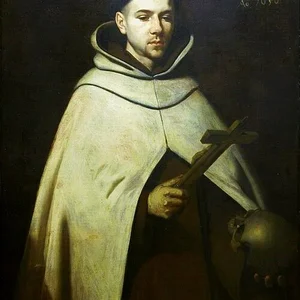

Spanish Carmelite friar, mystic, and poet of the 16th century. A reformer of the Carmelite Order alongside Teresa of Ávila, he is the author of major works of mystical literature such as the *Dark Night of the Soul* and the *Spiritual Canticle*. A Doctor of the Church.
John of the Cross(1542 — 1591)
John of the Cross
couronne de Castille
6 min read
Frequently asked questions
Famous Quotes
« In the evening of life, we will be judged on love.»
« To come to enjoy everything, desire to have enjoyment of nothing.»
Key Facts
- Born in 1542 in Fontiveros (Castile), died in 1591 in Úbeda
- Met Teresa of Ávila in 1567 and committed to the reform of the Discalced Carmelites
- Imprisoned in Toledo in 1577-1578 by the Calced Carmelites, where he composed part of his poetic work
- Author of the *Dark Night of the Soul*, the *Spiritual Canticle*, and the *Living Flame of Love*
- Canonized in 1726, proclaimed a Doctor of the Church in 1926
Works & Achievements
Together with Teresa of Ávila, John founded the reformed branch of the Carmelites (the “discalced,” or barefoot, friars), advocating a return to poverty and contemplation.
A spiritual treatise describing the soul's path of purification toward union with God; it is a commentary on his poem The Dark Night.
A poem and treatise on the “dark night of the soul,” a stage of spiritual stripping-away that has become a universal expression.
A long poem of mystical love inspired by the Song of Songs, a dialogue between the soul (the bride) and Christ (the Bridegroom).
A poem and commentary celebrating the soul's highest union with God, the summit of Spanish mystical literature.
Recognition by Pope Pius XI of the doctrinal authority of his writings; he is also the patron saint of Spanish-language poets.
Anecdotes
In December 1577, John of the Cross was kidnapped by Carmelites hostile to the reform and locked away in a cell of the monastery in Toledo, a former storage closet barely larger than a cupboard. Deprived of light and regularly whipped, he nevertheless composed from memory some of his most beautiful mystical poems there.
After nine months of captivity, he escaped by night by working loose the hinges of his door and lowering himself down a rope improvised from blankets, onto a rampart overlooking the Tagus. Starving and weakened, he found refuge with the Discalced Carmelite nuns of the city.
John was very short in stature: his contemporaries described him as a slight man, barely five feet tall. Teresa of Ávila joked that with him and another friar, she had “a friar and a half” to carry out her reform.
All his life, he accompanied his poetry with little drawings. His sketch of Christ on the cross seen from above, in a downward view, has remained famous: four centuries later, it is said to have inspired the painter Salvador Dalí's celebrated “Christ of Saint John of the Cross.”
A tireless reformer, he often walked barefoot from monastery to monastery across Castile and Andalusia, in keeping with the rule of the “discalced” (unshod) Carmelites that he defended against the “calced” Carmelites, who remained faithful to a more relaxed observance.
Primary Sources
On a dark night, kindled in love with yearnings—oh, happy chance!—I went forth unseen, my house being now at rest.
Where have you hidden, Beloved, and left me moaning? You fled like the stag after wounding me.
Oh living flame of love that tenderly wounds my soul in its deepest center!
To come to enjoy what you have not, you must go by a way in which you enjoy not. To come to the knowledge you have not, you must go by a way in which you know not.
Key Places
Village in the province of Ávila, in Old Castile, where John was born in 1542 into a poor family of weavers.
A merchant town in Castile where John grew up, was schooled at the Jesuit college, and entered the Carmelite order in 1563.
Famous university city where John studied theology and philosophy, and was ordained a priest in 1567.
City where John was imprisoned for nine months in 1577-1578 in a narrow cell; it was there that he composed part of the Dark Night and the Spiritual Canticle.
A hamlet in Castile where John, along with a few companions, founded the first monastery of Discalced Carmelites in 1568.
A town in Andalusia where John died on 14 December 1591, worn out by illness; his tomb there became a place of pilgrimage.
Typical Objects

Robe of coarse brown wool, belted with a cord, a symbol of voluntary poverty. The “discalced” (barefoot) Carmelites wore it with sandals or barefoot, in contrast with the relaxed observance of the calced Carmelites.

A piece of cloth worn over the shoulders on top of the habit, distinctive of the Carmelite order. It expressed consecration to the Virgin Mary, the order's patroness.

Writing tools with which John set down his poems and their prose commentaries. A large part of his work was first composed from memory in prison, for lack of materials.

A simple cross, the central object of meditation and the emblem of the religious name he had chosen for himself. It inspired his famous drawings of the crucified Christ.

A liturgical book containing the psalms and prayers recited at the different hours of the day. It set the rhythm of the Carmelite monk's daily life.

A small scourge of knotted cords used for bodily mortification, a penitential practice widespread in the reformed monastic life of the 16th century.
School Curriculum
Vocabulary & Tags
Key Vocabulary
Daily Life
Morning
John would rise before dawn for the Office of Matins and silent prayer in the dim light of the chapel. The morning was divided between Mass, mental prayer, and the reading of Scripture, the heart of the Carmelite contemplative life.
Afternoon
The afternoon combined manual labor, spiritual direction of nuns and friars, and the writing of poems or commentaries. As prior and reformer, he also devoted time to administering the convents and to long journeys made on foot.
Evening
In the evening, after Vespers and a frugal meal taken in silence, came another period of prayer. John loved to pray alone at night, sometimes at a window facing the starry sky, sources of imagery in his poetry.
Food
His diet was deliberately poor and often vegetarian, in keeping with the austerity of the Discalced Carmelites: bread, vegetables, soups, and fruit. Fasting was frequent, and meat was largely set aside for a good part of the year.
Clothing
He wore the brown homespun habit of the Carmelites, cinched with a cord, along with the scapular and the mantle of the order. Faithful to the rule, he went barefoot or in simple sandals, even in cold weather.
Housing
He lived in convents that were often small and bare, with a narrow cell containing only the bare essentials: a pallet, a cross, a breviary. This ideal of poverty stood in deliberate contrast to the comfort of the unreformed convents.
Historical Timeline
Period Vocabulary
Liens externes & ressources
Références
Œuvres
Réforme du Carmel déchaussé
à partir de 1568
La Montée du Carmel (Subida del Monte Carmelo)
vers 1579-1585
La Nuit obscure (Noche oscura)
vers 1578-1585
Cantique spirituel (Cántico espiritual)
vers 1578-1584
La Vive Flamme d'amour (Llama de amor viva)
vers 1585-1587
Proclamation comme Docteur de l'Église
1926